What a Press Release Example Actually Looks Like (And Why It Matters)
A great press release example gives you a clear blueprint to follow — so here is the essential structure at a glance:
| Part | What It Does | Ideal Length |
|---|---|---|
| Headline | States the single most newsworthy fact | Under 90 characters |
| Subheadline | Adds supporting context | 1 sentence |
| Dateline | City and date of release | Standard format |
| Lead paragraph | Answers who, what, when, where, why | 40-60 words |
| Body | Context, data, supporting details | 2-3 short paragraphs |
| Quotes | Executive + external validator | 30-50 words each |
| Boilerplate | Brief company description | 50-100 words |
| Contact info | Name, email, phone | Required |
| End marker | Signals close of release | ### |
Total target length: 300-500 words.
Getting media coverage for your business is hard. Most press releases never get read — fewer than 3% of wire-distributed releases generate any media pickup at all. That is a brutal number, especially for small business owners who are already stretched thin on time and marketing budget.
The difference between a release that earns coverage and one that gets deleted usually comes down to structure, specificity, and voice — not fancy writing or expensive distribution.
Whether you are announcing a new product, landing a partnership, or trying to get your business name in front of local journalists in South Florida, studying real press release examples is the fastest shortcut to getting it right.
I’m Fernando Larez, a marketing professional and business leader with hands-on experience in PR, SEO, and digital strategy — including crafting and distributing press release examples that actually move the needle for brands. In the sections below, I’ll break down exactly what works, what to avoid, and how to adapt proven formats to your specific announcement type.
Press release example terminology:
Anatomy of a Standard Press Release Example
To write a release that busy editors won’t immediately delete, we must adhere to a standardized, universally recognized structure. Journalists are under extreme deadline pressure. They do not have the time to hunt through a wall of text to find your actual news.
Every standard press release example relies on the classic inverted pyramid structure. This means placing the most critical, high-impact information at the very top of the page, followed by supporting details, quotes, and finally, background organizational info.

Let’s break down the essential components that make up a professional, AP-style document:
- The Headline: This is your hook. It must be written in the active voice and convey the single most newsworthy fact under 90 characters. Avoid marketing jargon and focus on a quantified outcome.
- The Subheadline: A single sentence that provides supporting context or secondary facts without repeating the headline.
- The Dateline: This indicates where and when the news is originating. For a South Florida business, this might look like: MIAMI, FL — June 15, 2026 —.
- The Lead Paragraph: This is the most crucial 50 to 60 words of your release. It must answer the classic “5 Ws” (Who, What, When, Where, and Why) so clearly that a reporter could write a brief story based on this paragraph alone.
- The Body Paragraphs: Two to three short paragraphs providing essential context, data, and background. Keep your sentences under 25 words and paragraphs under four lines.
- The Quotes: A strong release typically includes two quotes. The first quote should come from your company’s executive (like a CEO or founder) explaining the vision or “why” behind the news. The second quote should ideally come from an external validator, such as a customer, partner, or industry expert, to provide third-party credibility.
- The Boilerplate: A brief, 50-to-100-word paragraph that acts as an “About Us” section. It remains consistent across your releases and gives a high-level overview of what your company does.
- The Contact Block: This must include a real name, email address, and a direct phone number (including an after-hours number for reporters working late).
Writing in the third person is non-negotiable. First-person pronouns like “I,” “we,” or “our” should only ever appear inside direct quotes. For a deeper dive into perfecting this layout on your own, explore our step-by-step workbook on How to Master Press Release Format in 30 Days.
To see how these individual parts fit together into a cohesive, professional document, you can review the annotated guides available in How to Write a Press Release in 2026 (Template + Example) | PressPilot.
Writing Headlines and Leads That Hook Journalists
If your headline and lead paragraph fail to grab attention, the rest of your press release doesn’t matter. In 2026, media relations is more competitive than ever. Data shows that 68% of journalists clear their pitch inbox before 10am local time. If your email subject line or headline looks like a marketing pitch, it will be deleted in seconds.
To hook a journalist, you must write with a neutral, objective “newsroom voice.” This means ruthlessly cutting out hype, buzzwords, and promotional adjectives. Instead of saying your new software is “a revolutionary, game-changing platform,” state exactly what it does using verifiable facts and metrics.
Keep your writing simple and accessible. Aim for an 8th-grade reading level. Use active verbs and strong, direct sentence structures.
For example, look at how local municipalities and public organizations structure their news. If you study public announcements from official sources, such as the Media Relations | Hollywood, FL – Official Website or the public updates on Press Releases – City of Miami Beach, you will notice they never use fluffy language. They lead with clear, direct facts about what is happening, who is affected, and why it matters to the community right now.
Your lead paragraph should follow this exact same discipline. Pack the 5 Ws into a single, punchy sentence. If you are announcing a business milestone in Fort Lauderdale, make sure your lead immediately establishes the local connection and the broader public impact.
Analyzing a Specialized Press Release Example by Type
Different business milestones require different storytelling angles. A product launch needs to highlight user benefits and pricing, while a funding announcement must focus on strategic growth metrics.
The following table highlights how to adjust your focus based on the type of announcement you are making:
| Press Release Type | Primary Focus | Key Metrics to Include | Crucial Elements |
|---|---|---|---|
| Product Launch | End-user benefits & problem solved | Pricing, availability dates, efficiency gains | Product screenshots, customer quote |
| Event Announcement | Public impact & participation details | Date, time, location, expected attendance | Media advisory format, speaker list |
| Funding / Partnership | Strategic growth & market validation | Capital raised, market size, growth rates | Investor/partner quotes, future roadmap |
To see how these structural variations play out in real-world scenarios, you can download pre-formatted layouts from The Product Launch Press Release Template | IP or review annotated drafts across multiple industries in Press Release Examples: Real Templates and Annotated Formats That Earn Coverage (2026) | Shadow. For a broader look at how different industries format their news, you can also explore the categorized templates in Best Press Release Examples [Organized by Type] – PRLab and Press Release Examples for 2026 (Real-Life Sample Texts Across 10 Industries) – The Square.
The Product Launch Press Release Example
A product launch is the most common reason companies write press releases. However, many businesses make the mistake of focusing entirely on technical specifications or development timelines that nobody outside their company cares about.
Your product launch release must lead with the end-user benefit. Explain the specific problem your target audience faces and how your new product solves it.
Always include concrete details such as pricing and actual availability dates. Vague language like “pricing is available upon request” reduces the usefulness of your release for journalists and AI search engines alike. Keep your technical architecture descriptions brief, and avoid comparing yourself directly to competitors.
For an excellent real-world benchmark of a highly technical yet structured product launch, read the official announcement for Introducing Eno: Genesis AI’s First General-Purpose Robot is Challenging Traditional Humanoid Design. Notice how it balances visionary design goals with concrete details about deployment timelines and functional capabilities.
The Event Announcement Press Release Example
An event press release—often structured as a brief media advisory—is designed to drive attendance, secure media coverage, or announce a major public milestone.
For events, structure is everything. You should list the “Who, What, Where, and When” as clear, bolded bullet points directly below your lead paragraph. This allows a reporter to see at a glance if they can send a photographer or camera crew to cover the event.
Focus heavily on the public impact or the unique theme of the gathering. For instance, if you look at how major retail events are announced, such as the Double-the-Days-Millions-of-Deals-Amazon-Announces-Prime-Day-Event-from-July-8-to-July-11-Offering-Members-More-Time-to-Shop-and-Save – US Press Center, the focus is entirely on concrete consumer benefits, specific dates, and participation metrics.
Similarly, local infrastructure and community-focused event releases, such as those published on Posts in Press Releases | Articles – Port Everglades, succeed because they highlight regional economic impact, clear logistics, and community relevance.
Funding and Partnership Announcements
Funding and partnership announcements are about validating your business model and demonstrating strategic growth.
If you are announcing a Series A round or a major corporate partnership, lead with the hard numbers. Releases that feature specific, quantified metrics in the headline or lead paragraph earn significantly more media attention.
Your quotes in a funding release should not just say you are “excited.” They should explain how the capital will be used—such as hiring local talent in Miami or expanding your service capacity across South Florida.
For inspiration on how to position corporate growth and transaction news in the local business ecosystem, look at the editorial formatting used in the Press Release+ – South Florida Business Journal.
The Evolution of Press Releases in the AI Era of 2026
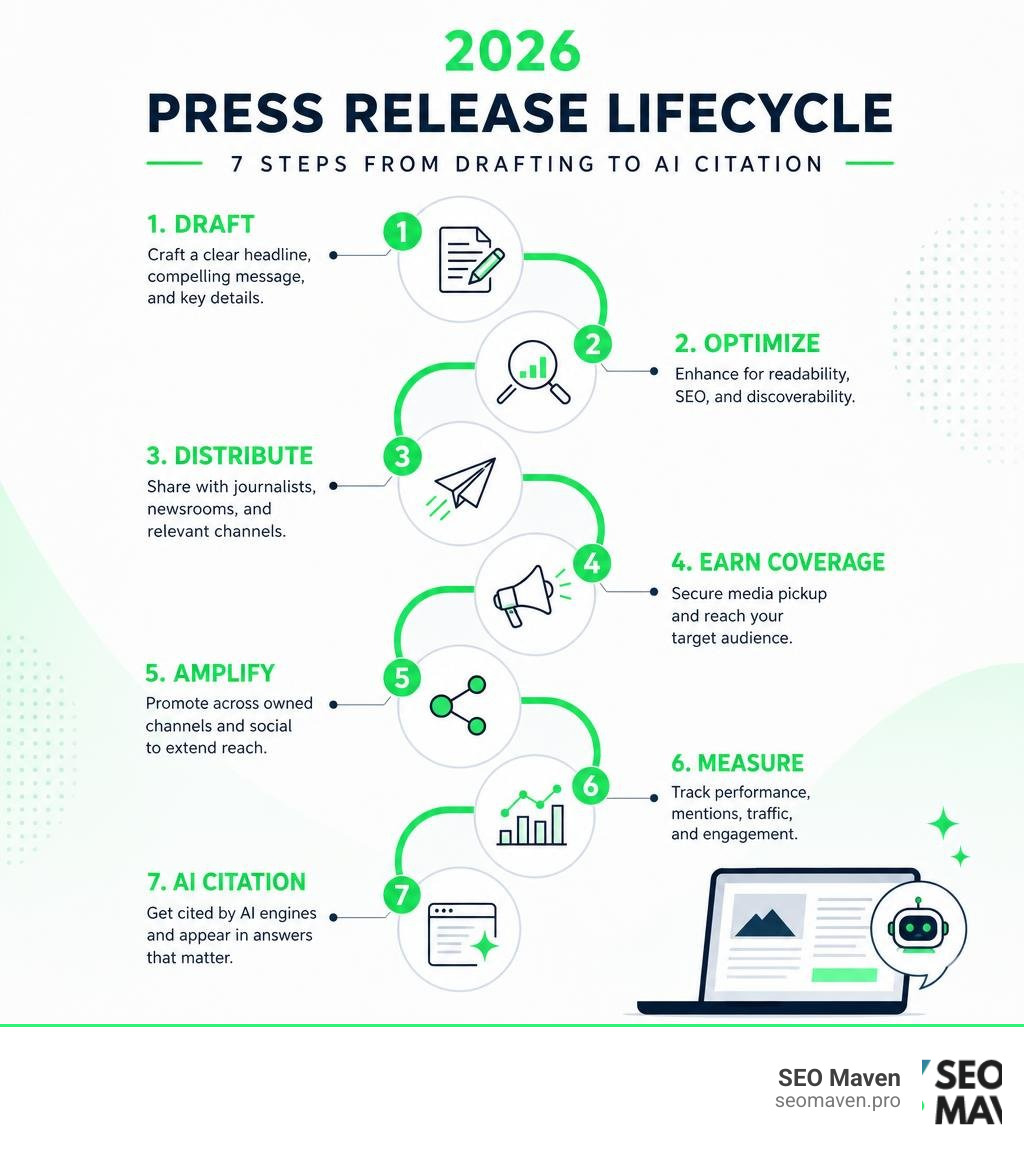
The way press releases are consumed has fundamentally changed. In 2026, we are no longer writing exclusively for human journalists. We are also writing for AI search engines like Perplexity, ChatGPT, and Gemini.
AI engines constantly crawl the web to answer user queries about brands, products, and industry trends. Because press releases are official, primary-source documents, AI engines heavily rely on them for factual data.

Consider these shift-defining statistics:
- 61% of PR professionals now track AI citation as a key performance indicator (KPI) alongside traditional earned media pickup.
- 54% of journalists use ChatGPT or Perplexity weekly to conduct background research on companies and industries.
- 82% of journalists have integrated AI tools somewhere into their daily editorial workflows.
What does this mean for your writing? It means structure, factual accuracy, and search optimization are more critical than ever. To ensure AI search engines can easily find, parse, and cite your news, you must publish your release on an owned newsroom page that uses proper schema.org NewsArticle markup.
By front-loading your release with clear facts, using structured headings, and avoiding vague marketing speak, you make your content highly indexable for AI models. To learn how to align your PR strategy with search visibility, check out our Beginner’s Guide to SEO Press Releases.
Distribution Best Practices and Common Pitfalls to Avoid
Even the best-written press release example will fail if your distribution strategy is flawed. Many businesses make the mistake of paying for expensive, unsolicited wire blasts that target thousands of generic inboxes. This approach rarely works. Fewer than 3% of wire-distributed releases result in earned media coverage.
Instead, we recommend a highly targeted, personalized approach.
When planning your distribution, keep these proven best practices in mind:
- Respect the Word Count: Keep your release between 300 and 500 words. Muck Rack data reveals that 73% of journalists prefer press releases under 400 words. Releases that exceed 600 words are twice as likely to be skipped by busy editors.
- Negotiate Personal Embargoes: If you want a journalist to write an in-depth story, share the news with them 24 to 48 hours in advance under an embargo. However, make sure you negotiate this individually. While 61% of reporters will honor a personally negotiated embargo, only 14% respect an embargo attached to an unsolicited wire blast.
- Pitch Local and Trade Outlets: If your business is based in South Florida (such as Hollywood, Fort Lauderdale, or Aventura), pitch directly to local business reporters and regional trade publications. For broader statewide reach, consider professional distribution networks like the Press Release Service – Florida Press Association.
- Ditch the Jargon: Eliminate words like “synergy,” “disruptive,” or “best-in-class.” If a sentence sounds like a marketing brochure, rewrite it.
Frequently Asked Questions about Press Releases
When should a company use a press release versus a blog post?
A company should use a press release when they have a genuine, verifiable news event that is of interest to the public or their industry. This includes major product launches, funding rounds, executive hires, or community events.
Blog posts and LinkedIn updates are excellent for sharing opinions, educational content, and informal company updates. Use a press release when you want to establish an official public record and earn external media coverage.
How long should a standard press release be in 2026?
The ideal length for a press release is 300 to 500 words. Keep it strictly to a single page. Brevity is highly valued by modern journalists who do not have time to read long, drawn-out pitches.
What is a boilerplate and where does it go?
A boilerplate is a short “About Us” paragraph that provides a high-level overview of your company, its mission, and its achievements. It always goes at the very bottom of the release, directly before your media contact information. You should signal the end of your press release text by placing three pound signs (###) or “-30-” centered on the line directly below the boilerplate.
Conclusion
Mastering the structure of a professional press release example is one of the most cost-effective ways for small businesses to build authority, earn media coverage, and secure valuable AI citations. By focusing on objective facts, clear formatting, and targeted distribution, you can achieve massive PR results without a massive budget.
At SEO Maven, we are a boutique digital marketing agency based in South Florida. We specialize in helping small businesses in Hollywood, Fort Lauderdale, Miami, and Aventura achieve maximum ROI by combining high-impact SEO services with strategic content marketing. We believe in helping your business achieve more with less.
Ready to get your news in front of the right audiences? Explore SEO Maven’s PR Services and let’s build your brand’s authority together.