Why Press Release Format Determines Whether Journalists Read You or Delete You
The press release format is a standardized structure that journalists expect — and when you get it right, your story gets coverage. When you get it wrong, it gets deleted in seconds.
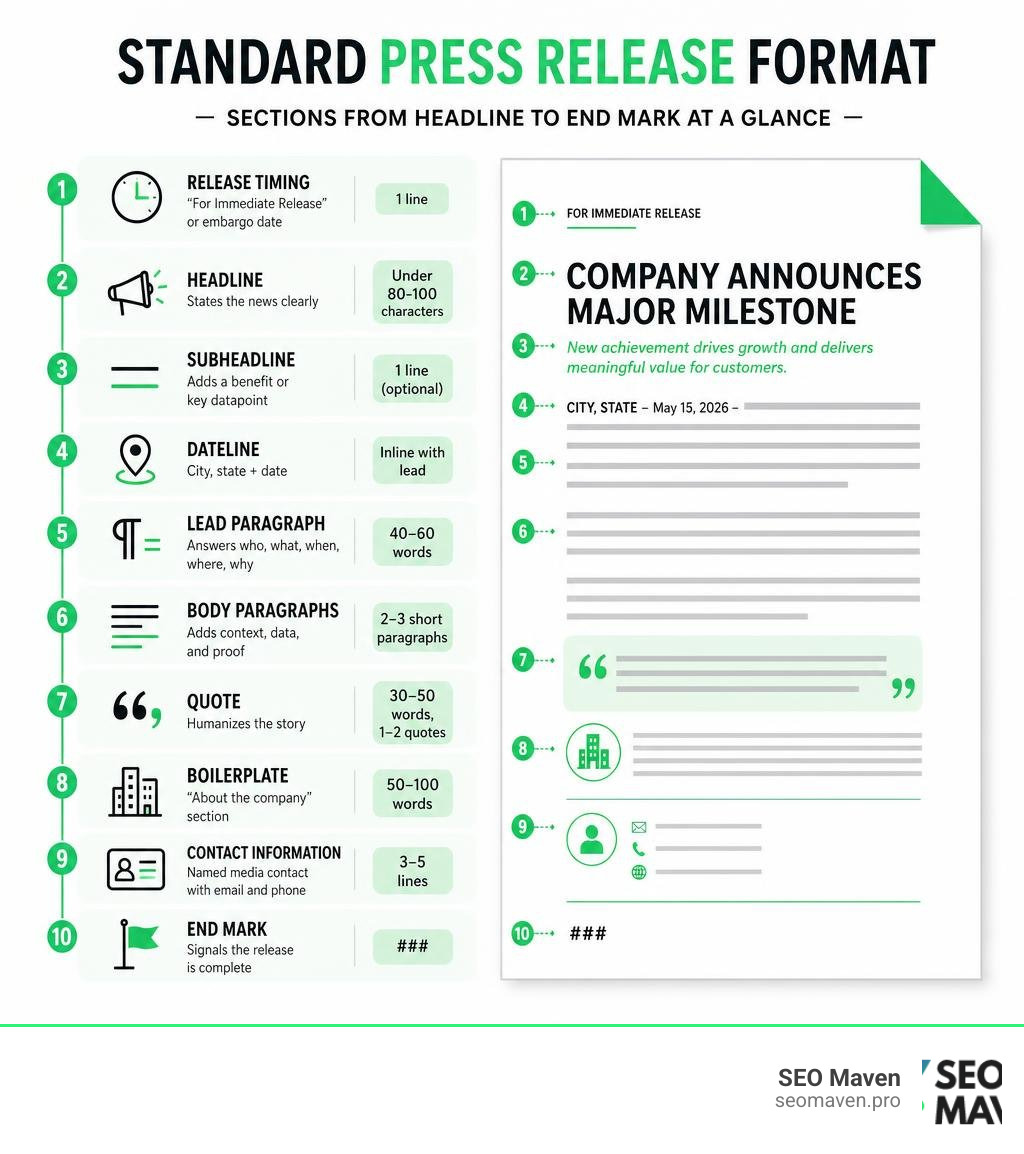
Here is the standard press release format at a glance:
| Section | What It Does | Recommended Length |
|---|---|---|
| Release Timing | “For Immediate Release” or embargo date | 1 line |
| Headline | States the news clearly | Under 80-100 characters |
| Subheadline | Adds a benefit or key datapoint | 1 line (optional) |
| Dateline | City, state + date | Inline with lead |
| Lead Paragraph | Answers who, what, when, where, why | 40-60 words |
| Body Paragraphs | Adds context, data, and proof | 2-3 short paragraphs |
| Quote | Humanizes the story | 30-50 words, 1-2 quotes |
| Boilerplate | “About the company” section | 50-100 words |
| Contact Information | Named media contact with email and phone | 3-5 lines |
| End Mark | Signals the release is complete | ### |
Total target length: 300-500 words. Anything over 600 words is twice as likely to be skipped by journalists.
Journalists are overwhelmed. They receive dozens — sometimes hundreds — of pitches daily and spend just 3-5 seconds deciding whether a release is worth reading. According to the Muck Rack 2026 State of Journalism report, 73% of journalists prefer press releases under 400 words. The format has barely changed in decades, not because the industry is stuck in the past, but because a predictable layout helps reporters find what they need fast.
For small businesses, this matters more than ever. A well-formatted press release does two jobs at once: it earns media coverage and builds SEO value through high-authority backlinks. In 2026, press releases are also being picked up by AI tools like ChatGPT and Perplexity as source material — making the format even more important for visibility beyond traditional newsrooms.
This guide walks you through every section, every rule, and every mistake to avoid — with a practical 30-day plan to make the format second nature.
I’m Fernando Larez, a marketing professional with hands-on experience in PR, SEO, and digital strategy across multiple industries, and I’ve used the press release format to help brands generate earned media and improve search visibility in competitive markets. Let’s break down exactly how to build a press release that journalists actually want to read.
The Standard Press Release Format Journalists Expect
A standard press release is a one-page, third-person, AP-style news document written in an inverted pyramid structure. That means the most important information comes first, followed by supporting details, quotes, background, and contact information.
Think of it as a news story starter kit. A journalist should be able to skim it, understand the story, pull a quote, verify the source, and decide whether to cover it without hunting for basic facts.
Good press release format signals:
- You understand how newsrooms work
- Your announcement is factual, not a sales brochure
- The story can be edited quickly
- The release can be quoted, cited, or republished with minimal cleanup
- Your organization is credible enough to contact
For a helpful institutional overview of formatting basics, see this press release formatting guidance. For the SEO and AI side of modern releases, we also recommend our guide to press releases and AI visibility.
The Recommended Order of Press Release Sections
Use this order almost every time:
- Release timing: “For Immediate Release” or “Embargoed Until…”
- Headline
- Subheadline
- Dateline and lead paragraph
- Body paragraphs
- Quote or quotes
- Boilerplate
- Media contact
- End marker: ###
Most releases should start with “For Immediate Release.” Use an embargo only when there is a clear reason journalists need advance access, such as a major research report or coordinated launch. Blanket embargoes can annoy reporters faster than a broken coffee machine on deadline.
Why the Format Has Not Changed Much
The format works because it matches the journalist’s workflow.
Reporters make fast decisions. They scan the headline, lead, quote, and contact information. If those sections are easy to find, your odds improve. If the release opens with three paragraphs of “we are thrilled to announce,” the story may never reach human eyes again.
The traditional structure also helps with:
- Editorial cuts: Less important details can be trimmed from the bottom
- Public record: The announcement is clear and timestamped
- AI discovery: Search engines and AI tools can identify the entity, news event, date, and source
- Earned media: Journalists can quickly turn the release into coverage
How Long a Press Release Should Be in 2026
Aim for 300-500 words, with the strongest releases often under 400 words.
Why so short?
Because journalists prefer concise information. Research shows 73% prefer press releases under 400 words, and releases over 600 words are twice as likely to be skipped. That does not mean every release must be tiny, but it does mean every sentence needs a job.
Use this simple length guide:
| Section | Target |
|---|---|
| Headline | 8-15 words |
| Lead paragraph | 40-60 words |
| Body | 2-3 short paragraphs |
| Quote | 30-50 words |
| Boilerplate | 50-100 words |
| Total release | 300-500 words |
Short sentences. Short paragraphs. One page. Single column. No fluff.
How to Write Each Section of a Press Release
Each section has one purpose. The headline gets attention. The lead delivers the news. The body proves the story matters. The quote adds perspective. The boilerplate explains who you are. The contact block tells journalists how to reach you.
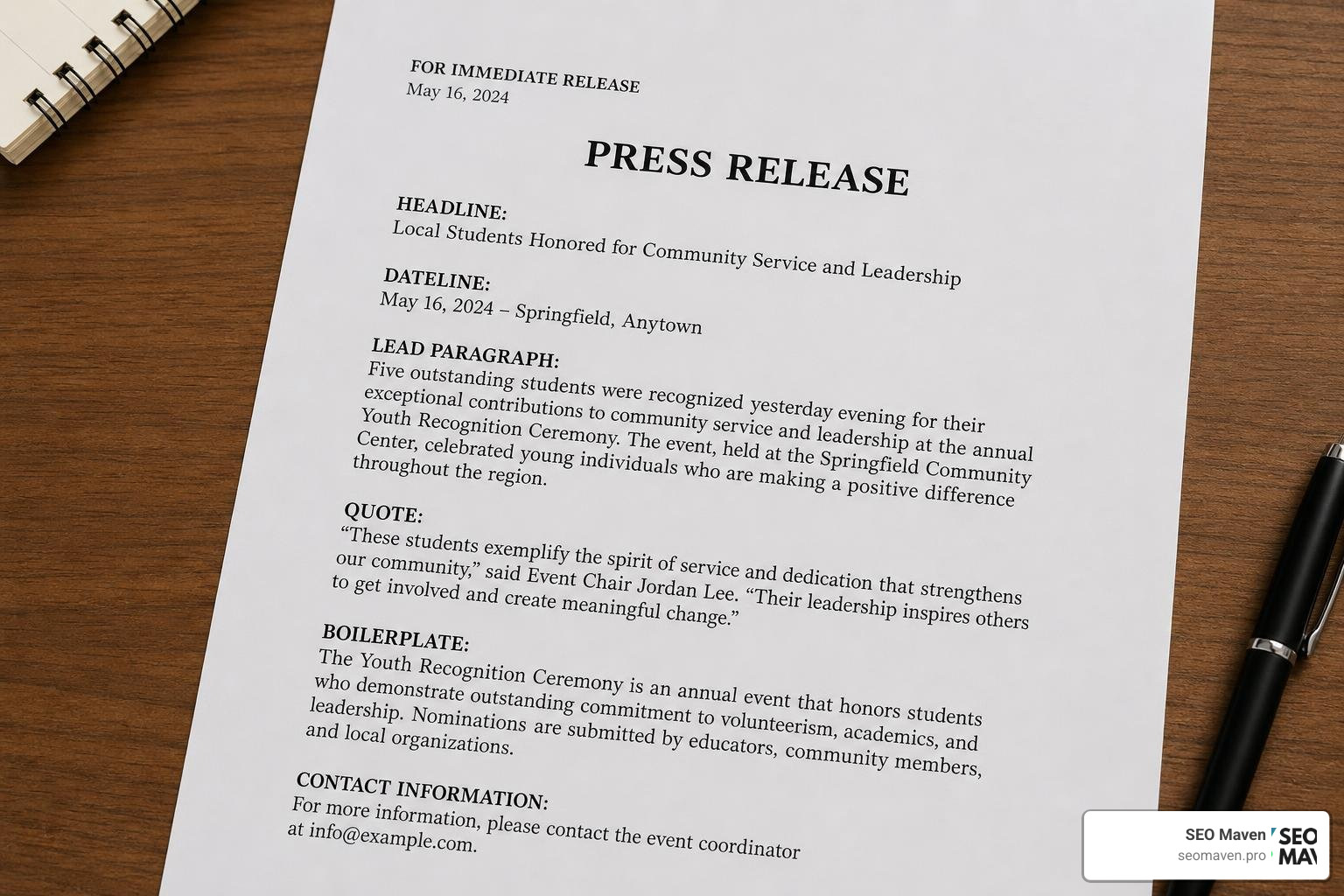
Use active voice, neutral language, and factual claims. Avoid hype words like “revolutionary,” “game-changing,” and “world-class” unless you can prove them. Even then, maybe do not. Journalists have allergy symptoms around marketing adjectives.
How to Write a Press Release Format Headline That Gets Opened
Your headline should state the news directly in under 80-100 characters. Press release views decline sharply when headlines pass 100 characters.
A strong headline includes:
- Company or organization name
- Clear news verb
- Concrete outcome or news angle
- Keyword relevance when natural
- No clickbait
- No vague hype
Formula:
[Company] [News Verb] [Specific Announcement] to [Outcome or Audience Benefit]
Example:
South Florida Bakery Opens Second Miami Location After 40% Catering Growth
Why it works:
- It names the business
- It states what happened
- It includes location
- It gives a reason the news matters
Weak version:
Local Bakery Takes Things to the Next Level
That sounds like a motivational poster. Not news.
How to Write the Subheadline
The subheadline is optional, but useful. It adds context, a datapoint, or a second reason to care.
Good subheadlines:
- Expand the headline
- Add a benefit or proof point
- Stay to one line
- Avoid repeating the headline
- Help the reader understand relevance
Example:
The new Aventura storefront will add 12 jobs and expand same-day delivery across North Miami-Dade.
If the headline is the hook, the subheadline is the “and here is why this matters.”
How to Structure the Lead Paragraph Around the 5 Ws
The lead paragraph should answer the 5 Ws in 40-60 words:
- Who is involved?
- What happened?
- When is it happening?
- Where is it happening?
- Why does it matter?
- How is it happening, if needed?
A standard lead begins with the dateline:
FORT LAUDERDALE, Fla., June 7, 2026 - [Company] today announced...
Strong lead example:
FORT LAUDERDALE, Fla., June 7, 2026 - A South Florida healthcare startup today launched a bilingual patient scheduling platform designed to reduce missed appointments for small clinics across Miami-Dade, Broward, and Palm Beach counties.
That lead gives the complete story. If a journalist reads only one paragraph, they still understand the announcement.
How to Build the Body With the Inverted Pyramid
The body supports the lead. Put the most important context first, then details, then background.
Use body paragraphs for:
- Data points
- Market context
- Product or service details
- Funding use
- Event logistics
- Partnership purpose
- Customer or community impact
A simple body structure:
- Paragraph 1: Why the news matters now
- Paragraph 2: Specific proof, numbers, or details
- Paragraph 3: What happens next
If SEO is part of your strategy, include relevant branded terms, location terms, and one or two useful links. But do not stuff keywords. Press releases support broader search visibility best when they are factual, entity-rich, and connected to a real digital presence. For the foundation behind that, see our guide to SEO fundamentals.
How Many Quotes to Include and What They Should Do
Use one to two quotes.
A good press release quote does not repeat facts already in the body. It adds perspective, emotion, or strategic meaning.
Good quote:
"Small clinics are losing revenue and patient trust because scheduling systems were not built for bilingual communities," said [Name], founder of [Company]. "We built this platform to make appointment access simpler for patients and easier for staff."
Bad quote:
"We are thrilled to announce this innovative, best-in-class solution," said everyone, everywhere, forever.
Use quotes from:
- A founder or executive
- A partner
- An investor
- A customer, if approved
- A subject matter expert
Keep each quote around 30-50 words.
How to Write the Boilerplate and Contact Block
The boilerplate is the “About” section. It should be 50-100 words and explain who you are without turning into a company autobiography.
Include:
- Company name
- What you do
- Who you serve
- Location, if relevant
- Website
- One credibility point, if factual
Example:
About SEO Maven: SEO Maven is a South Florida-based digital marketing agency helping small businesses grow through SEO, content marketing, web design, consulting, and digital advertising. With a boutique approach focused on ROI, SEO Maven helps businesses in Hollywood, Fort Lauderdale, Miami, Aventura, and across Florida improve visibility and compete online.
Contact block should include:
- Named media contact
- Title
- Phone
- Website or newsroom link
- After-hours contact, if needed
Avoid generic inboxes when possible. A real person builds trust.
Key Formatting Rules That Make a Release Look Professional
Formatting is not decoration. It is a credibility signal.
A clean release should be easy to scan, easy to quote, and easy to verify.
| Formatting Element | Correct | Incorrect |
|---|---|---|
| Release timing | For Immediate Release | BIG NEWS!!! |
| Headline | Clear, factual, under 100 characters | Vague slogan or clickbait |
| Dateline | FORT LAUDERDALE, Fla., June 7, 2026 – | Missing city/date |
| Voice | Third person | “We are excited…” in body copy |
| Length | 300-500 words | 900-word essay |
| Links | 1-3 useful links | Link stuffed paragraph |
| Contact | Named person with email and phone | No contact or generic form |
| End mark | ### | No ending signal |
Dateline, Release Timing, and End Marker Rules
Use this structure:
CITY, State abbreviation, Month Day, Year -
Example:
MIAMI, Fla., June 7, 2026 -
Put “For Immediate Release” at the top unless the release is embargoed.
Use embargoes carefully:
Embargoed Until: June 10, 2026, 9:00 a.m. ET
End the release with:
###
If your release somehow runs beyond one page, use “-more-” at the bottom of the first page. But honestly, try harder to make it one page. Your future editor will thank you.
Style Rules Journalists Notice Immediately
Use AP-style conventions where possible:
- Write in third person
- Use active voice
- Avoid first person in the body
- Spell out numbers one through nine, use numerals for 10 and above
- Write money as “$5 million,” not “$5,000,000”
- Use percent signs with numerals, such as 25%
- Define acronyms on first use
- Avoid jargon
- Use job titles correctly
- Do not overuse adjectives
- Skip the Oxford comma in strict AP style
Most importantly: sound like a newsroom, not a billboard.
Link, Multimedia, and SEO Formatting Rules
Use links sparingly. One to three links is usually enough.
Good links include:
- Company newsroom
- Product page
- Media kit
- Research report
- Event registration page
Use informative anchor text, not “click here.”
For multimedia, link to a media kit with:
- High-resolution images
- Logos
- Headshots
- Product screenshots
- Video clips
- Usage notes
Do not attach giant files to a pitch email. Nobody wants their inbox crushed by a 48 MB logo file named “finalfinalREAL_final.png.”
For SEO, publish the release on your owned newsroom and use structured data when appropriate, such as NewsArticle schema. Press releases can also support off-page authority when they earn pickup, citations, and backlinks. Learn more in our off-page SEO strategy guide.
How Press Release Format Changes by Announcement Type
The structure stays mostly the same. What changes is the angle, proof, and call to action.
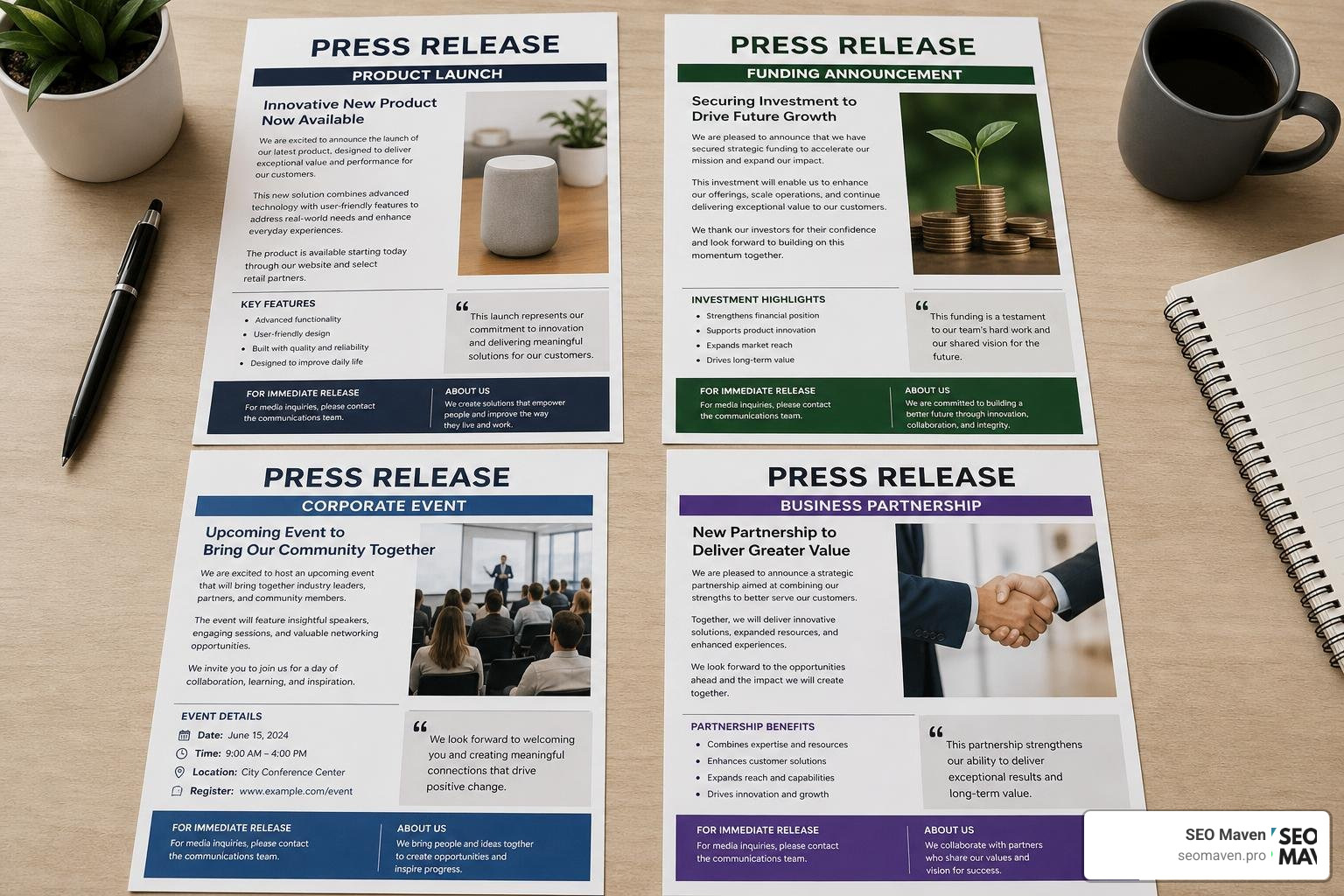
Product Launch Press Release Format
For a product launch, lead with the customer problem and what is now available.
Include:
- Product name
- Launch date
- Who it is for
- Problem solved
- Key features
- Availability
- Demo or product link
- Media assets
- Executive quote
- Customer benefit
Best angle: “Here is a new solution to a clear market problem.”
Funding Announcement Press Release Format
For funding, the lead should include the amount, round type, and purpose.
Include:
- Funding amount
- Round type
- Lead investors or participating investors, if public
- Use of funds
- Growth metrics
- Market opportunity
- Founder quote
- Investor quote
- Credibility data
Best angle: “This funding validates growth and supports a specific next step.”
Event Press Release Format
For an event, the format must make logistics impossible to miss.
Include:
- Event name
- Date and time
- Location
- Registration details
- Speakers or guests
- Audience
- Agenda highlights
- Photo opportunities
- Media access instructions
- Registration deadline
Best angle: “Here is a timely event with community, industry, or local relevance.”
For South Florida businesses, local angles matter. A Fort Lauderdale workshop, Miami opening, Hollywood community event, or Aventura retail launch should clearly state why the local audience should care.
Partnership Press Release Format
For a partnership, focus on the shared objective and customer impact.
Include:
- Partner names
- Purpose of partnership
- Integration or collaboration details
- Customer benefit
- Market relevance
- Joint quote
- Rollout timeline
- Measurable outcome
Best angle: “Together, these organizations can deliver something neither could do as effectively alone.”
The 30-Day Plan to Master Press Release Format
You do not master press releases by reading one article and whispering “AP style” into the mirror. You master them through repetition.
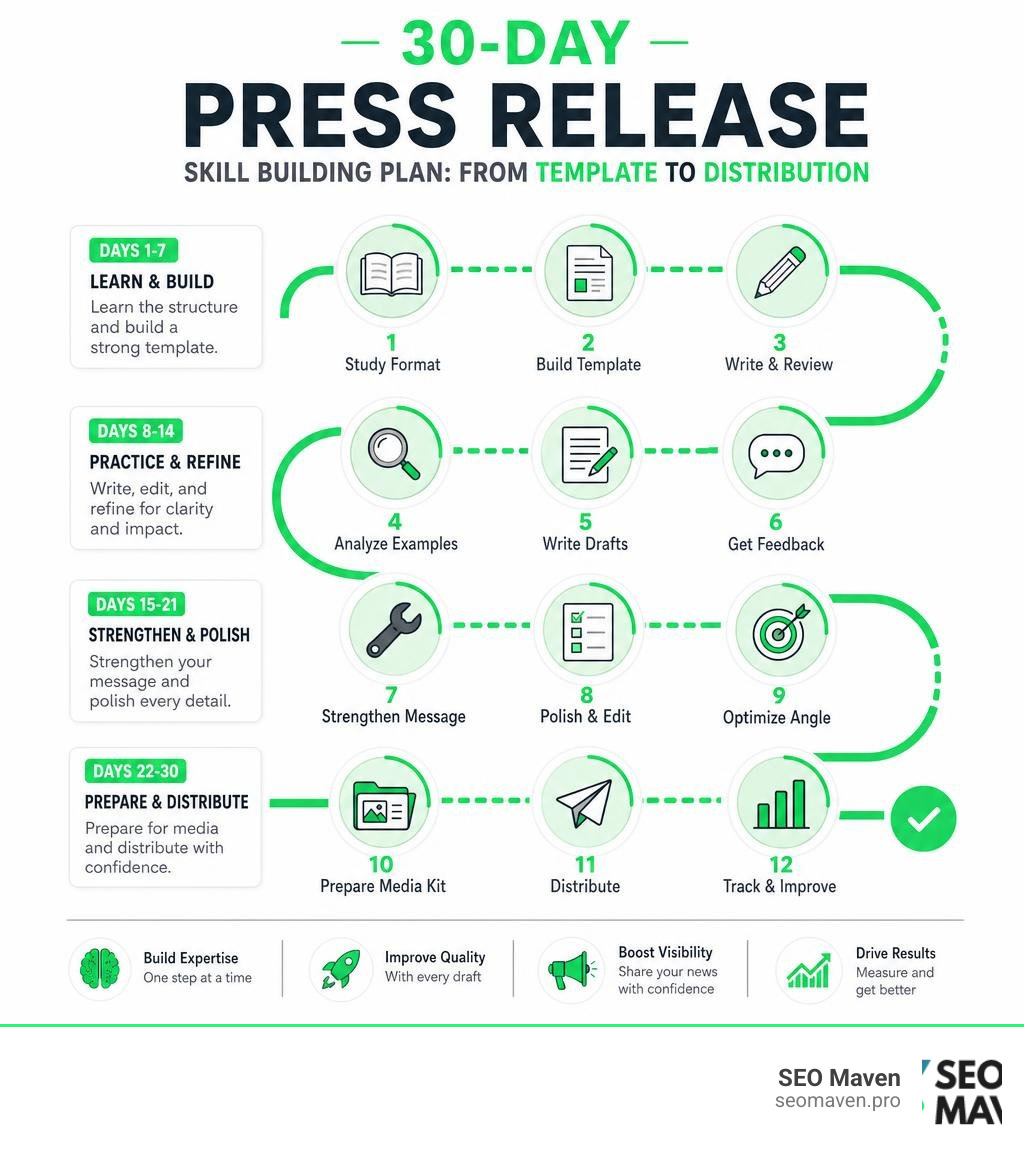
Days 1-7: Learn the Structure and Build a Template
Your first week is about structure.
Do this:
- Create a reusable press release template
- Label each section
- Study AP style basics
- Write your boilerplate
- Build your media contact block
- Create a newsworthiness checklist
- Save examples of strong headlines
Newsworthiness checklist:
- Is it timely?
- Is it relevant to a real audience?
- Is there a local, industry, financial, or community angle?
- Can it be verified?
- Would someone outside the company care?
If the answer is no, you may need a blog post instead of a press release.
Days 8-14: Practice Headlines, Leads, and Quotes
This week is about reps.
Practice:
- Write 10 headlines for one announcement
- Cut each headline under 100 characters
- Rewrite leads to answer the 5 Ws
- Remove hype words
- Add one hard datapoint
- Turn generic quotes into useful quotes
- Ask someone outside your company to read it
A useful editing rule: if a sentence could appear in any company’s release, rewrite it.
Days 15-21: Adapt the Format for Real Announcements
Now practice different release types:
- Product launch
- Event
- Funding or growth milestone
- Partnership
- Local community announcement
- Research or data release
For each one, adjust the lead and proof points. A product launch needs customer benefit. An event needs logistics. A partnership needs shared purpose. A local South Florida announcement needs location relevance.
Also look for SEO angles:
- Branded entity mentions
- Location relevance
- Industry keywords
- Links to useful owned pages
- Clear subject matter context
Days 22-30: Distribute, Measure, and Improve
The final stretch is distribution and learning.
Build a targeted media list before you send. For small businesses, this may include:
- Local South Florida business reporters
- Industry journalists
- Trade publications
- Community publications
- Relevant newsletters
- Local TV and radio assignment desks
- Bloggers or creators with real audience overlap
Send Tuesday through Thursday, ideally between 9-11 a.m. in the journalist’s local time zone. Research shows 68% of journalists clear their pitch inbox before 10 a.m. local time, so timing matters.
Use this distribution mix:
- Direct personalized outreach
- Wire or syndication distribution when appropriate
- Owned newsroom post
- Social amplification
- Email newsletter
- Partner channels
- Local citation and profile updates when relevant
Track:
- Media pickups
- Backlinks
- Referral traffic
- Branded search lift
- Social mentions
- Journalist replies
- AI citations
- Ranking movement
In 2026, 61% of PR professionals track AI citation as a KPI alongside earned media pickup. That makes your release part PR asset, part search asset, and part entity-building tool. For local visibility, pair press releases with clean business data using our local citation building guide.
Common Press Release Mistakes to Avoid Before You Send
Most bad releases fail for the same reasons:
- No real news hook
- Marketing voice
- Buried lead
- Too long
- Generic quotes
- Missing contact information
- Vague headline
- Weak or missing data
- Too many links
- Wrong timing
- Mass blasting
- Broken links
- PDF-only attachment
- No media assets
- No owned newsroom version
Press Release Format Checklist Before Publishing
Before you send, check:
- Headline is under 80-100 characters
- Headline states real news
- Subheadline adds context, not repetition
- Dateline is formatted correctly
- Lead is under 60 words
- Lead answers who, what, when, where, and why
- Body uses inverted pyramid structure
- Every paragraph is short
- At least one specific datapoint is included
- Quote adds insight
- Boilerplate is current
- Named media contact is included
- Email and phone number are included
- Links are tested
- Media kit is ready
- Release is pasted into the email body
- End marker is included
- Total length is 300-500 words
Distribution Mistakes That Reduce Media Pickup
Avoid these distribution mistakes:
- Sending to a random giant list
- Sending Friday afternoon
- Ignoring time zones
- Using the same pitch for every journalist
- Following up five times
- Attaching huge files
- Misusing embargoes
- Forgetting your owned newsroom
- Failing to track results
Targeted outreach to fewer relevant journalists usually beats blasting thousands of unrelated contacts. Relevance wins. Spam loses. Shocking, we know.
How to Distribute a Press Release for Maximum Pickup
Use a layered approach:
- Publish the release on your owned newsroom.
- Send personalized pitches to targeted journalists.
- Use distribution services when broader reach is useful.
- Share through social and email channels.
- Notify partners, customers, or community stakeholders.
- Follow up once after 3-4 business days.
- Monitor backlinks, mentions, traffic, and citations.
A strong release can generate high-authority backlinks, but the SEO value depends on relevance, pickup quality, and how the release supports your broader digital footprint. For more context, read our Google ranking factors guide.
Frequently Asked Questions About Press Release Format
What are the essential parts of a press release?
The essential parts are:
- Release timing
- Headline
- Subheadline
- Dateline
- Lead paragraph
- Body paragraphs
- Quote
- Boilerplate
- Contact information
- End marker
Some guides combine boilerplate and contact information, but we prefer treating them separately because they do different jobs.
Should a press release be pasted into an email or sent as an attachment?
Paste the release into the body of the email. You can also include a Word document if requested, but avoid sending a PDF-only pitch.
Make life easy for the journalist:
- Put the release in the email body
- Include a short personalized pitch above it
- Link to a media kit
- Avoid large attachments
- Make contact information easy to find
Convenience increases your chances. Tiny friction kills pickup.
Do press releases help with SEO and AI discovery?
Yes, when they are part of a real PR and content strategy.
Press releases can help with:
- High-authority backlinks
- Branded search visibility
- Entity building
- Local relevance
- Referral traffic
- News indexing
- AI research citations
- Trust signals around your company
They are not magic ranking buttons. But when paired with strong content, technical SEO, local optimization, and consistent authority building, they can support meaningful visibility.
Conclusion
Mastering press release format is not about memorizing old-school PR rules for fun. It is about making your news easy to understand, easy to verify, easy to quote, and easy to cover.
In 30 days, you can build the habit:
- Use the standard structure
- Write concise headlines and leads
- Answer the 5 Ws immediately
- Add proof instead of fluff
- Use quotes for perspective
- Keep the release to one page
- Include a real media contact
- Distribute with intention
- Measure coverage, backlinks, traffic, and AI visibility
For small businesses in Hollywood, Fort Lauderdale, Miami, Aventura, and across South Florida, press releases can create local authority, media awareness, and SEO value without wasting resources.
At SEO Maven, we help small businesses achieve more with less through SEO, content, web design, digital strategy, and visibility campaigns that connect PR with measurable growth.
If you want to go deeper, read our guide on press releases and AI discovery.