Core Technical Principles of SEO for E Commerce Sites
Technical SEO forms the foundation of any successful online store. Stores with solid technical foundations and AI-ready schema report 47% higher organic revenue and 62% better conversion rates than technically deficient competitors.
Google evaluates technical performance through Core Web Vitals thresholds:
- Largest Contentful Paint (LCP): Under 2.5 seconds.
- Interaction to Next Paint (INP): Under 200 milliseconds.
- Cumulative Layout Shift (CLS): Under 0.1.
Every 100ms improvement in load time nudges conversion rates up by roughly 1%, while sites loading in 1 second convert at 3.05% compared to just 0.67% for sites taking 4 seconds. Since 53% of mobile users abandon sites taking over 3 seconds to load, speed directly impacts both rankings and revenue.
Your site architecture should follow the 3-click discovery rule: every product page should be reachable within three clicks from the homepage. Clean URL structures use lowercase characters, hyphens to separate words, primary keywords, and no tracking parameter strings. For more details on official crawling guidelines, review Best practices for ecommerce sites in Google Search.
Faceted Navigation and Crawl Budget SEO for E Commerce Sites
Faceted navigation allows shoppers to filter products by color, size, brand, or price, but it creates thousands of duplicate parameter-heavy URLs that exhaust your crawl budget.
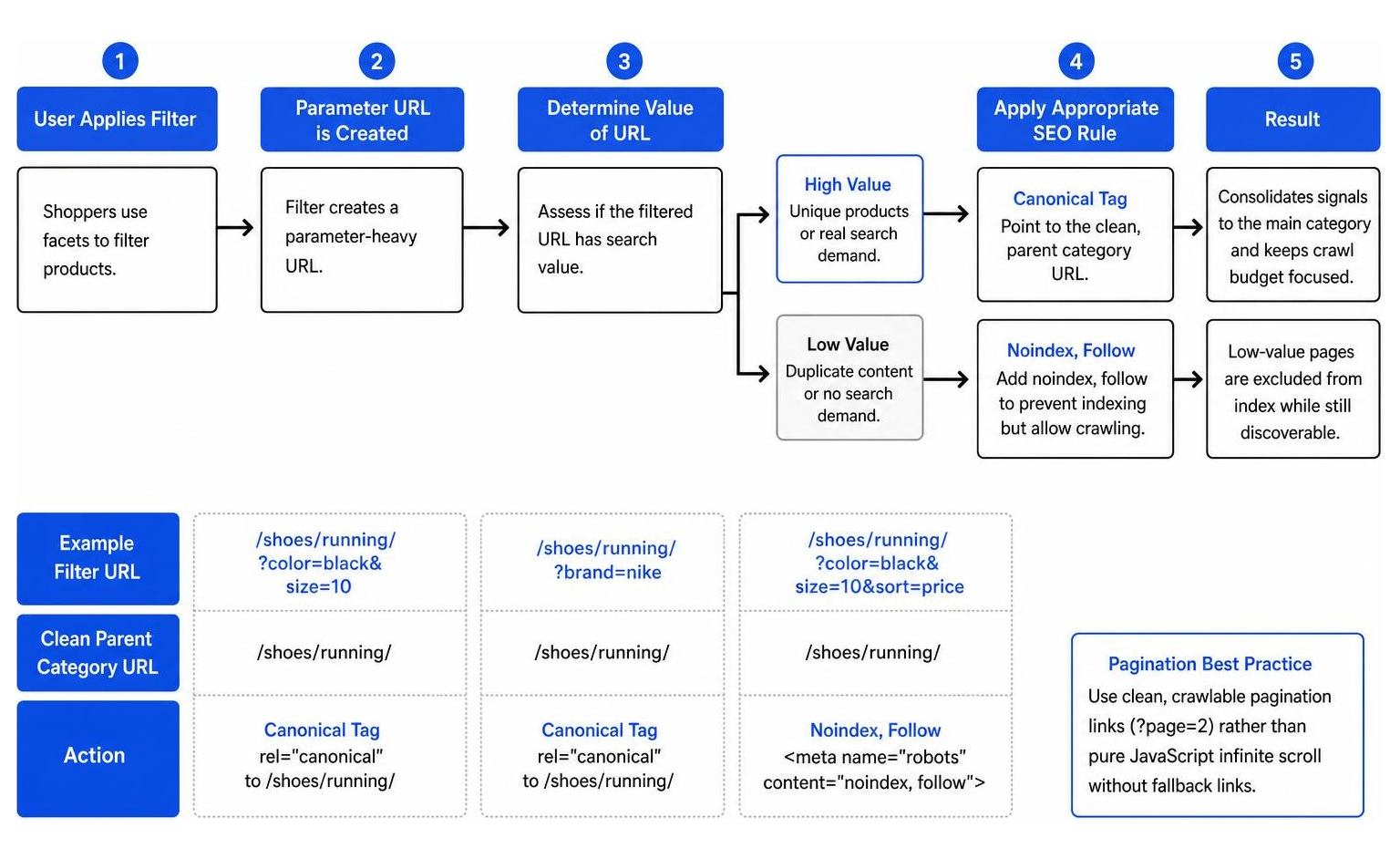
To manage faceted navigation and preserve crawl health:
- Canonical Tags: Point parameter filter URLs back to the clean parent category URL.
- Noindex Rules: Add
noindex, followtags to low-value filter combinations that have zero search volume. - Pagination Patterns: Use clean, crawlable pagination links (
?page=2) rather than pure client-side JavaScript infinite scroll without fallback links.
Managing Out-of-Stock Products in SEO for E Commerce Sites
Handling out-of-stock items incorrectly destroys link equity and user trust.
- Temporarily Out-of-Stock: Keep the page live with a
200 OKstatus code. Keep structured data active withItemAvailability: OutOfStock, display similar product recommendations, and add an email notification form to capture buyer intent. - Permanently Discontinued: Issue a 301 redirect to the most relevant alternative product or parent category page to retain accumulated backlink equity. Never let discontinued items default to generic 404 error pages if they possess external links or traffic.
Keyword Strategy and Intent Mapping for Online Stores
Keyword strategy requires mapping search queries to user intent across the purchasing funnel.
| Keyword Type | Intent Level | Example Query | Best Page Type | Conversion Rate Potential |
|---|---|---|---|---|
| Transactional | High Purchase Intent | “buy leather running shoes size 10” | Product Detail Page | Very High |
| Commercial | Comparison / Research | “best running shoes for flat feet” | Category / Buying Guide | High |
| Informational | Early Discovery | “how to fix overpronation when running” | Blog Post / FAQ | Moderate |
Balancing Transactional and Informational Keywords on Product Pages
Transactional keywords belong on category and product pages, while informational queries fuel blog content, comparison articles, and FAQ hubs. Distribute your keyword strategy across 70% long-tail, 20% mid-tail, and 10% short-tail queries.
Align buyer personas with product descriptions by highlighting exact pain points, specifications, and primary benefits early in the body text.
SKU Number Optimization Strategy for High-Intent Long-Tail Traffic
Optimizing for exact Stock Keeping Unit (SKU) numbers is an extraordinarily effective tactic for capturing ultra-high-intent long-tail traffic.
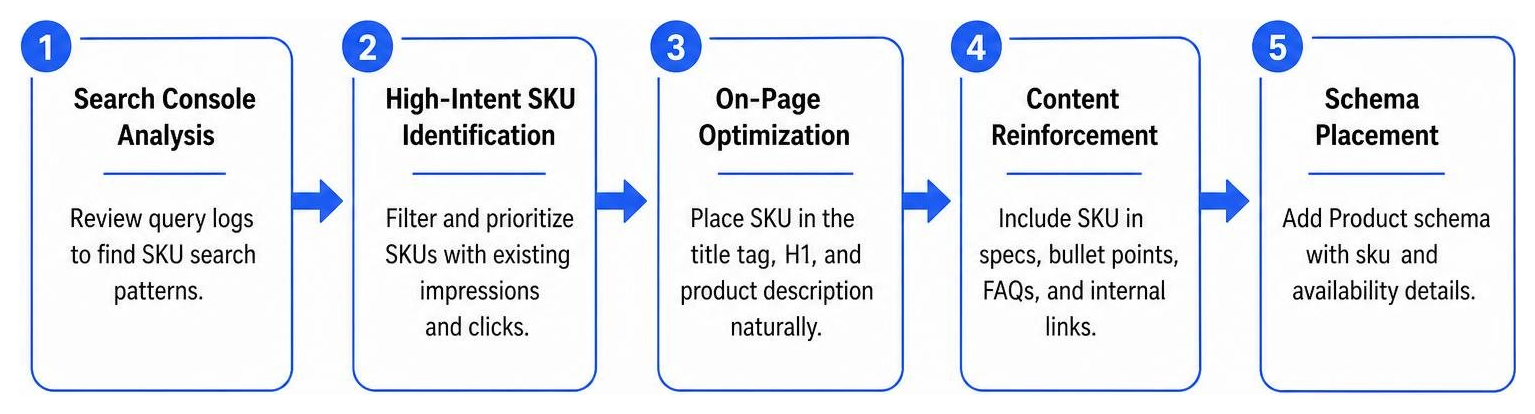
When buyers search for precise SKU numbers, manufacturer part numbers, or exact model codes, they are usually ready to make a purchase.
To implement SKU optimization:
- Analyze Search Logs: Review Google Search Console query logs to identify SKU search patterns.
- Page Title & Headings: Place the SKU in the page
), and product description text. - Prevent Seasonal Duplication: Use SKU codes in title tags to differentiate multi-season products that share identical names across different release cycles.
- Schema Integration: Add SKU numbers directly into the
skuandmpnproperties of your JSON-LD product schema markup.
Product Page Optimization and AI-Ready Structured Data
Thin content remains one of the largest hurdles in seo for e commerce sites. Standard product pages require 500 to 800 words of original, persona-focused copy, while high-consideration items benefit from 1,000 to 1,500 words. To learn more about how local optimization fits into broader search strategy, read Why Your Brand Needs SEO in Miami to Survive the Heat.

Essential Schema Markup for AI Overviews and Search Citation
Implementing detailed structured data markup makes your inventory visible to search engines and AI engines. Comprehensive schema for Product, Offer, and AggregateRating can increase AI citation probability by up to 340%.
In 2026, AI agents parse structured JSON-LD data directly to deliver concise summaries, current pricing, and inventory availability straight to users in search overviews.
Eliminating Duplicate Content and Canonicalization Pitfalls
Copying boilerplate manufacturer descriptions guarantees thin content flags and poor rankings. Instead, use structured copy templates to craft unique product descriptions at scale:
- Opening Statement: Write a unique 2-sentence value proposition for the product.
- Key Features: List 3–5 bullet points tailored to target buyer personas.
- “Best For” Line: Add a clear, intent-defining sentence specifying who should use the item.
- Dynamic Elements: Include user-generated content, customer reviews, and FAQ accordion blocks.
Always enforce self-referencing canonical tags on primary product URLs to prevent duplication caused by tracking parameters or alternate category paths.
Content Marketing and Authority Building for Online Catalogs
Publishing educational content builds site-wide topical authority and draws upper-funnel shoppers into your sales funnel. Research shows that 61% of online shoppers have purchased a product based on blog recommendations, and stores with active blogs see 55% more organic visitors. For an example of authority-driven content frameworks, read The Ultimate Guide to Medical Spa SEO Organic Traffic.
High-Converting Content Formats: Buying Guides and Comparisons
Top-performing ecommerce content formats include:
- Detailed Buying Guides: 2,000–4,000 word guides solving specific customer problems with linked product grids.
- Product Comparison Pages: Head-to-head feature breakdowns targeting commercial queries (e.g., “Product A vs Product B”).
- Curated FAQ Hubs: Structured question-and-answer hubs capturing conversational search traffic.
Internal Linking Architecture and Page Rank Distribution
86% of ecommerce websites lack an optimized internal link structure. Pass authority from high-equity pages (like your homepage or high-ranking blog posts) to core category and product pages.
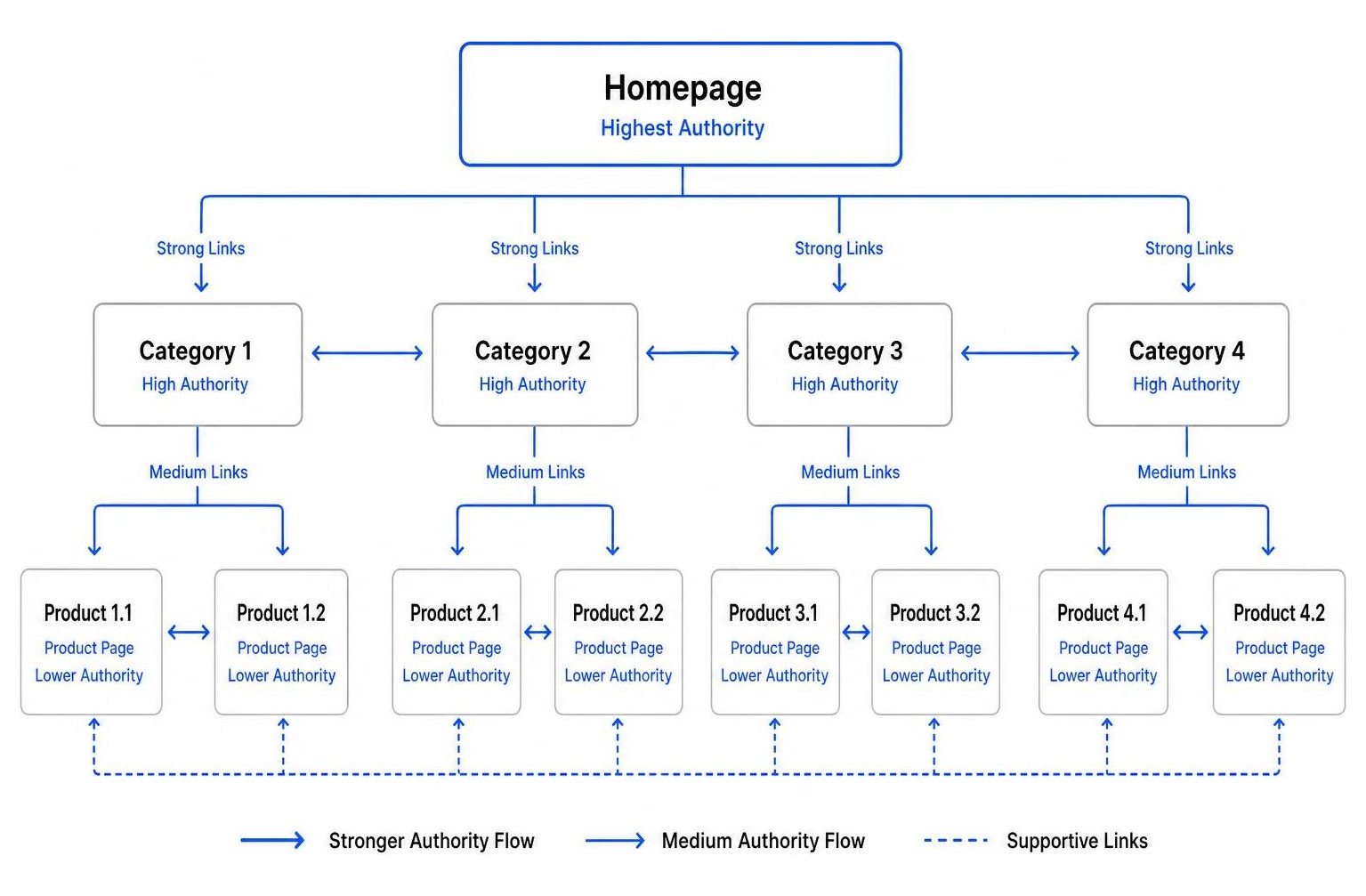
Link every published commercial blog post to at least three relevant product or category pages using descriptive, keyword-rich anchor text.
Measuring Ecommerce SEO Success and Choosing Services
Tracking performance requires looking beyond vanity rankings to focus on conversion revenue and user engagement metrics.
Organic Revenue KPIs and Analytics Tracking in GA4
Monitor these primary ecommerce KPIs in Google Analytics 4 (GA4) and Google Search Console:
- GA4 Ecommerce Events: Verify
view_item,add_to_cart,begin_checkout, andpurchaseevents in GA4 DebugView. - Organic Conversion Rate: Measure organic traffic purchase conversions against baseline site metrics.
- Click-Through Rate (CTR): Monitor search impressions and CTRs across money keywords.
- AI Citations: Track brand mentions and product citations within AI search engines and AI Overviews.
If you are exploring budget allocations for your SEO, review our guide on How to Pick SEO Packages Small Business Budgets Won’t Hate.
Evaluating Agency Partners and Service Packages
When choosing an agency partner to manage your store’s optimization:
- Prioritize ROI: Choose boutique agencies focused on technical health and conversion revenue over superficial keyword volume metrics.
- Look for Technical Mastery: Ensure the agency understands JavaScript rendering, schema architecture, and faceted navigation management.
- Local & Regional Expertise: For South Florida businesses, working with local experts ensures personalized strategies. Check out our Ultimate Checklist for Miami SEO Services and review 7 Trusted Local SEO Agencies to Hire for additional guidance.
Frequently Asked Questions About Ecommerce SEO
How long does it take to see results from ecommerce SEO?
For established websites fixing technical errors and optimizing existing templates, initial organic improvements typically appear within 3 to 6 months. Brand new domains building initial authority should expect a 6 to 12 month horizon for substantial traffic and organic revenue growth.
How do AI Overviews impact ecommerce search traffic?
While search engine results pages with AI Overviews can reduce direct organic link click-through rates, products cited directly within AI Overviews experience an average 35% boost in CTR. Implementing complete, validated JSON-LD schema markup is essential to ensure your catalog is properly indexed and cited by AI engines.
Is blogging necessary for online stores to rank high?
While high-volume category and product pages handle transactional search traffic, blogging is essential for building topical authority, capturing top-of-funnel shoppers, and earning organic backlinks. Commercial blog content routes valuable authority back into product pages via strategic internal links.
Conclusion
Mastering seo for e commerce sites requires balancing solid technical fundamentals, detailed structured schema, strategic keyword targeting, and authority-building content. Because organic search yields a median ROI of 748%, optimizing your site architecture, product descriptions, and site speed creates a sustainable source of revenue that compounds over time.
Ready to transform your online store into a predictable organic revenue engine? Partner with our South Florida-based team at SEO Maven. Explore Professional Ecommerce SEO Services to audit your catalog and unlock your store’s search potential.