Modern Mechanics of Press Release SEO Link Building
To understand modern press release seo link building, we first have to dispense with the ghost of SEO past. A decade ago, SEOs would write a 300-word promotional article, load it with exact-match keyword anchor text, blast it across hundreds of syndication networks, and watch their search engine rankings jump.
Those days are long gone. Google updated its link scheme guidelines to explicitly flag syndication links designed to pass PageRank, forcing major wire services to default outgoing links to rel="nofollow" or rel="sponsored".
So how does press release link building function today?
Modern distribution works through a two-step mechanism:
- Direct Wire Distribution (Entity & Discovery Layer): When you push a press release through a reputable wire service, hundreds of news sites post identical copies. While these syndicated links carry no direct PageRank authority due to
nofollowtags, they serve a critical infrastructure role. They create timestamped brand citations, establishing entity validation across search engine knowledge bases and training models. - Earned Editorial Pickup (Authority & Link Equity Layer): Journalists, industry bloggers, and media researchers monitor news wires and company announcements. When your release contains genuine news or proprietary data, these writers cover your story on their own websites, crafting unique articles that link back to your site with contextual
dofollowlinks.
As we highlight in our guide on The Ultimate Guide To Press Release Seo Benefits, this second layer is where actual search ranking power lives.
Wire Links vs Editorial Coverage in Press Release SEO Link Building
Understanding the structural difference between direct wire links and secondary editorial pickup is essential for setting expectations and executing campaigns that produce real ranking signals.
| Characteristic | Syndicated Wire Links | Earned Editorial Pickup Links |
|---|---|---|
| Link Attribute | Nofollow / Sponsored / Duplicate | Dofollow (typically organic editorial editorial links) |
| PageRank Transfer | Zero to minimal direct link equity | Direct transfer of authority and link equity |
| Content Uniqueness | High duplicate content footprint across distribution channels | 100% unique contextual content written by media authors |
| SEO Ranking Impact | Indirect (Entity verification, indexing speed) | Direct (Increases domain rating, target URL rankings) |
| AI Search Impact | Low direct citation value | High citation authority (Earned news media represents 37.6% of LLM citations) |
Direct syndicated links are best viewed as digital PR infrastructure. They confirm to search engines and AI models that your company is an active, legitimate entity. However, if you rely exclusively on distribution without earned outreach, you are leaving virtually all SEO link equity on the table.
Keyword Optimization vs Newsworthiness
A common mistake digital marketers make when drafting press releases is prioritizing commercial keyword density over journalistic merit. Forcing phrases like “best Miami IT support agency” into headlines and body copy immediately signals to journalists that your text is marketing fluff rather than legitimate news.
When optimizing press releases for 2026, adhere to these simple editorial rules:
- Target Brand Terms and Long-Tail Query Intent: Focus headline keywords on your brand entity, key personnel, official product names, or target industry statistics.
- Optimize for Anchor Text Safety: Never insert commercial exact-match keywords into hyperlinks. Use branded terms (e.g., “SEO Maven”), natural URLs (e.g., “seomaven.pro”), or clean navigational anchors (e.g., “read the full research report”).
- Prioritize the News Angle First: Ask a simple question: Would a journalist at a trade publication actually take 15 minutes to write about this? If the answer is no, refine the story angle before writing a single word. You can check our detailed strategy breakdown on How To Write Seo Press Release The Right Way to streamline this process.
High-Impact Formats and Structuring for Editorial Pickup

If your goal is earning high-authority backlinks from major publishers, your press release must be formatted in a way that journalists can scan, evaluate, and quote within seconds. Media rooms receive hundreds of pitches every morning—friction in your content structure guarantees your release lands in the trash folder.
High-Performing Angles for Press Release SEO Link Building
Not all company announcements are created equal. Data shows that announcements tied to original research, milestone achievements, or genuine product innovation generate roughly 6x to 10x more editorial pickup than generic corporate announcements.
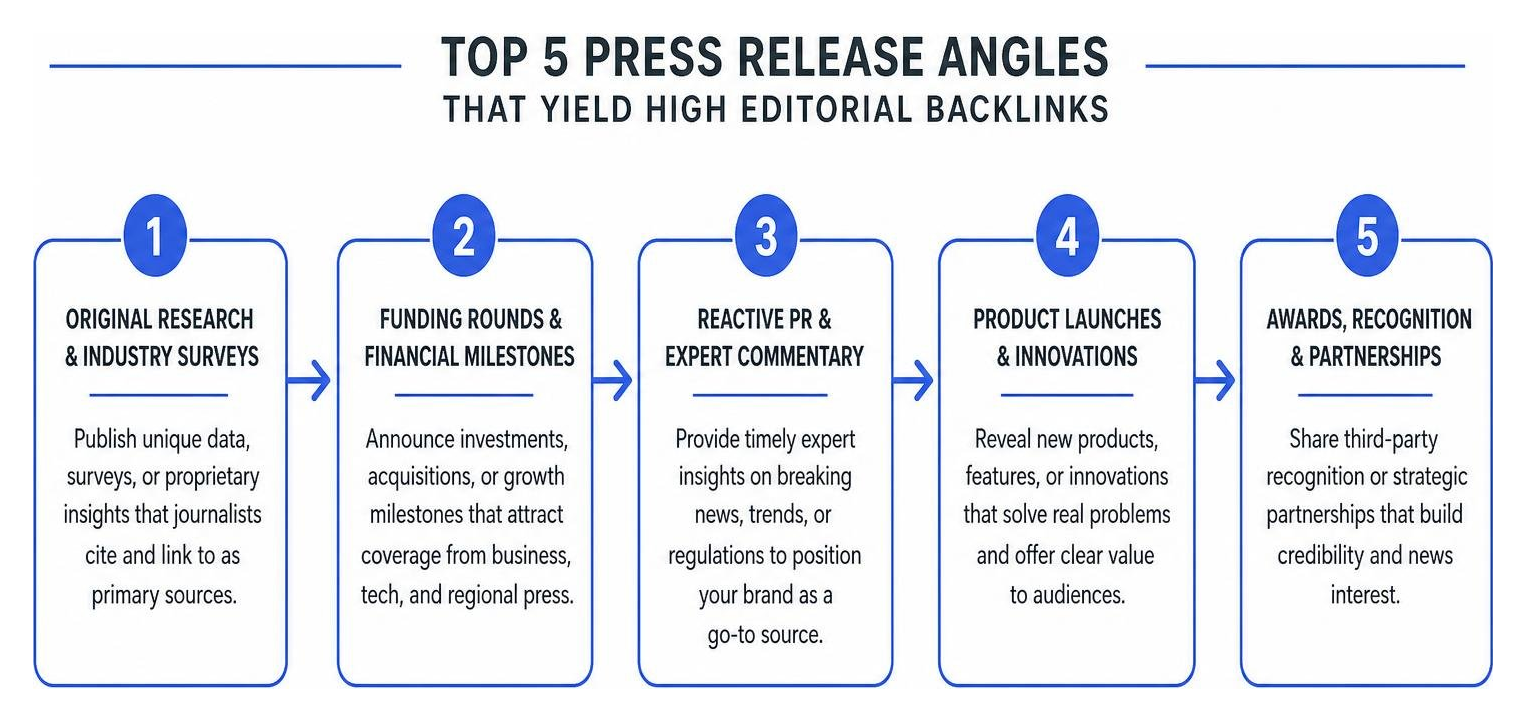
Here are the top five press release angles that consistently secure editorial coverage and high-authority links:
- Original Research & Industry Surveys: Conducting primary surveys or analyzing unique proprietary platform data is the most reliable press release angle in SEO. Journalists actively seek fresh statistics to back up their articles. When they cite your data, they link to your original press release or target landing page as the primary source.
- Funding Rounds & Financial Milestones: Investments, corporate acquisitions, and rapid growth milestones are naturally covered by financial, tech, and regional business press across South Florida and national publications alike.
- Reactive PR & Expert Commentary: Timing a release alongside breaking industry news or emerging regulations positions your executives as industry thought leaders available for comment.
- Novel Product & Feature Launches: Launching a product that genuinely solves a persistent industry problem gives technology writers a compelling reason to publish product reviews or news spotlights.
- Recognized Industry Indexing & Rankings: Publishing an annual industry index or ranking list creates recurring annual backlink opportunities as benchmarked companies proudly link to your research.
Crafting Releases That Earn Secondary Coverage
Journalists operate on tight deadlines and strict editorial standards. To make your release as easy as possible for them to adapt into a news story, keep these formatting best practices in mind:
- Respect the 400-Word Rule: Industry data reveals that 68% of journalists prefer press releases under 400 words. State the facts, present the key data points, provide one crisp quote, and stop writing.
- Front-Load the Inverted Pyramid: Structure your opening lead paragraph to answer the traditional 5 Ws (Who, What, When, Where, Why) within the first 30 to 50 words. Put your vital statistics and core announcement directly up front.
- Embed High-Resolution Media: Press releases containing embedded multimedia assets (such as charts, executive headshots, or product video links) experience up to 9x the engagement of plain-text announcements.
- Limit Internal Links: Do not turn your release into a link farm. Use a maximum of two strategic links: one pointing to your target campaign or research landing page on the first brand mention, and one navigational link within your company boilerplate or press contact section.
- Provide Standardized Boilerplates and Direct Media Contacts: Always end with a clean, standardized “About” section and include direct contact information (a specific named PR rep, phone, and direct email address—not a generic contact form).
Mastering these elements takes practice, but following a standardized step-by-step framework speeds up execution. Review How To Master Press Release Format In 30 Days to build a repeatable publishing template for your team.
Entity Building, AI Search, and Measuring PR Performance
The search landscape of 2026 demands visibility beyond standard organic search listings. With Google AI Overviews appearing in 15% to 38% of search results across enterprise and commercial verticals, press releases now fulfill a critical dual role: driving SEO backlinks while feeding clean, verifiable factual data directly into Artificial Intelligence and Answer Engine Optimization (AEO) frameworks.
Optimizing for Answer Engines and Generative Search
Large Language Models (LLMs) like ChatGPT, Claude, Perplexity, and Gemini consume real-time web indexes to generate dynamic search answers. These engines evaluate content based on structural clarity, verifiable facts, and entity consistency across trusted media ecosystems.
Interestingly, recent industry research indicates standalone press release citations in major LLMs fell from 0.4% of tracked citations in April 2026 to 0.2% in May 2026. Conversely, earned and news media accounted for 37.6% of total LLM citations during the same period.
This confirms a fundamental truth about generative search: AI engines prefer to cite the journalist who verified your news over the press release itself.
To maximize your press release impact for both search algorithms and generative AI engines:
- Use “Key Facts” Bullet Summaries: Insert a bulleted summary near the end or top of your release highlighting key metrics, dates, and takeaways. AI scrapers extract structured list data with exceptional accuracy.
- Maintain Strict Entity Consistency: Ensure executive names, business addresses across South Florida (such as Miami FL, Fort Lauderdale FL, or Hollywood FL), exact corporate entities, and brand product titles match your online knowledge base assets verbatim.
- Implement Structured Data (JSON-LD): Implement
NewsArticleschema markup on your newsroom hosted releases to explicitly define entities, published dates, author attributes, and primary images for web crawlers.
For additional perspectives on optimizing for search engine intelligence layers, check out Does Press Release Distribution Affect AI Search? as well as our Beginners Guide To Seo Press Releases.
Tracking Campaign ROI and SEO Metrics
Evaluating a press release link building campaign requires looking past surface-level vanity metrics provided by distribution networks. Receiving a PDF report showing 300 automated pickup links on local affiliate news sites does not mean your campaign generated meaningful organic search lift.
Instead, evaluate your campaign over a 60-day tracking framework focusing on three distinct analytical tiers:
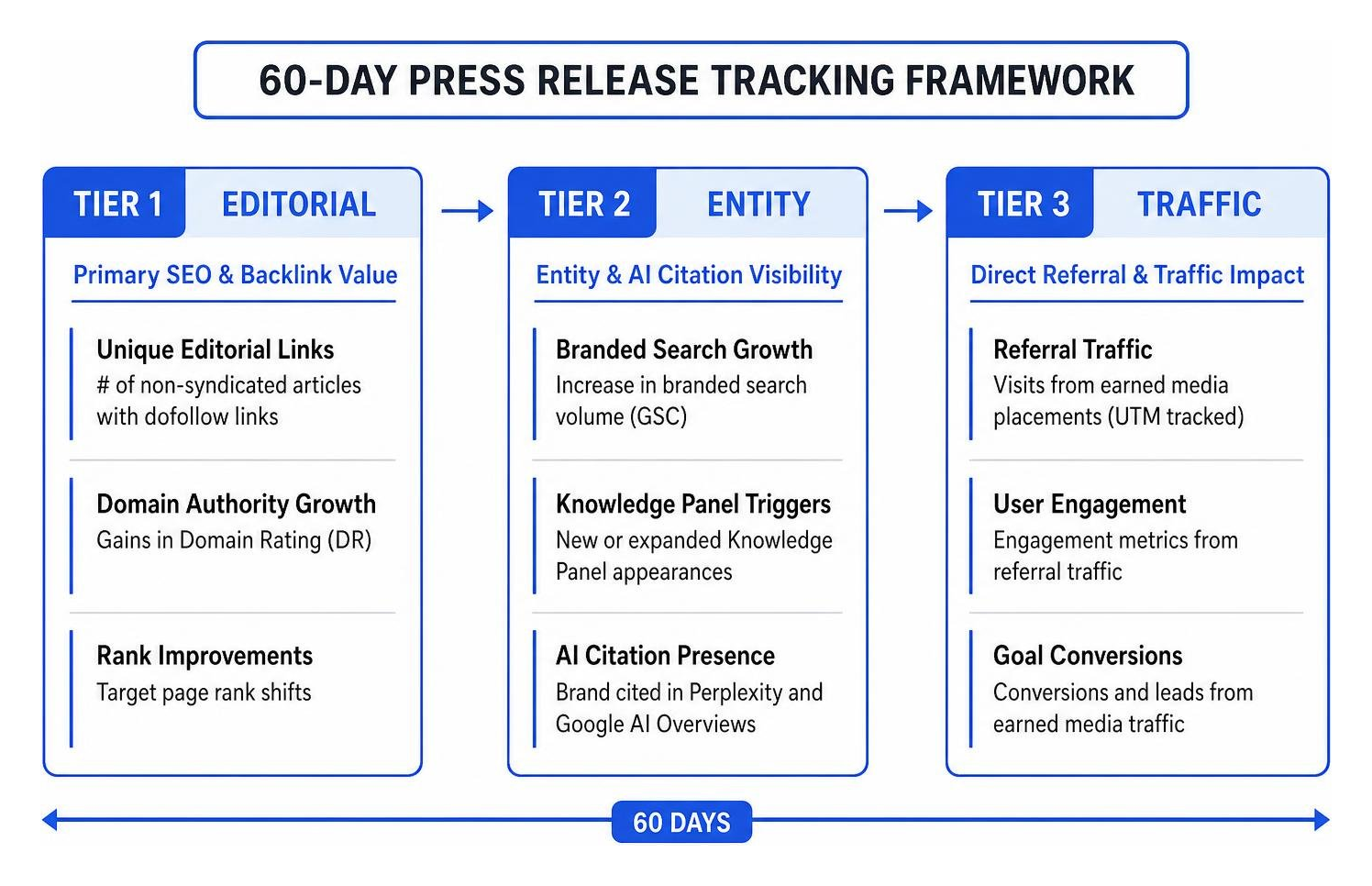
- Tier 1 Metrics (Primary SEO & Backlink Value): Count the number of unique, non-syndicated editorial articles published by real journalists containing
dofollowlinks to your domain. Measure gains in overall Domain Rating (DR) and monitor target page rank shifts. - Tier 2 Metrics (Entity & AI Citation Visibility): Monitor increases in branded search volume in Google Search Console, track new Knowledge Panel triggers, and run automated prompts across Perplexity and Google AI Overviews to verify whether your brand entity is cited for relevant category queries.
- Tier 3 Metrics (Direct Referral & Traffic Impact): Track referral traffic, user engagement metrics, and goal conversions originating from earned media placements via custom UTM links.
Consider these real-world business outcomes from strategic distribution:
- Startup Funding Case Study: A tech startup distributed one structured funding release focused on verifiable growth numbers. The campaign secured 52 media placements, 19 high-quality contextual backlinks, established their initial AI search citations, and drove a 3x surge in branded search queries.
- B2B SaaS Growth Case Study: A B2B SaaS company distributed six research-backed press releases over nine months. By converting coverage into organic media pickups, their domain rating rose from 31 to 49, organic traffic grew by 340%, and their core solution achieved consistent featured placements within Google AI Overviews.
When evaluating distribution partners, bookmark our curated list of Top Free Press Release Sites to analyze indexing capabilities and cost efficiencies.
Frequently Asked Questions About Press Releases and SEO
Are press release backlinks dofollow or nofollow?
Direct syndicated links published on news syndication networks are almost universally tagged as rel="nofollow" or rel="sponsored". This practice complies with search engine guidelines regarding paid distribution links.
However, secondary editorial coverage—meaning articles independently researched and published by third-party journalists who found your press release—typically contain standard, organic dofollow links that pass link equity directly to your target pages.
Do press release distribution links directly improve Google rankings?
No, direct wire distribution links do not pass direct link equity or PageRank to move organic rankings on their own.
Instead, wire distribution provides indirect SEO benefits: it alerts search engines to new brand entity data, accelerates content discovery and indexing, and puts your news in front of journalists whose follow-up coverage generates the authoritative dofollow links that directly drive Google ranking improvements.
What are the most common mistakes in press release link building?
The six most frequent mistakes that ruin press release campaigns include:
- Keyword Stuffing Anchor Text: Using commercial exact-match anchors (e.g., “cheap Florida SEO services”) instead of clean brand names or standard URLs.
- Distributing Generic Non-News: Sending releases for minor internal events that lack genuine interest for outside journalists.
- Writing Overly Lengthy Copy: Exceeding 500 words and burying core statistics under promotional corporate jargon.
- Failing to Conduct Manual Outreach: Expecting wire distribution alone to earn press coverage without sending targeted direct email pitches to journalists.
- Omitting Direct Contact Details: Leaving off direct media contacts or using unmonitored generic web form emails.
- Over-Distributing identical releases: Publishing identical releases across multiple competing wire services on the same day, causing self-inflicted canonical and duplicate content conflicts.
Conclusion
Press release SEO has evolved into a strategic digital PR motion. While automated link syndication packages belong in the past, modern press releases serve as an indispensable bridge connecting brand entity validation, earned high-authority backlinks, and visibility across generative AI answer engines.
By shifting your strategy toward original data, machine-readable formatting, concise copywriting, and targeted media outreach, your business can build an online authoritative footprint that boosts search engine rankings and establishes ongoing digital visibility.
At SEO Maven, we are a boutique digital marketing agency helping small businesses, mid-market companies, and scaling brands throughout South Florida (including Miami FL, Fort Lauderdale FL, Hollywood FL, and Aventura FL) achieve maximum ROI with streamlined digital strategies. Whether you need end-to-end press release link building, local citation management, technical SEO optimization, or modern digital strategy consulting, our team focuses on delivering measurable ranking growth.
Ready to transform your PR strategy into real search visibility and authority? Explore Our Press Release SEO Solutions and let’s craft a high-impact strategy for your business today.