What PPC Ads Services Actually Do (And Why Small Businesses Need Them)
PPC ads services are a form of paid digital advertising where your business only pays when someone clicks your ad – not just when they see it.
Here is a quick breakdown of what they include:
| What You Get | Why It Matters |
|---|---|
| Paid ads on Google, Meta, YouTube, and more | Instant visibility in front of buyers |
| Keyword targeting and bid management | Your ads show to the right people |
| Landing page and conversion optimization | Clicks turn into leads and sales |
| Performance tracking and reporting | You know exactly what your money is doing |
| Ongoing campaign adjustments | Results improve over time |
If organic search is not bringing in enough traffic – and waiting 6 to 12 months for SEO results is not an option – PPC can put your business in front of ready-to-buy customers today. According to Google Economic Impact methodology, businesses make an average of $2 in revenue for every $1 spent on Google Ads. That kind of measurable return is why PPC has become one of the most popular tools in digital marketing.
But there is a catch. Running PPC campaigns without the right strategy wastes money fast. Poorly managed ads, weak landing pages, and bad keyword targeting can burn through your budget with little to show for it. That is exactly where a professional PPC service makes the difference.
I’m Fernando Larez, a marketing professional and business leader with hands-on experience in PPC ads services, digital strategy, and brand development across multiple industries. In this guide, I will walk you through everything you need to know to get real results from paid advertising – without the guesswork.
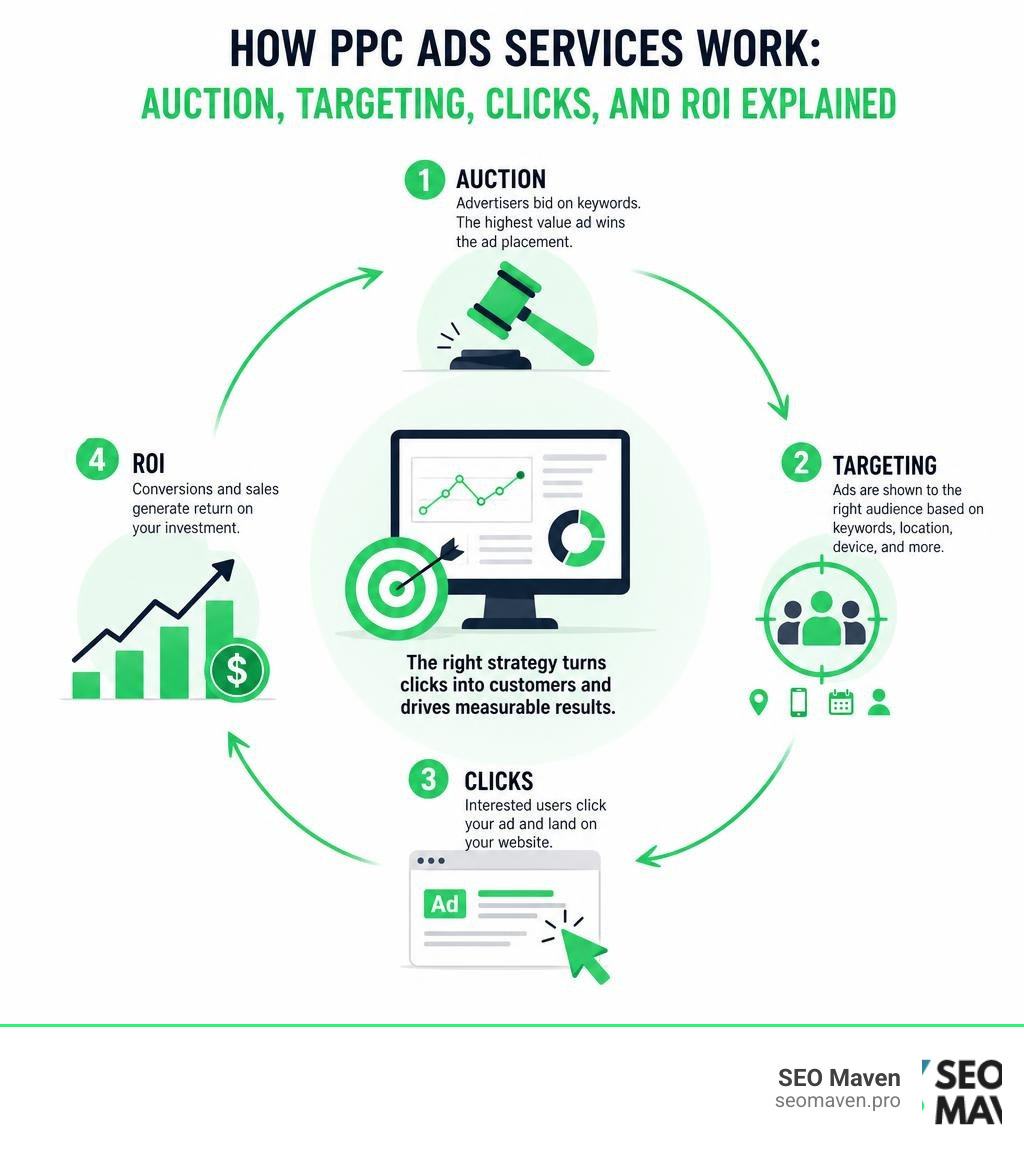
Ppc ads services word roundup:
What is PPC Advertising and How Does It Work?

At its core, pay-per-click (PPC) advertising is an auction-based system designed to match a user’s immediate search query or online behavior with highly relevant commercial solutions. When we talk about PPC ads services, we are referring to the professional setup, management, and continuous optimization of these digital campaigns.
To understand how PPC functions, you have to look past the simple act of clicking an ad. Every single time a user types a query into a search engine, a lightning-fast, automated auction takes place behind the scenes. Within milliseconds, the advertising platform decides which ads to display, what order they should appear in on the search engine results page (SERP), and how much each advertiser will pay if their ad gets clicked.
This decision is not based solely on who has the biggest wallet. Instead, platforms like Google Ads use a sophisticated formula that combines your maximum bid with your Quality Score to determine your Ad Rank. We discuss this dynamic in detail in our A Practical Guide to Pay Per Click Companies, but the takeaway is clear: a highly relevant ad with a great landing page can easily outrank a massive competitor who is simply throwing money at the wall.
The Core Mechanics of Paid Search
To master the basics of paid search, we must first get comfortable with the core metrics that define every campaign:
- Impressions: The number of times your ad is displayed on a screen. If your ad appears on a SERP or a social media feed, that counts as one impression, regardless of whether the user interacts with it.
- Clicks: The actual physical or digital interaction where a user clicks on your ad, which triggers the cost-per-click (CPC) charge.
- Click-Through Rate (CTR): Calculated by dividing the number of clicks by the number of impressions. It is expressed as a percentage. The average CTR for search ads across all industries is roughly 3.17%. A higher CTR indicates that your ad copy is highly relevant to what users are searching for.
- Google Ads: The largest and most dominant PPC platform in the world, allowing businesses to bid on keywords to show up at the top of Google search results, YouTube videos, and partner websites.
- Ad Relevance: A measure of how closely your ad matches the user’s search intent. High ad relevance keeps costs low and positions high.
Understanding the Ad Auction and Quality Score
The Quality Score is Google’s way of ensuring that users see helpful, high-quality ads rather than spam. Rated on a scale of 1 to 10, your Quality Score is calculated based on three factors: expected click-through rate, ad relevance, and landing page experience.
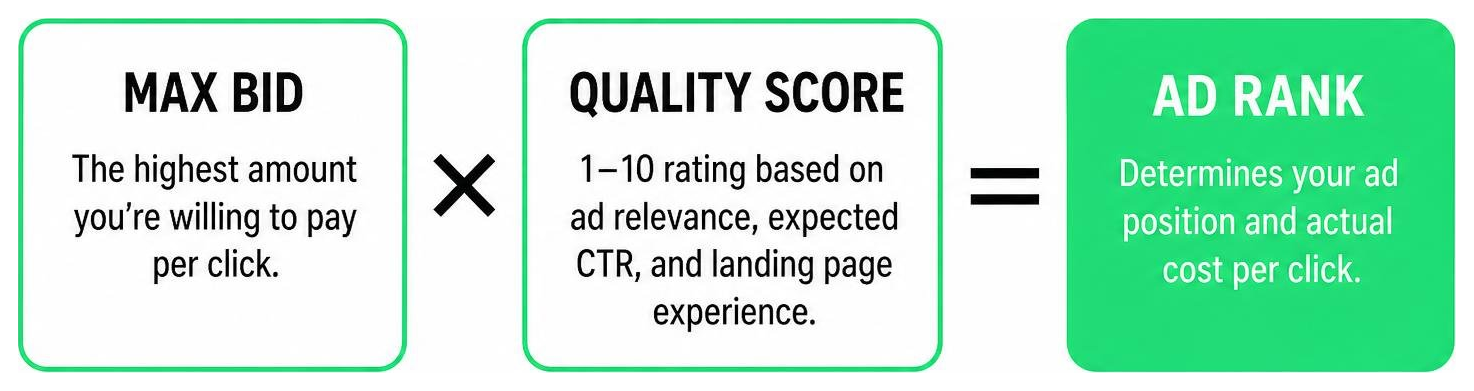
When the auction occurs, the platform calculates your Ad Rank using this basic logic:
$$text{Ad Rank} = text{Maximum Bid} times text{Quality Score}$$
If your landing page experience is seamless — meaning it loads instantly, is mobile-friendly, and directly answers the searcher’s question — your Quality Score climbs. A higher score lowers your actual cost-per-click, allowing you to secure top-tier placements on the search engine results page without blowing through your daily budget.
The Main Types of PPC Ads for Modern Businesses
Modern digital marketing is highly fragmented. While search engines remain the gold standard for capturing high-intent buyers, we also utilize a broad ecosystem of display networks, video platforms, and social media channels to reach customers at every stage of the buying funnel.
For instance, if you are looking to scale your social media presence, you can learn How to Win at Instagram Advertising Using Meta to build targeted visual campaigns that complement your search efforts.
Search and Shopping Campaigns
Search ads are the classic text-based ads that appear at the very top of Google or Bing search results, clearly marked with a “Sponsored” label. These ads target users with high buyer intent — people who are actively searching for a specific product or service (e.g., “emergency plumber in Fort Lauderdale” or “boutique SEO services Hollywood FL”).
Google Shopping campaigns, on the other hand, are highly visual. Instead of bidding on keywords, these campaigns rely on a structured product feed containing product images, prices, ratings, and descriptions. When a user inputs search queries for physical goods, Google displays these product cards directly at the top of the SERP, allowing shoppers to compare options instantly.
Display, Video, and Social Media Advertising
While search ads capture people who are already looking for you, display and social ads introduce your brand to people who might need you but don’t know you exist yet.
- Display Ads: These visual banner ads appear across millions of partner websites on the Google Display Network. They are exceptional for building brand awareness, as they can increase brand recognition by up to 80%.
- YouTube Ads: As the world’s second-largest search engine, YouTube offers video ad placements that run before, during, or after video content. These are highly effective for storytelling and visual demonstrations.
- Social Media Ads: Platforms like Meta (Facebook and Instagram), TikTok, and LinkedIn offer incredibly granular audience targeting based on demographics, interests, and professional job titles. To maximize your return on these social channels, check out The Definitive Guide to Meta Ads Management.
PPC vs. SEM vs. SEO: Key Differences Explained
One of the most common points of confusion for small business owners is the difference between PPC, SEM, and SEO. These terms are often thrown around interchangeably, but they represent entirely different strategies.
| Feature | Pay-Per-Click (PPC) | Search Engine Optimization (SEO) | Search Engine Marketing (SEM) |
|---|---|---|---|
| Cost Structure | Paid traffic (you pay for every click) | Organic traffic (clicks are free; you pay for content/optimization) | Umbrella term (combines paid and organic strategies) |
| Speed of Results | Instant (campaigns can go live and drive traffic today) | Long-term (takes 3 to 12 months to build authority) | Variable (fast for paid elements, slow for organic elements) |
| Sustainability | Traffic stops the moment your daily budget runs out | Continues to drive traffic and leads long after optimization | Dynamic, hybrid approach |
| Primary Goal | Immediate sales, lead generation, and quick testing | Sustainable growth, brand authority, and passive traffic | Dominating the search engine results page entirely |
When to Use SEO vs. PPC Ads Services
Ideally, we do not view these channels as competitors. In fact, when integrated correctly, SEO and PPC can work together to deliver incredible compounding results. Paid campaigns provide immediate traffic and instant data on which keywords convert best, while SEO builds the foundation for long-term growth and zero-cost organic traffic.
If your South Florida business is launching a new product, running a seasonal promotion, or needs leads immediately to keep your team busy, you should prioritize PPC ads services. If you are looking to build a sustainable, cost-effective lead generation machine that protects your brand for years to come, SEO is your primary vehicle.
For local businesses, partnering with regional specialists who understand the South Florida market can help bridge the gap between local organic presence and paid dominance.
How to Build a Winning PPC Strategy
A successful PPC strategy is not built on guesswork or gut feelings. It requires a systematic, data-driven approach that aligns your business goals with user behavior. In July 2026, the digital landscape is more competitive than ever, meaning clean campaign execution is non-negotiable.
Choosing the Right Keywords for Your Campaign
Your keyword strategy is the foundation of your entire campaign. To find terms that drive actual revenue rather than empty clicks, we start with tools like the Google Keyword Planner.
We look for a balance of three primary factors:
- Search Volume: How many people search for this term monthly.
- Competition and CPC: How much other businesses are bidding on the term.
- Buyer Intent: How close the searcher is to making a purchase.
For example, bidding on a broad keyword like “shoes” is incredibly expensive and highly inefficient. However, bidding on a long-tail keyword with high buyer intent, such as “handmade leather boots in Miami FL,” will have a lower search volume but a much higher conversion rate and a lower cost-per-click.
Equally important is your negative keyword list. Negative keywords allow you to exclude search terms that are irrelevant to your business. If you are a high-end luxury real estate agency in Aventura FL, you will want to add negative keywords like “cheap,” “rental,” “free,” or “diy” to ensure your budget is not wasted on searchers looking for low-cost alternatives.
Measuring Success and ROI
One of the greatest advantages of digital advertising is its absolute measurability. By integrating your campaigns with Google Analytics 4 (GA4) and setting up robust conversion tracking, you can track a lead from their initial click all the way to their final purchase.
To evaluate campaign health, we closely monitor these key performance indicators (KPIs):
- Return on Ad Spend (ROAS): Calculated as revenue generated divided by ad spend. If you spend $1,000 on ads and generate $4,000 in sales, your ROAS is 4:1 (or 400%).
- Cost Per Acquisition (CPA): How much it costs you in ad spend to secure a single paying customer or qualified lead.
- Conversion Rate: The percentage of website visitors who complete a desired action, such as filling out a contact form or making a purchase.
Why Your Business Needs Professional PPC Ads Services
Many business owners attempt to manage their own Google Ads or Meta campaigns, only to find themselves frustrated by the complexity of the platforms and the rapid rate at which their budgets disappear. In digital marketing, managing paid ads requires specialized knowledge, daily monitoring, and advanced technical skills.
To understand why professional management is so critical for business survival, read Why Your Business Needs a PPC Ad Company to Survive the Internet.
The Pros and Cons of Managing PPC In-House
While managing campaigns in-house offers direct control and deep product familiarity, it comes with a steep learning curve and massive time constraints.
PPC platforms update their algorithms, ad formats, and compliance policies constantly. A small mistake in your bidding strategy, match types, or geo-targeting parameters can result in hundreds of dollars of wasted ad spend overnight. Furthermore, small business owners rarely have the time to perform daily search term audits, run A/B split tests on ad creatives, or clean up broken product feeds.
How Much Do PPC Ads Services Cost?
The cost of professional PPC management varies depending on the scale of your campaigns and the agency’s pricing model. Most agencies charge using one of three structures:
- Flat Monthly Fee: A set fee for managing your campaigns, regardless of your ad spend. This is highly predictable and popular among small businesses.
- Percentage of Ad Spend: The agency charges a percentage (typically 10% to 20%) of your total monthly advertising budget.
- Hybrid Model: A base flat fee combined with a smaller percentage of ad spend.
When budgeting, your management fee is separate from your ad spend, which is paid directly to the advertising platforms (like Google or Meta).
If you are looking for local representation and transparent management frameworks in South Florida, working with a regional agency that understands the local demographics of Hollywood, Fort Lauderdale, and Miami is essential. A local partner can tailor your geo-targeting and ad copy to resonate directly with South Florida residents, ensuring your budget is spent on high-intent local buyers.
How an Agency Optimizes Your Campaigns
A dedicated digital marketing team does not just “set and forget” your ads. We employ constant, micro-level optimizations to squeeze the absolute most value out of every dollar:
- A/B Split Testing: We continuously test different headlines, descriptions, call-to-actions, and landing page layouts to see which variations generate the highest conversion rates.
- Bid Management: We adjust bids based on device performance, time of day (dayparting), and geographic locations to focus your budget on peak converting hours.
- Geo-Targeting: Ensuring your ads only show in the specific neighborhoods, ZIP codes, or cities where your customers live, preventing wasted spend on distant clicks.
To find an agency that matches your operational style, read our guide on How to Pick a PPC Advertising Company That Actually Delivers.
Frequently Asked Questions about PPC Ads
How long does it take to see results from PPC?
Unlike SEO, which requires months of content building and authority gathering, PPC provides immediate traffic. Your ads can go live and start driving targeted visitors to your website the very same day your campaign launches. However, we always advise clients that the first 30 to 90 days serve as an optimization phase. During this period, we collect user data, filter out negative search terms, and refine bidding strategies to maximize your long-term ROI.
Can small businesses compete with large budgets in PPC?
Yes, absolutely. Because the Google Ads auction relies heavily on Quality Score and ad relevance rather than just bid size, small businesses can easily outperform massive corporations. By focusing on highly specific long-tail keywords, tight geographic targeting, and offering an exceptional landing page experience, you can capture high-converting local traffic at a fraction of the cost.
What is remarketing and why is it important?
Remarketing (or retargeting) is a powerful strategy that shows targeted ads to users who have already visited your website but left without completing a purchase or filling out a form. Because these users are already a warm audience familiar with your brand, remarketing campaigns have incredibly high conversion rates and are highly effective for combating shopping cart abandonment and building brand recall.
Conclusion
PPC advertising is one of the fastest, most predictable, and highly measurable ways to grow your business online. Whether you are looking to dominate local search results in Miami, Fort Lauderdale, or Hollywood FL, a well-engineered campaign puts your brand directly in front of the people who are actively looking to buy your products or services.
At SEO Maven, we operate as a boutique digital marketing agency focused on helping small businesses achieve maximum ROI with minimal waste. We don’t believe in vanity metrics or empty clicks; we build integrated search engine optimization, content marketing, and ppc ads services designed to turn search intent into sustainable business growth.
Ready to stop wasting ad spend and start driving real revenue? Explore SEO Maven’s Marketing Services today, and let’s build a custom digital strategy that scales your business safely and predictably.