Why Every Business Needs a Meta Ads Playbook in 2026
A meta ads playbook is your step-by-step system for running profitable campaigns on Facebook and Instagram — from campaign structure and creative strategy to tracking, scaling, and measurement.
Here’s what a winning Meta Ads playbook covers in 2026:
- Campaign structure — Simplify to 2-3 campaigns (Sales CBO, Awareness, Remarketing)
- Creative strategy — Launch 5-10 new vertical (9:16) creatives weekly; prioritize UGC
- Algorithm alignment — Feed the Andromeda algorithm variety, not volume
- Tracking setup — Install Conversions API (CAPI) alongside Meta Pixel for clean data
- Key metrics — Monitor CPMr (keep it under $20), hook rate, CTR, and true ROAS
- Scaling rules — Increase budgets 20-30% weekly only when CAC holds
- Omnichannel measurement — Account for in-store and Amazon impact, not just DTC
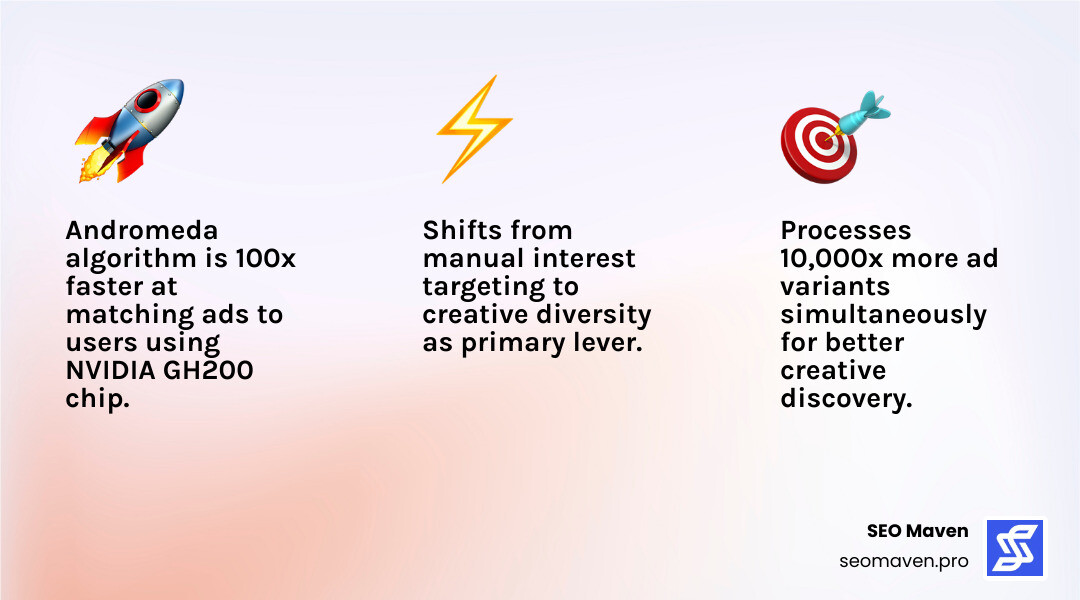
Meta has evolved more in the last twelve months than in the previous five years combined. The platform’s new Andromeda retrieval algorithm — powered by NVIDIA’s GH200 chip — is now 100x faster at matching people to ads and can process 10,000x more ad variants simultaneously. Manual interest targeting is fading. Creative diversity is the new targeting lever.
For small businesses, this is actually good news. The playing field is leveling. You no longer need a massive budget to compete with big brands. You need the right system.
But most advertisers are still running 2020 playbooks in a 2026 environment — and it’s costing them.
I’m Fernando Larez, a marketing professional and digital strategist based in Hollywood, Florida, with hands-on experience in paid advertising, SEO, and brand growth across multiple industries — including building and refining a meta ads playbook that drives real results for competitive markets. In this guide, I’ll walk you through everything you need to win on Meta in 2026, from algorithm changes to creative workflows to omnichannel measurement.
The 2026 Meta Ads Playbook: Navigating the Andromeda Algorithm
The biggest change in Meta ads is simple: the platform now behaves more like a creative discovery engine than an audience selection tool.
Andromeda is the reason. Meta’s newer retrieval system dramatically speeds up how ads get matched to people. In practical terms, it evaluates many more possible ad-user combinations, much faster than older systems. That means your account wins less by slicing audiences into tiny buckets and more by giving Meta strong inputs:
- clean conversion data
- enough budget concentration
- a wide range of creative angles
- clear business goals
If you want a deeper agency-side view, see our Meta Ads Agency Playbook 2026 and this outside perspective on Meta Ads 2026 Playbook: 5 Creative Strategies That Convert.
Understanding the Death of Manual Targeting
A few years ago, advertisers could obsess over:
- stacked interests
- hyper-specific lookalikes
- exclusion mazes
- demographic micromanagement
In 2026, that approach is often a liability.
Meta has steadily reduced the usefulness of detailed targeting, and privacy changes have made many old signals less dependable. Broad targeting now works better in many accounts because the algorithm can interpret real-time behavior, engagement patterns, and conversion signals better than a human building a tiny audience by hand.
This does not mean targeting is dead. It means targeting has moved upstream.
Today, your real targeting inputs are:
- the creative itself
- the landing page
- the conversion event you optimize for
- your first-party data
- your customer list quality
- your server-side signal setup
This shift also lines up with the growing importance of data restrictions and privacy-safe measurement. If you have not revisited your setup since the recent platform changes, our guide on Meta 2025 Data Restrictions is worth reading.
Why Creative Diversity is the New Targeting Lever
Creative diversity is not the same as making tiny edits to one ad.
Changing one headline five times is variation. Testing five genuinely different concepts is diversity.
Andromeda rewards diversity because it has more combinations to test across placements, behaviors, and intent stages. Your ad library should look less like a duplicate folder and more like a small film festival.
Useful archetypes include:
- cinematic founder story
- lo-fi UGC testimonial
- chaotic meme-style comparison
- motion-graphic explainer
- nostalgic throwback ad
- quick demo
- problem-solution before/after
- objection-handling testimonial
Modern paid social is now heavily creative-led. A good rule of thumb from the research: this channel is closer to 80% creative operations and 20% media buying.
That is why brands that scale usually build a system for ongoing concept production, not just campaign edits. The basic principle is the same one echoed in the broader Scaling Meta Ads in 2025 Playbook: feed the algorithm variety, not clutter.
Campaign Architecture: Simplification and Advantage+ Automation
One of the most common reasons Meta accounts underperform is over-complication.
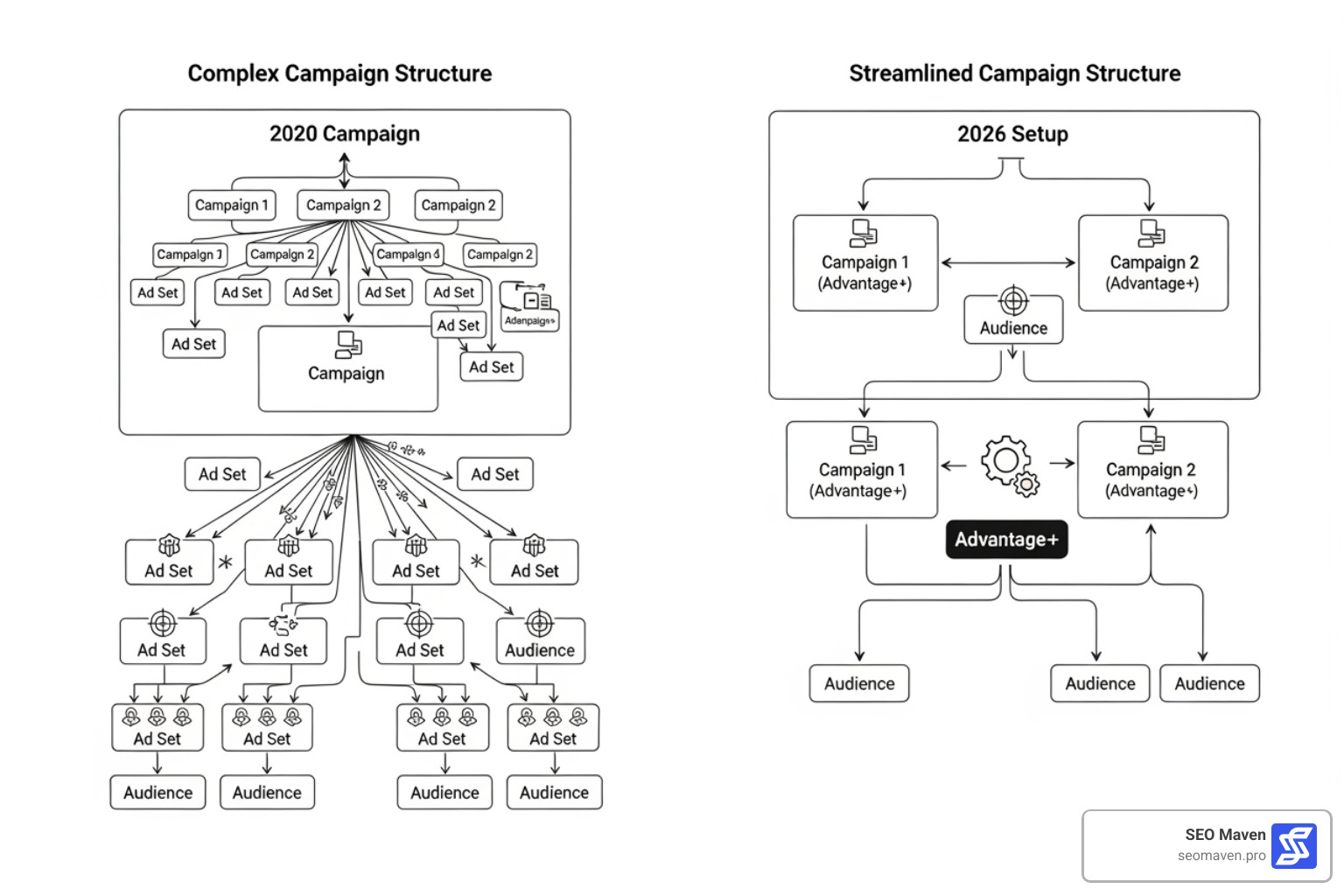
Too many campaigns split budget. Too many ad sets split learning. Too many audience tests create overlap. Too many “control” settings reduce signal density.
A cleaner account helps Meta learn faster. In most cases, we recommend simple structures that concentrate events and reduce noise.
Structuring Your Meta Ads Playbook for Maximum Signal
For most brands, the strongest 2026 setup is one of these:
- A 2-campaign structure
- Testing campaign
- Scaling campaign
- A 3-campaign structure
- Sales CBO or Advantage+ Shopping
- Awareness campaign
- Remarketing campaign
The right choice depends on volume and funnel maturity.
A practical 3-campaign setup looks like this:
- Sales campaign as your main acquisition engine, usually broad
- Awareness campaign for video views, reach, or top-funnel education
- Remarketing campaign for engaged visitors, viewers, and cart users
If your account is smaller, the 2-campaign structure is often easier to manage:
- 10% to 20% of budget goes to testing
- the rest goes to scaling proven winners
The reason this works is signal concentration. Meta still benefits from enough conversion volume to exit learning and stabilize delivery. A common benchmark is roughly 50 optimization events per week at the ad set level. Fragmented structures struggle to get there.
For a more tactical look at cleanup and simplification, see How To Navigate Meta Ad Manager Without Crying and this outside resource: Meta Ads Campaign Optimization: A 2026 Playbook.
Balancing Manual Controls with AI-Driven Scaling
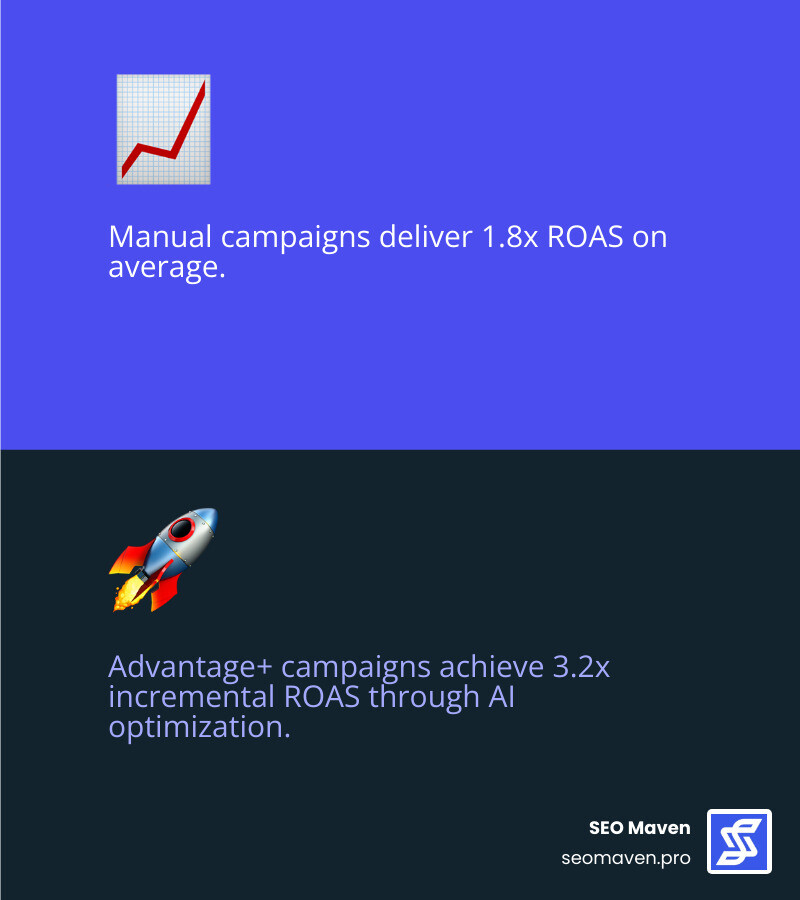
Advantage+ is no longer optional to understand. It has been widely adopted and accounts for a major share of spend. In some tests, Advantage+ beat manual setups early, with about a 9% midpoint advantage. But longer-term incremental tests also showed manual campaigns can outperform on true incremental ROAS by the end of the test.
So what should we do?
Use both intelligently.
A smart rule set for 2026:
- Use Advantage+ or broad automated sales campaigns for speed and exploration
- Use manual controls when you need cleaner funnel separation, testing discipline, or better incrementality
- Test automation against manual setups instead of assuming either is always better
For lead generation, Advantage+ can be especially useful. Research suggests businesses adopting Advantage+ lead campaigns may reduce lead costs by 20% to 35%.
For scaling, stay boring. Boring is profitable.
- Increase budgets by 20% to 30% per week when CAC remains stable
- Avoid doubling budgets overnight unless you enjoy chaos
- Refresh creative before forcing spend higher
- Consider creator whitelisting when social proof and native delivery matter
- Maintain budget stability so the system keeps learning
If you need help deciding when to keep campaigns in-house and when to bring in support, our article Why Your Business Needs A Ppc Ad Company To Survive The Internet covers the bigger picture.
Creative Operations: Winning the 9:16 Vertical Revolution
By 2026, around 90% of Meta inventory is expected to be vertical. If your creative is not built mobile-first, you are designing for the wrong internet.
That means:
- prioritize 9:16 video
- build for Reels and Stories first
- keep key visual elements centered and visible early
- show the product or transformation immediately
- assume sound-off viewing unless audio is essential
Placements matter, but not in the old “pick one winner” way. Instead, match the format to the job:
- Reels and Stories for attention and discovery
- Carousel for comparison, education, or product depth
- Flexible Ad Format for efficient combinations and iterations
- Static images for strong offers or simple visual hooks
If Instagram matters to your funnel, our guide on How To Win At Instagram Advertising Using Meta pairs well with this playbook.
Implementing a Weekly Creative Testing Meta Ads Playbook
The best Meta teams work on a rhythm, not random bursts of inspiration.
A simple weekly process:
- Launch 5 to 10 new creatives each week
- Keep testing variables clean:
- one hook
- one angle
- one creator style
- one format shift
- Let the test run long enough to collect signal
- Midweek, review leading indicators
- End of week, kill losers and move winners into scale
What should you watch early?
- hook rate or 3-second view rate
- CTR
- CPM or CPMr
- landing page view rate
- cost per result trend
What should you do with winners?
- create spin-offs with new hooks
- cut shorter versions
- translate or localize if relevant
- adapt into Carousel or Stories
- move into scaling campaign
AI tools can speed this up. Small businesses and agencies can use Gemini or Claude to:
- analyze winning ads for patterns
- generate new hook ideas
- rewrite scripts for different buyer objections
- create concept briefs for creators
- summarize comments into objection libraries
The AI is not the strategy. It is the intern who never sleeps.
For broader retailer-specific creative benchmarks, see Meta Advertising for Online Retailers: 2026 Playbook.
The Role of UGC and Authentic Storytelling
UGC keeps winning because it feels native to the feed. It looks less like an ad and more like a recommendation, demo, reaction, or honest opinion.
That matters because people do not open Instagram and think, “I hope I see a highly polished corporate banner today.”
UGC works especially well for:
- cold traffic testimonials
- product demos
- daily routine integrations
- comparison videos
- objection handling
- customer reaction clips
- founder-led authenticity
The key is authenticity, not fake messiness. Good UGC still needs:
- a strong first second
- one clear idea
- fast visual pacing
- social proof
- a specific CTA
Creator whitelisting can also help. When the ad runs from a creator identity, it may feel more natural and trust-building than a brand-only delivery.
Measurement, Attribution, and the Omnichannel Loop
If your tracking is weak, your optimization is weak. Period.
Meta cannot learn well from missing events, and marketers cannot make good decisions from partial data. That is why Conversions API is now a core part of any serious meta ads playbook.
CAPI sends server-side data that complements browser-side Pixel tracking. In a privacy-restricted world, that extra signal matters a lot. Some research estimates that advertisers not using CAPI may suffer 30% to 50% higher CPAs because of missing or underreported events.
At minimum, we recommend:
- Meta Pixel installed correctly
- CAPI implemented alongside Pixel
- event deduplication configured
- CRM or offline conversion uploads where relevant
- regular validation in Events Manager
- attention to data quality scores for offline feeds
If your business sells both online and offline, web-only attribution can hide real value. Meta’s omnichannel tools and offline event feeds can help tie digital exposure to store sales or non-DTC outcomes.
For funnel-specific retargeting strategy, this is a useful outside read: Meta Ads Retargeting for eCommerce: The Full-Funnel Playbook (2026).
Key Metrics for Your Meta Ads Playbook in 2026
The dashboard is full of numbers. Most are distractions unless they connect to business outcomes.
The key metrics we care about most in 2026 are:
- CPMr
- CTR
- hook rate
- CAC or cost per acquisition
- ROAS
- contribution margin
- frequency
- landing page view rate
Let’s break them down.
CPMr
CPMr means cost per 1,000 people reached. A healthy CPMr is often under $20. When CPMr rises, especially while CTR weakens, it often signals creative fatigue. In plain English: Meta has to work harder to find people who still care.
CTR
CTR is still a strong directional metric.
- Prospecting benchmark from research: around 1.25% CTR
- Retargeting benchmark from research: around 2.86% CTR
These are not universal laws, but they are useful reference points.
Hook rate
For video, hook rate tells you whether the first second is doing its job. Some research suggests a hook rate below 25% means the opening is weak. If the intro fails, the rest of the ad never gets a chance.
ROAS vs contribution margin
ROAS is helpful, but it can mislead. A lower ROAS may still be more profitable if your margins are strong or if Meta is creating downstream value in other channels. We should evaluate efficiency in context, not worship the prettiest dashboard number.
Frequency
Frequency helps detect fatigue, especially in retargeting. If frequency climbs while performance falls, your audience is likely getting tired of seeing the same message.
For more paid media strategy content, browse our advertising resources.
Omnichannel Integration and Halo Effects
Meta should not be treated like an isolated machine. It works best inside an ecosystem.
Research shows Meta campaigns delivered an average 19% lift to brands’ main KPIs across hundreds of incrementality experiments. For omnichannel brands, about 32% of Meta’s attributed impact happened outside DTC, including in-store and marketplace sales. Upper-funnel campaigns also drove 21% more impact on new customer acquisition and had a large halo effect on non-DTC sales.
That means if we only judge Meta by last-click website purchases, we undercount what it really does.
A stronger growth system connects Meta with:
- YouTube Shorts for broader video reach
- TikTok for trend-native discovery
- CTV or OTT for credibility and household reach
- email and SMS for retention and recovery
- search and SEO for demand capture
- offline sales data where applicable
This matters especially for local and regional businesses in South Florida. Someone may discover your brand on Instagram, visit later through Google, and convert by phone or in person. That journey is normal, not messy.
Our broader guide on How To Pick A Ppc Advertising Company That Actually Delivers can help if you are evaluating outside support for multi-channel growth.
Frequently Asked Questions about Meta Advertising
What is the Andromeda algorithm in Meta Ads?
Andromeda is Meta’s newer ad retrieval system that helps match users to ads much faster and across far more creative possibilities. The big practical takeaway is this: it rewards strong data and diverse creative more than manual audience tinkering.
How often should I refresh my ad creative to avoid fatigue?
As a rule, refresh winners every 30 to 60 days and introduce new testing creatives weekly. In faster-moving accounts or smaller audiences, refreshes may need to happen every 7 to 10 days. If CPMr rises above healthy levels, CTR drops, or frequency climbs, your creative is likely tiring out.
Why is CPMr considered a hidden KPI in 2026?
Because it reveals whether Meta can still find fresh, qualified reach efficiently. A rising CPMr often appears before ROAS fully collapses, making it an early warning system for fatigue or weak creative-market fit. It is one of the fastest ways to spot account health issues before they become expensive.
Conclusion: Future-Proofing Your Brand Growth
The best meta ads playbook for 2026 is not more complicated. It is more disciplined.
We win by:
- simplifying campaign structure
- giving Meta better data
- producing more creative diversity
- designing for vertical placements
- tracking the right metrics
- measuring beyond platform-reported ROAS
- connecting Meta to the rest of the funnel
At SEO Maven, we bring that mindset to small businesses that want more growth with less waste. As a boutique, ROI-focused team in South Florida, we care about systems that actually hold up in the real world, not trendy account gymnastics.
If you want help building a smarter Meta strategy, explore our Meta Ads Agency page.