What SEO Press Release Distribution Can Do for Your Visibility
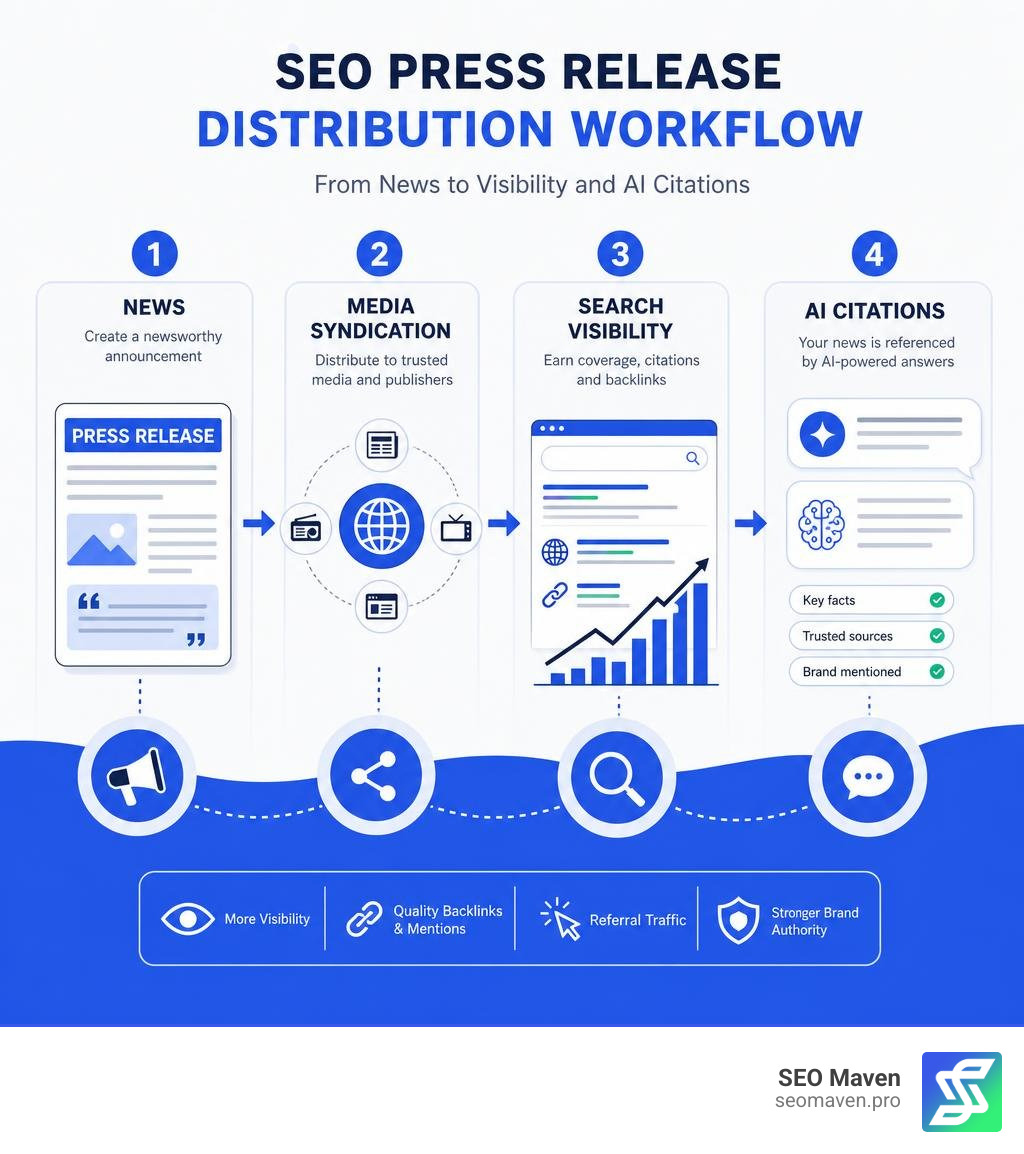
SEO press release distribution is the process of sending a real business announcement to relevant news sites, media contacts, and online publishers to increase visibility in search results, earn brand mentions, and create opportunities for media coverage.
For a small business, it is not a shortcut to top rankings. It is a way to put useful, timely information about your company in places that people, search engines, and AI search tools can find.
A strong release can support SEO when it includes:
- A genuinely newsworthy announcement, such as a launch, milestone, study, event, or expansion.
- Clear facts about the business, including its name, website, services, and location.
- Distribution to relevant national, industry, or local publications.
- Coverage, citations, referral visits, and sometimes editorial backlinks from publishers that pick up the story.
In 2026, the value goes beyond traditional Google rankings. Press releases can also help establish fresh, consistent facts about your brand across trusted media sources. That matters when tools such as ChatGPT, Perplexity, and Google AI features retrieve and summarize information about businesses.
The hard part is choosing the right distribution approach. Traditional wire services can deliver broad syndication, while newer platforms may focus more on structured content, targeted outlets, and AI-search visibility. Neither replaces useful website content, local SEO, or earned links. The best fit depends on your news, audience, location, and goals.
I am Fernando Larez, a marketing professional and business leader with experience in SEO, PR, digital strategy, advertising, and brand development. In this guide, I will use that experience with seo press release distribution to help you compare practical options and avoid spending on distribution that does not match your growth goals.
Seo press release distribution glossary:
How SEO Press Release Distribution Drives Search and AI Visibility
When we look at how search engines crawl and catalog the web in 2026, press release syndication serves as an engine for digital discovery. Search engine algorithms rely heavily on freshness, entity relationships, and trusted third-party verification. When a business distributes an announcement through established syndication networks, search engine bots immediately crawl these releases across hundreds of news nodes.
White-hat optimization ensures that news announcements strictly adhere to search guidelines. Rather than attempting to game ranking algorithms through aggressive, unnatural anchor text, modern press release distribution focuses on structured news signals. Web crawlers process the cleanHTML, canonical markup, and journalistic layout of press releases faster than standard blog content because news sites are checked frequently by search engine spiders. For a deeper look at the foundational mechanics, check out our Beginners Guide to SEO Press Releases.

Traditional Wire Services vs Modern AI Distribution Platforms
The press release industry has split into two distinct models: legacy wire networks and modern AI-optimized distribution platforms. Traditional wire platforms like PR Newswire were designed decades ago for financial disclosures and mainstream newsroom teletypes. They excel at broad media reaching over 1.7 million media contacts, including 700,000+ bloggers and influencers across thousands of news content systems. However, traditional wires can be slow to adapt to semantic web standards and Generative Engine Optimization (GEO).
Modern AI-focused networks, such as PressPush, structure press releases using specialized markup like AIWire formatting. This structured schema makes press release content instantly legible for Large Language Models (LLMs). By distributing structured data directly through licensed media networks, these modern platforms compress distribution turnaround times to 24-48 hours while maximizing AI search visibility.
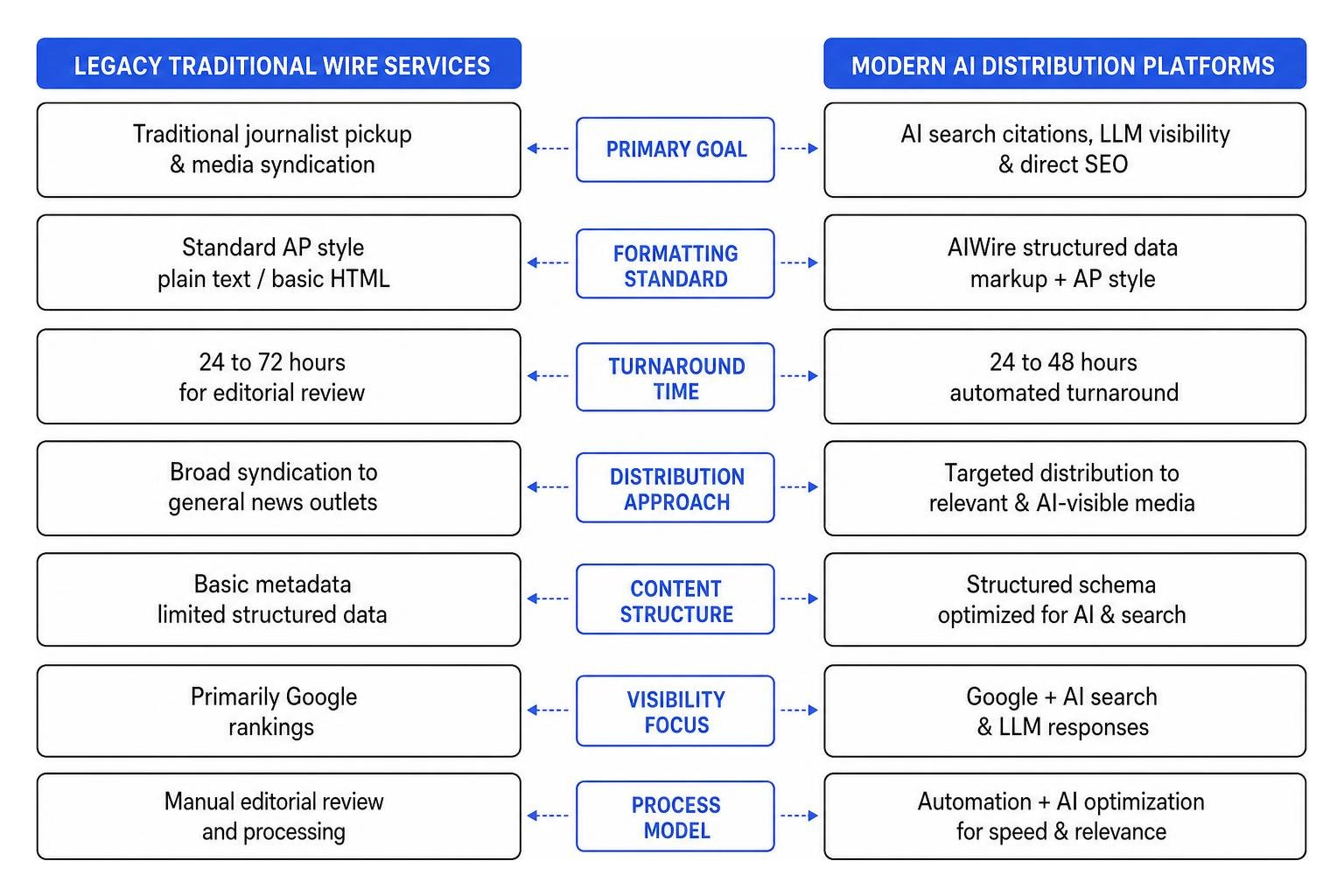
| Feature | Legacy Traditional Wire Services | Modern AI Distribution Platforms |
|---|---|---|
| Primary Goal | Traditional journalist pickup & media syndication | AI search citations, LLM visibility & direct SEO |
| Formatting Standard | Standard AP style plain text / basic HTML | AIWire structured data markup + AP style |
| Turnaround Time | 24 to 72 hours for editorial review | 24 to 48 hours automated turnaround |
| Search Engine Target | Google / Bing traditional organic index | Search Generative Experience, ChatGPT, Perplexity |
| Reporting Metrics | Impressions, wire views, basic clicks | AI search citations, branded visibility, indexing |
The Role of Freshness and Recency in AI Search Citations
Generative Engine Optimization places massive emphasis on real-time data retrieval. LLMs using Retrieval-Augmented Generation (RAG) pull context from recent, high-authority news items to answer user queries with up-to-date facts. When a customer asks an AI assistant about top service providers in Miami or Fort Lauderdale, the language model scans authoritative content nodes for recent validation.
Maintaining a steady publication cadence signals to search platforms that your organization is active, relevant, and growing. A steady flow of press releases ensures that AI engines store fresh entity data regarding your brand name, address, phone number, and website details. As highlighted in Press Releases Are Back (For AI Search), recency is a key factor in keeping your business at the forefront of AI-generated answers.
Key SEO Benefits of Distributing Digital Press Releases
Distributing digital news provides a multi-channel boost to your organic search ecosystem. While one single press release won’t magically launch a competitive keyword to position one overnight, a sustained distribution strategy creates authority signals that elevate your entire digital footprint.
Key benefits include:
- Amplified Branded Search Volume: Press releases can increase branded search visibility by up to 40% over the following month as curiosity drives readers to search for your company.
- Rapid Multi-Channel Exposure: Releases hit news aggregators, regional portals, trade publications, and search feeds simultaneously.
- Expanded Referral Networks: Interested readers, journalists, and industry bloggers discover your content and click directly through to your landing pages.
- Reinforced Local & Regional Authority: Releases targeted to markets like South Florida establish strong geographic relevance for regional search queries.
To learn more about maximizing these outcomes, review The Ultimate Guide to Press Release SEO Benefits.
Generating High-Authority Backlinks and Brand Mentions
A major technical benefit of modern news syndication is rapid backlink indexation and link velocity. Through networks like PRWiz, a single well-crafted announcement can secure syndication across 560+ media outlets, generating 40-60 indexed backlinks from real publishers with domain authority ratings between 40 and 90+.
While many media syndication links carry rel="nofollow" or rel="sponsored" attributes to comply with search guidelines, top-tier news portals often pass contextual value and domain authority. Furthermore, organic pickups occur when journalists read your distributed press release and cite your brand in unique editorial articles, yielding valuable dofollow backlinks. For tactical link building steps, check out A Quick Start Guide to Press Release SEO Link Building.
Unstructured Citations and Generative Engine Optimization
In the context of Generative Engine Optimization (GEO), press releases serve as powerful unstructured citations. Unlike structured citations found in online business directories, an unstructured citation occurs whenever your brand name, business address, phone number, and website (NAPW) appear alongside descriptive context inside news stories.
When language models synthesize answers for queries in AI tools like ChatGPT, Claude, or Perplexity, they scan these unstructured citations across media outlets to verify that your business exists and is trustworthy. A campaign can yield an average of 89 syndication placements and over 150 AI citations, anchoring your business entity into the permanent knowledge base of modern search engines.
Comparing Syndication with Alternative Link Building Tactics
To build a strong web footprint, smart marketers use press release distribution alongside other off-page SEO strategies. Syndication shouldn’t replace direct media outreach or guest content, but it offers scalability that manual link outreach simply cannot match.
- Speed: Generates dozens of media placements within 24 to 48 hours compared to weeks of manual negotiation.
- Predictability: Delivers guaranteed syndication across licensed networks, eliminating cold outreach response uncertainty.
- Entity Verification: Establishes official corporate records and verifiable news references that search engines and AI databases trust.
- Comprehensive Footprint: Combines brand mentions, geographic citations, NAPW validation, and referral pathways in a single push.
Evaluating Methods for SEO Press Release Distribution
When evaluating digital link strategies, comparing press releases to guest blogging or Help a Reporter Out (HARO) pitches reveals clear operational differences:
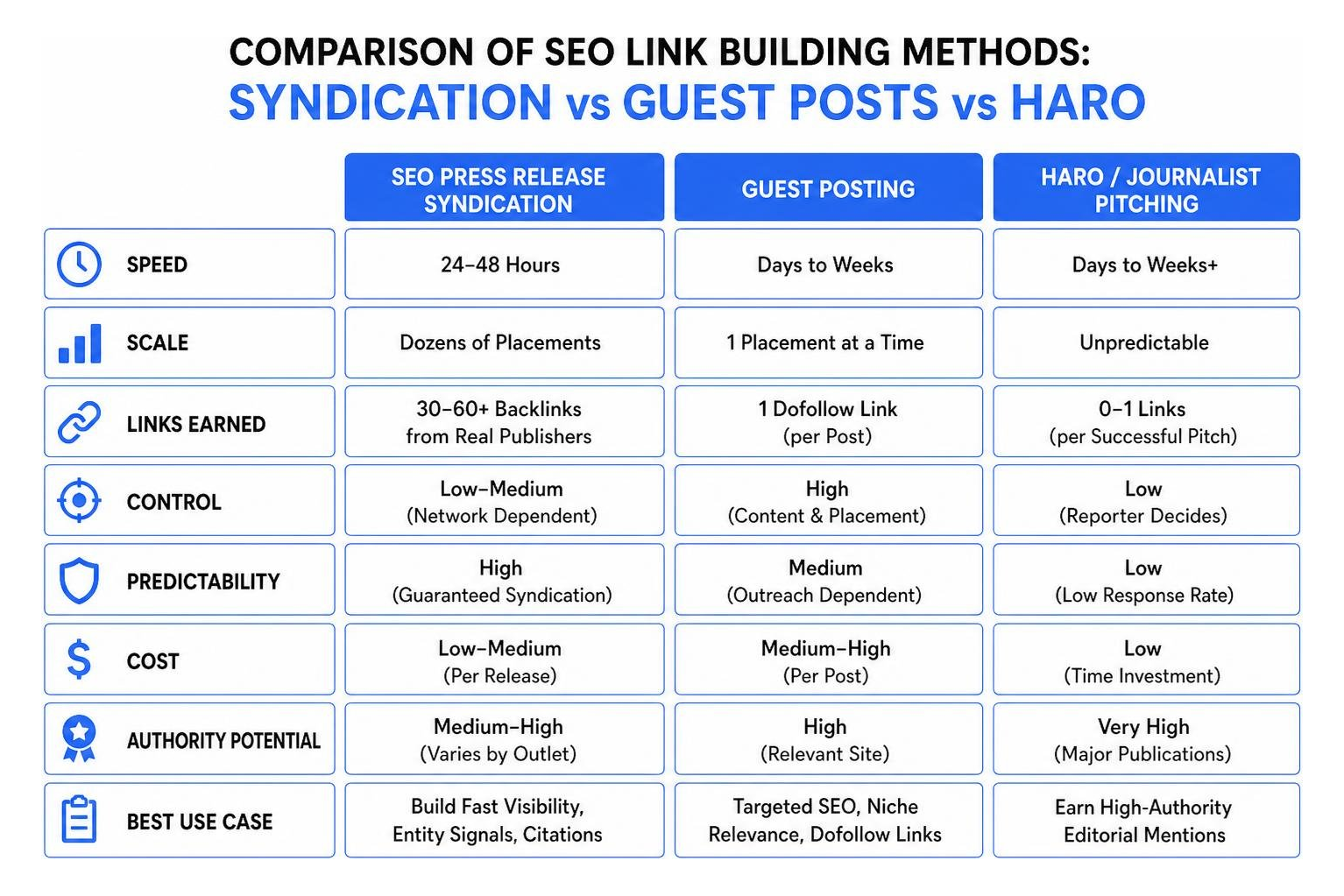
- Guest Posting: Involves pitching individual blogs, writing custom articles, and negotiating placements. It offers high control over dofollow link placement, but requires significant time and cost per link.
- HARO / Connectively Pitching: Requires monitoring journalist queries daily and sending quick pitches. Response rates hover between 5% and 10%. While earned links from major publications carry immense authority, pickup volume is unpredictable.
- SEO Press Release Syndication: Provides instantaneous scale. You draft a single AP-style release and syndicate it across networks such as 24-7PressRelease.com or IMCWire. This yields dozens of indexed citations in hours, making it an efficient foundational lever for entity authority.
Optimizing Format, Length, and Structure for Media Pickup
To ensure maximum pickup by human editors and automated AI indexers, press releases must follow a strict AP-style structure. Avoid fluff, sales jargon, and exaggerated claims. Language models prefer clear, declarative sentences filled with attributable facts and verifiable data points.
Follow these core structural principles:
- Optimal Length: Keep standard releases between 400 and 600 words.
- Declarative Headline: Include your target business topic and primary entity name in a clear, non-gimmicky title.
- Dateline & Lead Paragraph: Begin with city, state, and date (e.g., HOLLYWOOD, FL – August 18, 2026), followed by a concise answer to Who, What, Where, When, and Why.
- Attributable Data & Direct Quotes: Include precise metrics, statistical evidence, and authentic quotes from company leadership.
- Boilerplate with Full NAPW: Conclude with an “About” section containing full Name, Address, Phone Number, and Website URL.
For deeper formatting guidance, templates, and real-world examples, explore our guides on How to Write SEO Press Release the Right Way, How to Master Press Release Format in 30 Days, and The Ins and Outs of a Press Release Example.
Strategy Execution and Measuring Campaign Performance
Launching a campaign requires careful execution to avoid common pitfalls. A common mistake is mass-distributing low-quality announcements every week. This can create media saturation and dilute the impact of your news.
Proper duplicate content management relies on news aggregators using standard syndication tags to point back to your primary announcement source. Maintain a steady cadence—such as quarterly milestone releases or monthly product updates—to maximize ROI without fatiguing media outlets.
Tracking SEO Metrics Across Search Engines and LLMs
Evaluating campaign success requires tracking metrics beyond basic referral web traffic. Because readers often scan headline feeds rather than clicking through every link, referral traffic only tells part of the story.
Track campaign performance using these primary metrics:
- 24-Hour and 7-Day Pickups: Audit live pickup reports to confirm indexation across target news domains.
- Branded Search Lift: Measure search impression increases for your company name in Google Search Console over the 30 days following distribution.
- AI Search Prompt Monitoring: Run prompt queries in ChatGPT and Perplexity (e.g., “What are top digital marketing agencies in Fort Lauderdale?”) to check if your brand is cited as a source.
- Indexed Publisher Backlinks: Use SEO audit software to track incoming dofollow and nofollow backlinks from news publications.
For specialized reporting strategies, see our guide on SEO Press Release Distribution Services.
Maximizing ROI with Cost-Effective SEO Press Release Distribution
Startups and growing local businesses do not need Fortune 500 PR budgets to execute an effective press release strategy. Traditional wire services can charge significant fees per release, but modern platforms offer accessible, flat-rate campaign tiers designed for growth teams.
To stretch your marketing budget:
- Combine Localized Targeting with Digital Wires: Focus distribution on relevant geographic regions (such as Aventura FL, Miami FL, or South Florida) to keep syndication budgets efficient.
- Utilize Free Distribution Directories Cautiously: While free distribution sites exist for initial testing, they often lack domain authority and editorial vetting. Review our guide on X of the Best Websites for Free Press Release Sites to distinguish legitimate portals from spam directories.
- Follow Step-by-Step Submission Protocols: Streamline drafting and submission processes by following How to Do Press Release Submission for SEO in Easy-to-Follow Steps.
Frequently Asked Questions About SEO Press Releases
How long does it take to see SEO results from a press release?
Initial media pickups usually begin within 2 to 4 hours of submission, with comprehensive syndication reports available within 24 to 48 hours. Organic search indexation of syndicated releases occurs over the first week, while lifts in branded search visibility and AI citations typically build over 14 to 30 days.
Are press release links dofollow or nofollow?
Most syndicated news links distributed across wire networks use rel="nofollow" or rel="sponsored" attributes to comply with Google search engine webmaster guidelines regarding paid syndication. However, modern platforms can generate 30 to 60 permanent dofollow backlinks when publications pick up and feature your release editorially on high-authority news domains (DA 40-90+). Both link types contribute to a natural link profile.
Can press releases help my website rank in AI search engines like ChatGPT?
Yes. Generative search engines use language models that constantly crawl high-authority news sources for verified facts. Press releases formatted with structured data (such as AIWire schema) provide clear, declarative facts, named sources, and NAPW details. This makes it easy for LLM retrieval layers to cite your business when answering relevant user queries.
Conclusion
Distributing SEO press releases has evolved into a multi-faceted digital strategy. Beyond basic media distribution, press releases build unstructured citations, establish entity authority, reinforce geographic signals across South Florida markets, and power Generative Engine Optimization across AI search tools.
By choosing distribution methods aligned with your budget, maintaining a steady publication cadence, and adhering to strict AP-style structural guidelines, your business can maximize organic search authority and long-term brand equity.
Ready to expand your company’s search and media reach? Explore Professional Press Release SEO Solutions with SEO Maven to launch targeted, ROI-driven press campaigns designed for modern search engines and AI engines alike.