How to Do Press Release Submission for SEO (And Actually Get Results)
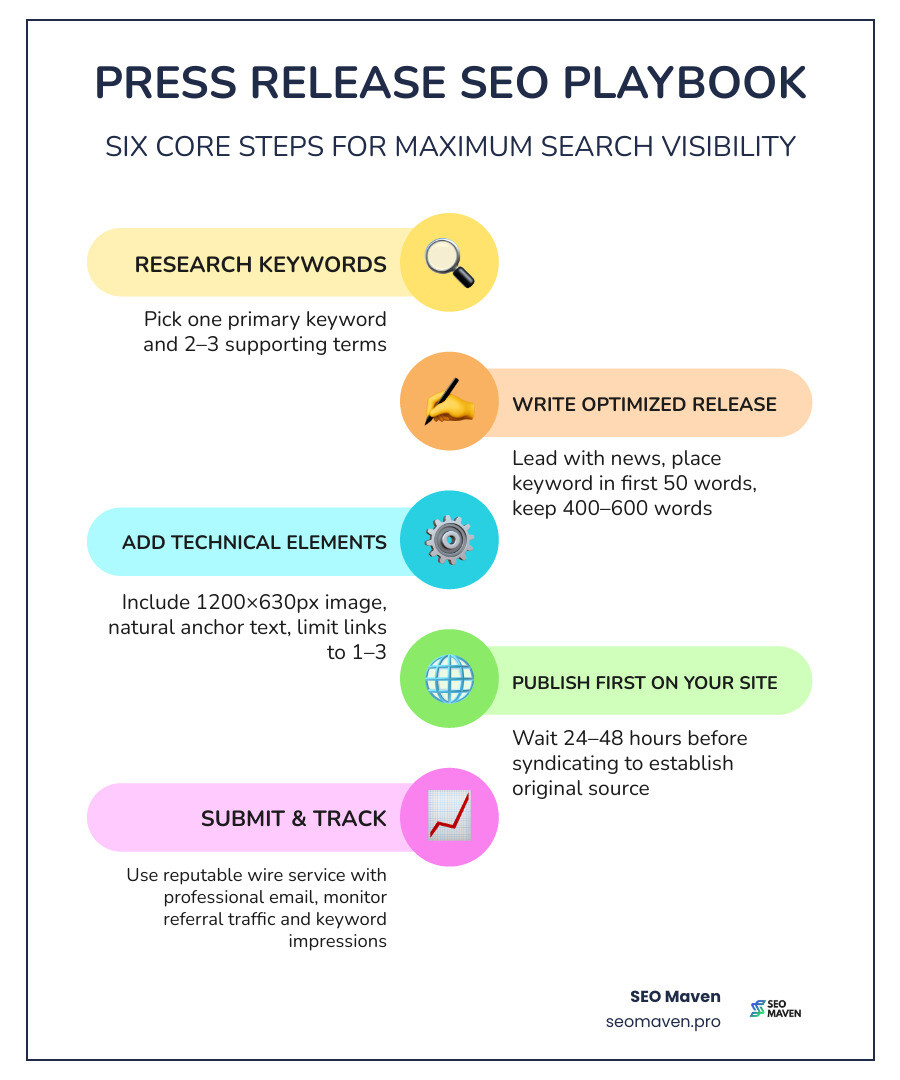
How to do press release submission in SEO comes down to six core steps:
- Research keywords — pick one primary keyword and 2-3 supporting terms
- Write an optimized release — lead with the news, place your keyword in the first 50 words, keep it 400-600 words
- Add technical elements — include a high-quality image (minimum 1200x630px), use natural anchor text, limit links to 1-3
- Publish on your own site first — wait 24-48 hours before syndicating so Google indexes you as the original source
- Submit to a distribution platform — use a reputable wire service with a professional business email (no Gmail)
- Track results — monitor referral traffic in Google Analytics and keyword impressions in Google Search Console
That’s the short version. The rest of this guide walks you through each step in detail so you can do it right.
Here’s something most people get wrong: they think submitting a press release to a wire service automatically boosts their Google rankings. It doesn’t — at least not directly.
Google devalued press release links back in 2013. By 2016, most major wire services had already switched syndicated links to nofollow. So if you’re hoping a $49 distribution package will move your rankings by Monday, you’ll be disappointed.
But press releases still work for SEO in 2026. Just not the way people expect.
The real value is indirect. A well-written, well-distributed press release:
- Gets picked up by journalists who write original stories with real editorial backlinks
- Creates citation density around your brand name, which helps Google’s Knowledge Graph recognize your business as a legitimate entity
- Feeds into AI search platforms like Perplexity, Gemini, and ChatGPT, building your visibility in answer-based search results
- Drives 100-500 referral visits within the first 30 days on average
Think of it less as a link-building tactic and more as a brand authority signal — one that compounds over time when you do it consistently.
I’m Fernando Larez, a marketing professional and digital strategist with hands-on experience in SEO, PR distribution, and brand development across multiple industries — including helping South Florida businesses understand how to do press release submission in SEO in a way that actually moves the needle. In this guide, I’ll walk you through the exact process, from keyword research to technical setup to measuring results.
How to do press release submission in seo word list:
Understanding Press Release Submission in SEO
To understand how press release submission works in modern SEO, we have to look past the old-school mentality of buying links. Ten years ago, SEO agencies would blast a low-quality, keyword-stuffed press release to thousands of obscure websites, instantly generating thousands of “dofollow” backlinks. It was spammy, it was easy, and Google hated it.
In 2026, Google’s search algorithms and AI-driven systems are incredibly sophisticated. When you submit a press release today, the distribution process syndicates your announcement across a network of news sites, financial portals, and regional publications. However, almost all of these syndicated links are tagged as rel="nofollow" or rel="sponsored". This means they do not pass direct PageRank (link juice) to your website.
So, how does this actually help your search rankings?
The modern value of press release submission lies in brand entity building, citation density, and Answer Engine Optimization (AEO).
When your press release is syndicated across hundreds of trusted media outlets, search engine crawlers index these pages and notice the consistent co-occurrence of your brand name, physical address, and target industry keywords. This “paper trail” of highly authoritative citations feeds directly into Google’s Knowledge Graph. It helps search engines verify your business as a real-world entity, which is a massive trust signal for E-E-A-T (Experience, Expertise, Authoritativeness, and Trustworthiness).
Furthermore, in the era of AI search, tools like ChatGPT, Claude, and Google Gemini rely on structured, factual public announcements to train their models and answer user queries. Having your official news syndicated across reputable channels ensures these AI search engines recognize your brand and cite your business as a trusted source.
For a deeper dive into how this benefits your overall search campaign, explore the ultimate guide to press release seo benefits and learn how to construct a forward-thinking Press Release SEO: The Real Playbook for 2026 | IP .
Traditional PR vs. SEO-Optimized Press Releases
While both traditional PR and SEO-focused press releases share the goal of spreading news, their structures, targets, and optimization techniques differ significantly.
Traditional PR is written exclusively for human journalists. Its main goal is to secure media pickup in major newspapers, magazines, or television networks. The language is often highly creative, sometimes focusing on high-level brand messaging rather than specific search queries.
An SEO-optimized press release, on the other hand, targets a dual audience: journalists and search engine algorithms. While it must remain highly newsworthy and professional, it strategically integrates target keywords, optimized headings, structured metadata, and clean URL redirects.
| Feature | Traditional Press Release | SEO-Optimized Press Release |
|---|---|---|
| Primary Audience | Journalists and editors | Journalists, search engine crawlers, and AI models |
| Structure | Standard inverted pyramid | Inverted pyramid with keyword-optimized headings, schema, and clean links |
| Keywords | Natural, unoptimized | Strategically placed primary and long-tail keywords |
| Links | Bare URLs or print-friendly text | 1-3 strategic links with natural, non-manipulative anchor text |
| Media Elements | Physical press kits or email attachments | Optimized digital images with alt text and embedded video links |
To make sure you get the structural fundamentals right, check out our beginners guide to seo press releases to build a solid foundation before diving into advanced syndication.
Do Press Releases Still Help SEO in 2026?
The short answer is yes, absolutely. But let’s be entirely transparent: the direct link-building value of a press release is gone. If an agency promises that submitting a single press release will give you 500 powerful “dofollow” links that skyrocket your search rankings, they are selling you an outdated, useless model.
In 2026, the real SEO power of press releases comes from co-occurrence and earned media.
Co-occurrence refers to search engines identifying your brand name in close proximity to your industry’s core keywords across multiple authoritative domains. When Google sees your business name mentioned alongside terms like “local SEO consulting” or “boutique digital marketing” on dozens of high-authority news platforms, it strengthens the association between your brand and those services.
Additionally, the primary goal of any SEO press release should be to act as a catalyst for genuine editorial coverage. If a journalist at a major publication finds your release on a wire service and decides to write an original, in-depth article about your business, that article will likely contain a natural, editorially placed dofollow link. Those are the highly coveted links that directly move organic search rankings.
How to Do Press Release Submission in SEO: The Modern Playbook
Now that we understand the strategic landscape, let’s look at the actual step-by-step execution. To get the absolute most out of your campaigns, you must follow a modern, technically sound playbook that balances editorial quality with technical optimization.
For a complete breakdown of technical execution, including schema integration, read through the authoritative Press Release SEO (2026): Schema, Google News & Distribution Guide .
Step 1: Keyword Research and On-Page Optimization for How to Do Press Release Submission in SEO
Before writing a single word, you need to identify the search terms your press release will target. Avoid highly competitive, broad terms. Instead, focus on long-tail keywords and branded search queries.
For example, if we are launching a new service in South Florida, targeting “SEO services” is incredibly difficult and highly inefficient for a press release. Instead, we would target a long-tail query like “boutique SEO consulting in Fort Lauderdale” or “Miami FL local search marketing launch.”
Once you have your keywords, structure your content using these on-page optimization rules:
- The Headline: Keep it under 70 characters (ideally 60-80 characters for maximum search visibility). It must include your primary keyword and your brand name. Avoid generic titles like “Company Announces New Service.” Instead, use something specific and action-oriented: “[Your Brand] Launches Advanced Local Search Consulting for Miami Small Businesses.”
- The Lead Paragraph: Place your primary keyword within the first 50 words. The first two sentences must answer the core “5 Ws” (Who, What, Where, When, and Why) within the first 60 words. Cut out the fluff and start with the actual news.
- The Body Copy: Keep the entire release between 400 and 600 words. Use H2 and H3 subheadings to naturally organize your secondary keywords. Write at a clear, accessible reading level (Grade 8-10) with short, punchy paragraphs of 2-3 sentences.
- The Boilerplate: This is your “About Us” section at the end of the release. Keep it between 75 and 100 words. It should include your consistent Name, Address, and Phone (NAP) details to build local SEO trust, along with a link back to your homepage.
For a step-by-step writing guide, check out how to write seo press release the right way and perfect your formatting within a month by reading how to master press release format in 30 days.
Step 2: Selecting the Best Distribution Channels for How to Do Press Release Submission in SEO
Choosing where and how to distribute your press release is just as critical as writing it. You have two primary paths: premium paid wire services and free submission sites.
Premium wire services offer wide syndication across major national and regional news outlets. They boast incredibly fast indexation latencies (often 2 to 8 hours) and put your release directly in front of real journalists. On the other hand, free press release sites can be a great starting point for small businesses on a tight budget, though they often have slower indexation times (8 to 24 hours) and stricter submission rules.
If you are exploring budget-friendly options, take a look at our curated list of 5 of the best websites for free press release sites.
Regardless of the platform you choose, you must adhere to strict administrative and anti-spam guidelines to ensure your release is accepted:
- Use a Professional Business Email: Reputable distribution sites will immediately reject submissions sent from free email providers like Gmail or Yahoo. To prevent spam, you must use an email address tied to your professional business domain (e.g.,
yourname@yourbusiness.com). - Abide by Link Limits: Most reputable platforms restrict you to a maximum of 3 to 5 in-text backlinks. Placing too many links will trigger spam filters and lead to your release being rejected or deleted. Never place links in the headline or the archive title.
- Minimum Character Counts: Many quality directories enforce a minimum length of 1,700 characters (roughly 300-350 words) to ensure the content has enough depth to be genuinely newsworthy.
- Avoid Automated Submission Software: Using automated tools to blast your release to hundreds of free directories will result in your content being flagged as duplicate spam and permanently removed. Always submit manually or use trusted, verified distribution partners.
Step 3: Technical Setup, Schema Markup, and Google News Indexing
To squeeze every drop of SEO value from your press release, you must handle the technical setup like a seasoned professional.
The first technical hurdle is the canonical dilemma. When your press release is syndicated across hundreds of different news websites, search engines might struggle to identify which version is the original. If Google indexes a syndicated copy on a high-authority news site before it indexes your own site, that third-party site gets all the credit.
To solve this, always publish the press release in your website’s newsroom first. Ensure your page uses a clean, keyword-rich URL slug (e.g., seomaven.pro/news/local-seo-launch-miami). Wait 24 to 48 hours to allow search crawlers to index your page as the original source, and then submit the release to your chosen wire service.
Next, implement NewsArticle schema markup on your self-published release. This structured data tells search engines exactly what the content is, who wrote it, when it was published, and which brand it represents. This drastically increases your chances of appearing in rich snippets and AI-generated search results.
Finally, if you want your press release to index in Google News, you must pay close attention to image requirements. Most major distribution platforms will completely exclude your release from Google News if it does not contain an optimized, high-quality image.
Ensure your submitted image is a minimum of 1200 x 900 pixels (or 1200 x 630 pixels) and under 1 MB in size. Keep the image caption under 130 characters, and make sure you hold the full copyrights to the image to prevent administrative rejection.
For a concrete, real-world layout of how this technical structure looks on the page, study the ins and outs of a press release example.
Measuring the SEO Success of Your Press Release Submission
You can’t improve what you don’t measure. To understand the true return on investment (ROI) of your press release campaigns, you must track specific Key Performance Indicators (KPIs) rather than just looking at the total number of syndicated placements.
To track this accurately, always append UTM parameters to the links inside your press release. This allows you to isolate referral traffic and conversions directly within Google Analytics 4 (GA4).
| KPI | What It Measures | Target Benchmark (Within 30 Days) | How to Track |
|---|---|---|---|
| Referral Traffic | Real users clicking links inside the release | 100 – 500 targeted visits | Google Analytics 4 (via UTMs) |
| Earned Backlinks | Natural dofollow links from journalists who cover the story | 1 – 3 high-authority editorial links | Ahrefs, Semrush, or Google Search Console |
| Media Pickups | The number of unique outlets syndicating your news | 3 – 10 high-quality editorial pickups | Distribution platform reports |
| Organic Impressions | Visibility of your brand name and long-tail keywords in SERPs | Upward trend in branded search volume | Google Search Console |
Frequently Asked Questions about Press Release SEO
Should press release links be nofollow or dofollow?
They should almost always be nofollow or sponsored. Google’s Link Schemes Guidelines explicitly state that links within syndicated content, including press releases, must use the rel="nofollow" or rel="sponsored" attributes. Trying to pass direct PageRank through syndicated press releases is a direct violation of Google’s guidelines and can result in manual penalties. Focus instead on using natural, brand-focused anchor text to earn traffic and genuine editorial links.
What are the most common press release SEO mistakes to avoid?
The most common mistakes that can kill your rankings and trigger Google penalties include:
- Keyword Stuffing: Forcing exact-match keywords into your headline, subheadings, and body copy. This makes the release unreadable for journalists and signals spam to search engines.
- Manipulative Anchor Text: Using commercial anchor text like “best cheap SEO” or “buy organic traffic” instead of natural brand names or naked URLs.
- Linking Only to Your Homepage: Always link to dedicated, highly relevant landing pages or service pages instead of pointing every single link to your homepage.
- Using Free Email Addresses: Submitting releases with a Gmail or Yahoo address, which leads to immediate rejection on reputable platforms.
How many press releases should a business submit per month?
For most small to medium-sized businesses, submitting one to two press releases per month is the sweet spot. Consistency matters far more than raw volume. You should only submit a release when you have genuine, high-quality news to share — such as a product launch, a significant milestone, a new executive hire, or original industry research. Blasting low-quality, non-newsworthy releases will damage your brand reputation and dilute your search authority.
Conclusion
Mastering how to do press release submission in SEO is no longer about finding quick ranking shortcuts. In 2026, it is about building a rock-solid foundation of brand authority, establishing clear entity trust in Google’s Knowledge Graph, and capturing the attention of both human journalists and AI search engines.
By executing a meticulous strategy — from performing focused long-tail keyword research and implementing NewsArticle schema to utilizing professional business emails and managing the canonical indexing window — your business can secure invaluable earned media that drives real, long-term search visibility.
As a boutique digital marketing agency based in South Florida, we specialize in helping small businesses across Miami, Fort Lauderdale, Hollywood, and Aventura maximize their digital ROI. We focus on cutting through the noise to deliver custom SEO and high-impact content strategies that help you achieve more with less.
Ready to take your brand’s authority to the next level? Explore our PR and SEO resources or reach out to our team at SEO Maven today to build a search strategy that delivers real, measurable growth.