Why Most Med Spas Are Invisible on Google (And How to Fix It)
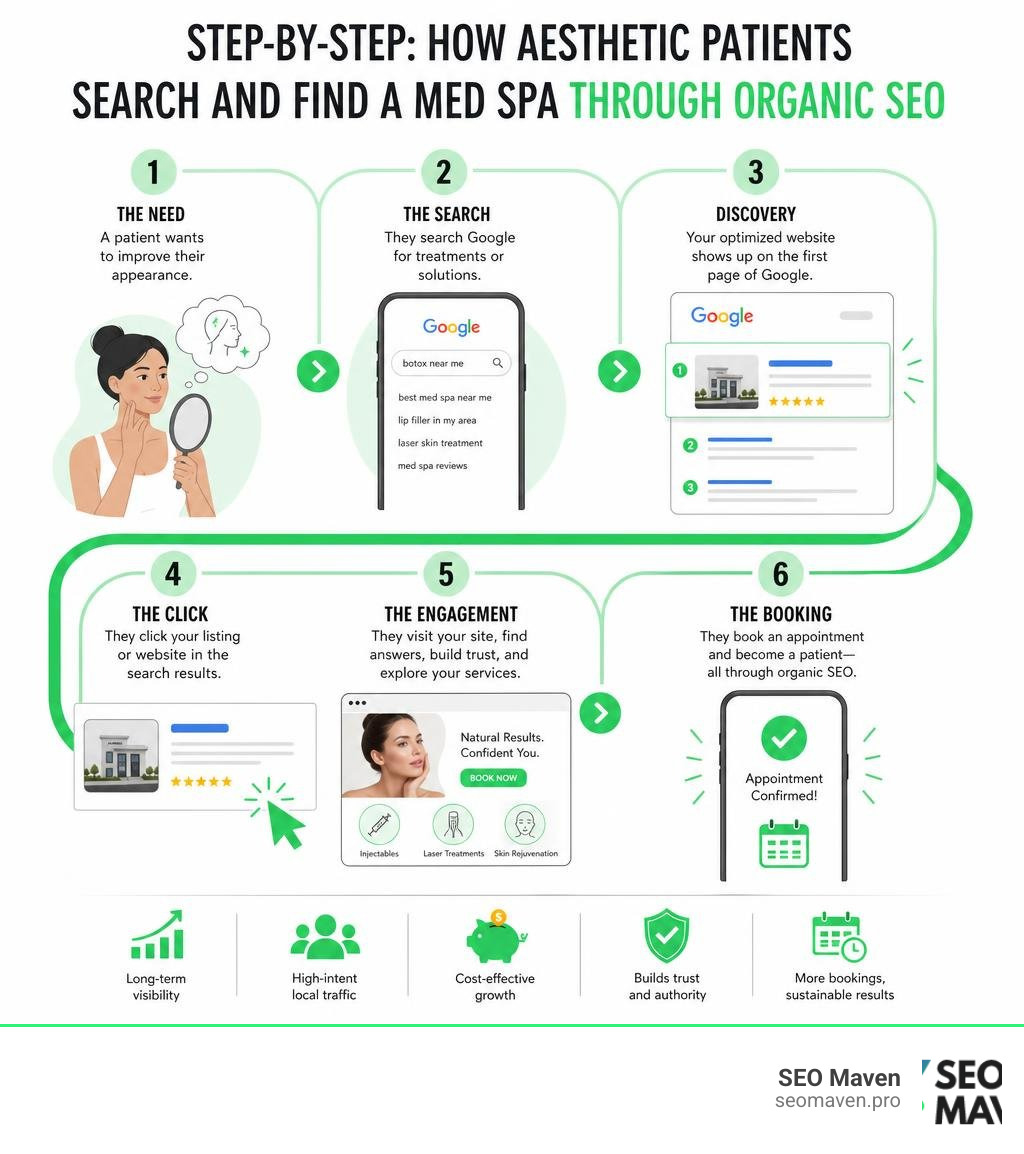
Medical spa SEO organic traffic is the single most cost-effective way to fill your appointment calendar — and most med spas are leaving it almost entirely on the table.
Here is what you need to know right now:
- 89% of patients start their search for aesthetic treatments online
- The top 3 Google results capture 75% of all clicks
- Organic search generates 40-60% of total website visits for established med spas
- Results typically begin within 2-3 months, with significant lead growth by 4-6 months
- The med spa industry grew from 8,899 to 10,488 locations between 2022 and 2023 — competition is rising fast
The challenge is real. With thousands of med spas competing for the same local patients, showing up on page one of Google is no longer optional. Paid ads can fill gaps, but they stop the moment your budget does. Organic traffic compounds over time — the same SEO investment that brings 1,200 clicks in Year 1 can bring 12,000 clicks by Year 3.
This guide breaks down exactly how to build that organic growth engine for your med spa — from Google Business Profile basics to advanced multi-location tactics.
I’m Fernando Larez, a marketing professional and digital strategist with hands-on experience driving SEO and lead generation results across competitive service industries, including medical spa SEO organic traffic strategy. My work combines data-driven SEO with creative execution to help businesses like yours get found by the right patients at the right moment.
Medical spa seo organic traffic terms to learn:
Why Medical Spa SEO Organic Traffic is Your Most Valuable Asset
In a highly visual and trust-driven industry like medical aesthetics, how you acquire patients determines your long-term profitability. Many clinic owners in South Florida—from Aventura FL down to Miami FL—fall into the trap of relying solely on paid social media or pay-per-click (PPC) ads. While paid channels can spark immediate inquiries, they come with a major catch: they require continuous funding. The moment you pause your ad budget, your lead stream evaporates.
In contrast, focusing on medical spa SEO organic traffic builds an appreciating digital asset. When your website ranks at the top of organic search results for high-intent terms like “Botox Fort Lauderdale” or “coolsculpting Hollywood FL,” you secure a continuous stream of pre-qualified patients without paying for every single click.
Aesthetic treatments are elective, high-consideration purchases. The average patient does not book on a whim; they research, compare, and evaluate. Their decision-making window often spans two to eight weeks. Organic search perfectly aligns with this behavior because it captures patients at every stage of their educational journey. By defining clear objectives through The Ultimate Guide to Medical Spa SEO Goals, you can align your digital presence to meet these searching patients exactly when they are ready to make a decision.
Maximizing Medical Spa SEO Organic Traffic for Long-Term Growth
To truly understand the value of organic search, let’s look at the compounding return on investment (ROI) compared to paid advertising over a multi-year horizon.
Paid advertising costs are punishing and continue to climb. In the aesthetic space, competitive keywords can carry incredibly high costs-per-click (CPC). If you rely entirely on paid ads, your customer acquisition cost (CAC) remains high and static.
With a dedicated focus on organic SEO, the math shifts in your favor. Your upfront investment goes toward building high-quality content, optimizing your technical foundation, and boosting your local authority. As your rankings climb, your traffic grows exponentially while your monthly marketing investment remains stable, causing your cost-per-booking to drop dramatically over time.
| Metric | Google Ads (PPC) | Organic SEO (Compounding) |
|---|---|---|
| Traffic Longevity | Stops immediately when budget ends | Continues to grow and persist over time |
| Cost Structure | Pay-per-click (costs rise with competition) | Consistent retainer/investment with declining cost-per-lead |
| Average Click Share | Captures roughly 10-15% of search clicks | Top 3 organic spots capture 75% of clicks |
| Patient Trust Level | Moderate (clearly marked as sponsored) | High (organic rankings imply authority and trust) |
| Year 3 Performance | Same cost for the same amount of traffic | Exponentially more traffic for the same investment |
Navigating YMYL and Medical-Specific Search Constraints
Medical spa SEO is fundamentally different from standard local business SEO because it operates under Google’s “Your Money or Your Life” (YMYL) guidelines. Because aesthetic procedures involve medical-grade devices, injectables, and wellness treatments, search engines apply incredibly strict standards to your content’s accuracy, safety, and scientific backing.
To rank in this space, your website must project strong E-E-A-T (Experience, Expertise, Authoritativeness, and Trustworthiness) signals:
- Credentialed Authorship: Your treatment pages and educational blog posts should be written by, or medically reviewed by, a credentialed healthcare professional.
- The Medical Director Entity: Google and modern AI search engines don’t just look at websites; they look at real-world entities. You must build out a dedicated biography page for your Medical Director and lead injectors. This page should detail their medical education, board certifications, licensing, and professional achievements.
- Scientific Accuracy: Avoid making sweeping, unbacked claims about results. Cite clinical studies where appropriate and clearly outline potential risks, candidacy requirements, and realistic expectations for every treatment.
- HIPAA and FDA Compliance: Beyond search algorithms, your digital footprint must comply with patient privacy laws and federal advertising guidelines. This means ensuring your before-and-after galleries have explicit, documented consent forms and that your online reviews do not inadvertently disclose protected health information (PHI).
The Core Pillars of a Medical Spa SEO Organic Traffic Strategy
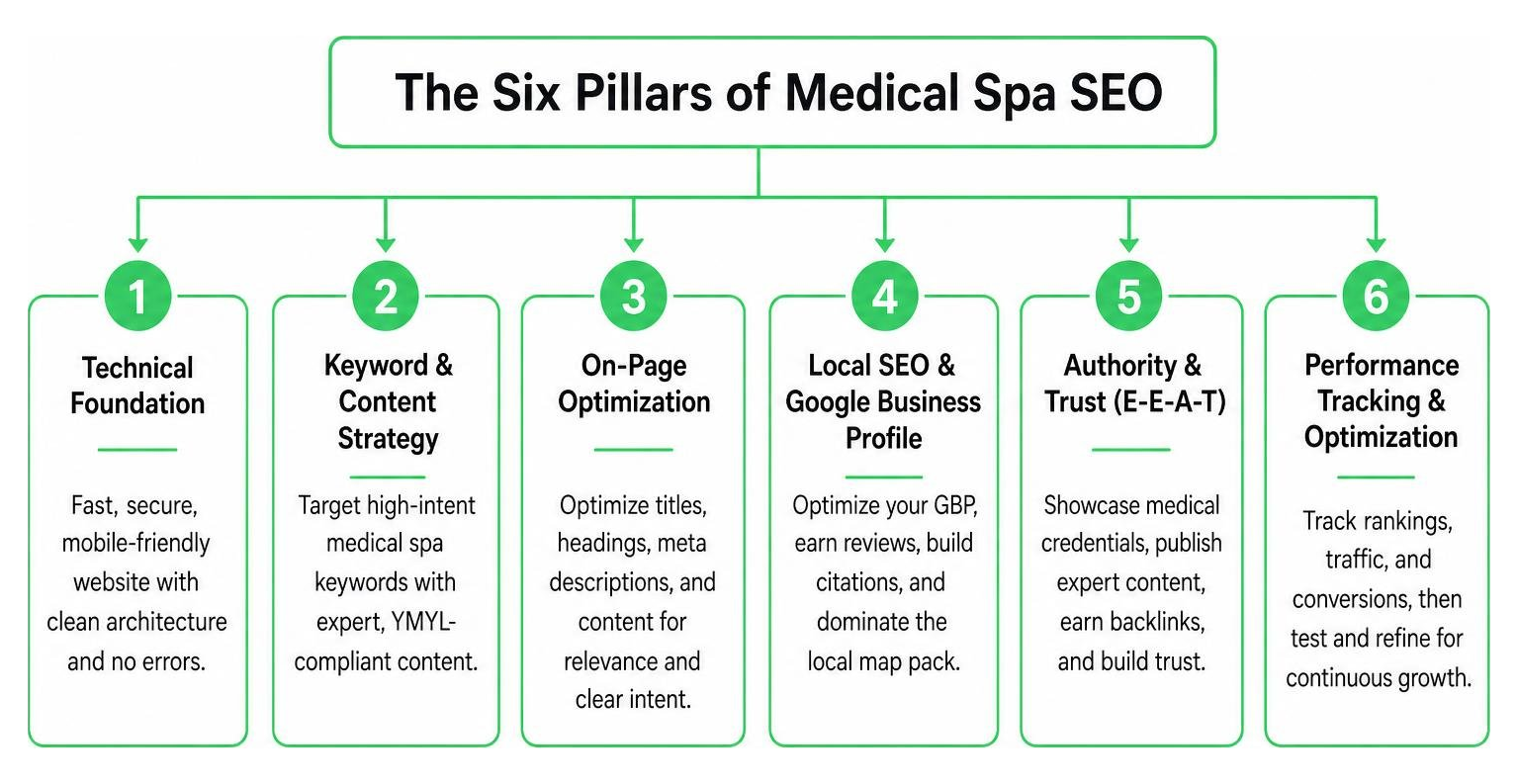
Achieving top rankings requires a cohesive approach. Many clinics make the mistake of focusing on just one element—like getting Google reviews—while ignoring their website’s technical health. To build a robust presence, you must master the core pillars of visibility outlined in The Ultimate Guide to Improving MedSpa Online Visibility.
Google Business Profile and Local Map Pack Dominance
For local businesses, the Google Map Pack (the map and three business listings that appear at the top of local searches) is where the vast majority of bookings begin. In fact, Map Pack visibility drives disproportionately high-intent traffic because users searching “med spa near me” are usually ready to book an appointment.
Optimizing your Google Business Profile (GBP) is the single biggest win for any aesthetic clinic. To optimize your profile for maximum local visibility:
- Select the Correct Primary Category: Your primary category must be “Medical Spa”. Do not choose “Facial Spa” or “Skin Care Clinic” as your primary category if you offer medical-grade treatments like injectables or laser resurfacing. You can add those as secondary categories later.
- Complete Your Service Menu: Do not leave your GBP service menu empty. Populate it with every treatment you offer, complete with clear descriptions and pricing ranges if appropriate.
- Maintain High Review Velocity: Total review count matters, but review velocity (how frequently you receive new reviews) and recency are even more critical. A profile with 300 older reviews but no recent activity will often be outranked by a competitor with 80 reviews who receives 3-5 fresh, authentic reviews every single month.
- Incorporate Keywords in Reviews: Google’s algorithm scans the contextual keywords within your patient reviews. When patients naturally write about their experiences with specific treatments—such as “best lip fillers in Fort Lauderdale” or “amazing Botox results in Miami”—it directly boosts your local rankings for those specific queries.
- Publish Weekly Updates and Photos: Treat your GBP like a social feed. Upload high-resolution, professional photos of your clinic, staff, and before-and-after results monthly. Publish weekly Google Posts highlighting seasonal promotions, educational tips, or new treatment offerings.
For a deeper dive into maximizing your local map presence, consult our specialized guide on Medical Spa SEO: Google Business Profile Optimization.
High-Intent On-Page Optimization and Content Structure
If you want your website to rank for a specific treatment, you must build a dedicated, high-quality page for it. A single, cluttered “Services” page listing ten different treatments with brief descriptions will not rank in competitive markets.
Every core service—whether it is Botox, dermal fillers, laser hair removal, or body contouring—needs its own dedicated landing page structured to satisfy both search engine spiders and prospective patients.
To structure your treatment pages for optimal organic performance, implement the following checklist:
- URL Structure: Keep URLs clean, logical, and keyword-focused (e.g.,
seomaven.pro/treatments/botox-miami/). - Keyword-Led Titles and Headers: Use your primary geo-targeted keyword in your H1 tag and title tag (e.g.,
H1: Botox Treatments in Fort Lauderdale, FL). - Content Depth: Aim for 1,200 to 2,000 words on highly competitive service pages. The content should be comprehensive, covering how the treatment works, ideal candidacy, what to expect during the session, recovery time, and safety disclosures.
- Topic Clustering: Group your content into logical clusters. Write supporting blog posts that answer common pre-treatment questions and link them back to your main treatment landing page. This builds deep topical authority.
- Structured Q&A Blocks: Implement a dedicated FAQ section on each treatment page. Answer real patient questions directly and clearly. This content structure is highly effective for capturing featured snippets and ranking in modern AI-driven search answers.
- Schema Markup: Implement advanced JSON-LD schema markup on your website. Use specific types like
MedicalBusinessorHealthAndBeautyBusinesswith theDaySpasubtype, and include your exact geo-coordinates, business hours, and service menu details.
For an exhaustive technical review of your site’s on-page health, download the Medical Spa SEO: 47-Point Audit Most Aesthetic Sites Miss. If you are looking to align your site structure to win both the local map pack and modern AI answer engines like ChatGPT or Google AI Overviews, explore the strategies outlined in Med Spa SEO: How Clinics Win the Local Pack and AI Answers | Fokal Guides and Med Spa SEO Guide 2026: The Complete Playbook | The Search Sherpa.
Advanced Local SEO Tactics for Multi-Location Med Spas
If your medical spa operates multiple clinics across South Florida—for example, locations in Hollywood FL, Fort Lauderdale FL, Aventura FL, and Miami FL—your SEO strategy must scale to reflect your physical footprint. Multi-location SEO is highly complex; if executed incorrectly, your locations can end up competing against one another in search results.
The foundation of multi-location success lies in NAP consistency (Name, Address, Phone number). Your business information must be byte-identical across your website, your Google Business Profiles, and every third-party local directory. Inconsistent NAP data—such as listing “Suite 101” on one platform and “Ste #101” or omitting it entirely on another—signals poor data quality to search engines, which can suppress your local rankings.
To master geo-targeting and dominate search results across South Florida, read our Step-by-Step Guide to Medical Spa SEO Geo-Targeting.
Scaling Medical Spa SEO Organic Traffic Across Multiple Locations
To successfully scale your medical spa SEO organic traffic across multiple physical clinics, you must avoid the common mistake of using a single, generic “Locations” page. Instead, build a dedicated, highly optimized location page for each physical office.
Every individual location page on your website must feature:
- Unique Localized Content: Do not simply copy-paste the same text and swap out the city names. Write unique descriptions highlighting that specific clinic’s staff, local community involvement, and unique amenities.
- Location-Specific NAP & Embedded Map: Display the exact address, local phone number, and business hours for that specific clinic alongside an embedded Google Map pointing directly to that location’s GBP.
- Local Reviews & Testimonials: Showcase reviews specifically left by patients who visited that particular office.
- Treatment Availability: Clearly list which treatments are available at that location, linking back to your main service pages.
- Localized Schema Markup: Apply unique schema code to each location page, complete with distinct geo-coordinates, phone numbers, and local business identifiers.
Beyond your website, you must audit and clean up your citations across the digital ecosystem. Ensure your clinics are listed accurately on core directories like Yelp, Healthgrades, and RealSelf. For a comprehensive look at how to drive local foot traffic and scale your clinic’s digital presence, refer to SEO for Med Spas: 2026 Local Growth Guide | Cited, Uncover The Best Organic Traffic Strategy For Med Spa SEO, and Med Spa SEO Agency | Top Medical Spa SEO Company.
Measuring Success, Timelines, and Avoiding Costly Mistakes
SEO is a long-term, compounding strategy, not an overnight fix. While you can expect to see early ranking movements and a lift in impressions within the first 2-3 months, significant increases in organic traffic, phone calls, and booked appointments typically take 4-6 months of consistent optimization. In highly competitive metro areas like Miami or Fort Lauderdale, achieving stable Map Pack dominance for your most valuable keywords can take 6-12 months.
To understand how professional optimization accelerates this timeline and drives measurable revenue, read How an SEO Agency Can Help You Rank.
When measuring the ROI of your SEO investment, focus on metrics that directly impact your bottom line:
- Organic Sessions: Monitor the growth of non-paid traffic arriving specifically on your treatment and location pages.
- Conversion Rate (Visit-to-Inquiry): Track the percentage of website visitors who fill out a contact form, request a consultation, or initiate a web chat. A healthy conversion rate for organic traffic typically ranges from 2% to 5%.
- Call Tracking: Implement dynamic call tracking to attribute phone calls directly to organic search. This allows you to measure exactly how many phone inquiries are generated by your SEO efforts.
- Customer Lifetime Value (LTV) vs. Acquisition Cost: Aesthetic patients are rarely one-time buyers. A patient who books an initial Botox treatment will often return multiple times a year and eventually explore other high-value services like dermal fillers or skin rejuvenation. Calculate your ROI based on the long-term value of the patients acquired through organic search.
To avoid wasting resources on ineffective strategies, learn How to Pick SEO Packages Small Business Budgets Won’t Hate and steer clear of common mistakes like thin content, missing Google Business Profile optimization, or neglecting your reputation management.
Frequently Asked Questions about Med Spa SEO
How long does it take to see results from medical spa SEO?
Most medical spas begin seeing improved search rankings and early traffic growth within 2 to 3 months of launching a consistent SEO campaign. Significant, revenue-driving growth—including a measurable increase in new patient consultations and phone bookings—typically occurs within 4 to 6 months. Achieving stable, top-three Map Pack rankings in highly competitive metropolitan markets like South Florida can take 6 to 12 months of ongoing optimization.
How do online reviews affect a med spa’s search rankings?
Online reviews are a top-five ranking signal for Google’s local search algorithm. Both the volume and velocity of your reviews directly influence your visibility in the Google Map Pack. Furthermore, Google scans reviews for contextual keywords, meaning that when patients naturally mention specific treatments (e.g., “microneedling” or “lip filler”), it helps your business rank higher for those specific searches. When responding to reviews, always maintain strict HIPAA compliance by never confirming that the reviewer is a patient or disclosing any medical details.
Can a medical spa do SEO in-house or should they hire an agency?
A medical spa can manage basic local SEO tasks in-house—such as updating their Google Business Profile, posting photos, and requesting reviews from satisfied patients—if they have a dedicated team member with 10 to 15 hours of availability per week. However, high-impact technical tasks like schema markup implementation, advanced content clustering, mobile speed optimization, and building authoritative backlinks typically require specialized digital marketing expertise. Partnering with a boutique agency allows you to achieve maximum ROI while keeping your internal team focused on patient care.
Conclusion
Building a consistent flow of medical spa SEO organic traffic is the most reliable way to scale your aesthetic clinic, reduce your reliance on expensive paid ads, and secure long-term profitability. By optimizing your Google Business Profile, creating comprehensive treatment pages, maintaining a steady stream of reviews, and building a strong technical foundation, your med spa can dominate local search results and consistently attract high-intent patients.
At SEO Maven, we specialize in helping small businesses across South Florida—including Miami, Fort Lauderdale, Hollywood, and Aventura—achieve more with less. As a boutique digital marketing agency, we focus on high-ROI search engine optimization and content marketing strategies tailored to your unique goals.
Ready to transform your online presence and fill your booking calendar? Let us help you build an organic growth engine that outranks the competition.
Schedule a Consultation with our Medspa Marketing Specialists today