Why Medical Spa SEO Geo Targeting Is the Key to Filling Your Appointment Calendar
Medical spa SEO geo targeting is the practice of optimizing your online presence so that nearby patients find your clinic — not a competitor — when they search for treatments like Botox, laser hair removal, or body contouring in your city.
Here is a quick answer to what it involves:
| Geo Targeting Element | What It Does |
|---|---|
| Location-specific pages | Ranks your clinic for “[treatment] in [city]” searches |
| Google Business Profile | Gets you into the local Map Pack results |
| Local citations & NAP | Builds trust signals across directories |
| Geo-modified keywords | Targets patients in your exact service area |
| Reviews with local context | Strengthens relevance for neighborhood searches |
The stakes are real. Over 90% of consumers use Google to find local businesses, and 76% of people who run a local search visit a business within 24 hours. Yet most med spas either have no location-specific pages at all, or they use the same generic content across every city they serve.
You can also review Google’s official Business Profile overview to understand how local business information appears across Google Search and Maps.
The result? Missed appointments. Patients who drove right past your clinic — and booked with someone who showed up first on Google.
This guide walks you through every step of building a geo-targeted SEO strategy that attracts local patients and converts searches into bookings.
I’m Fernando Larez, a marketing professional with hands-on experience in SEO, digital strategy, and lead generation across multiple industries, including helping med spas sharpen their medical spa SEO geo targeting to compete in crowded local markets. In the sections ahead, I’ll break down exactly how to structure your pages, optimize your Google Business Profile, and build the local signals that move you up in rankings.
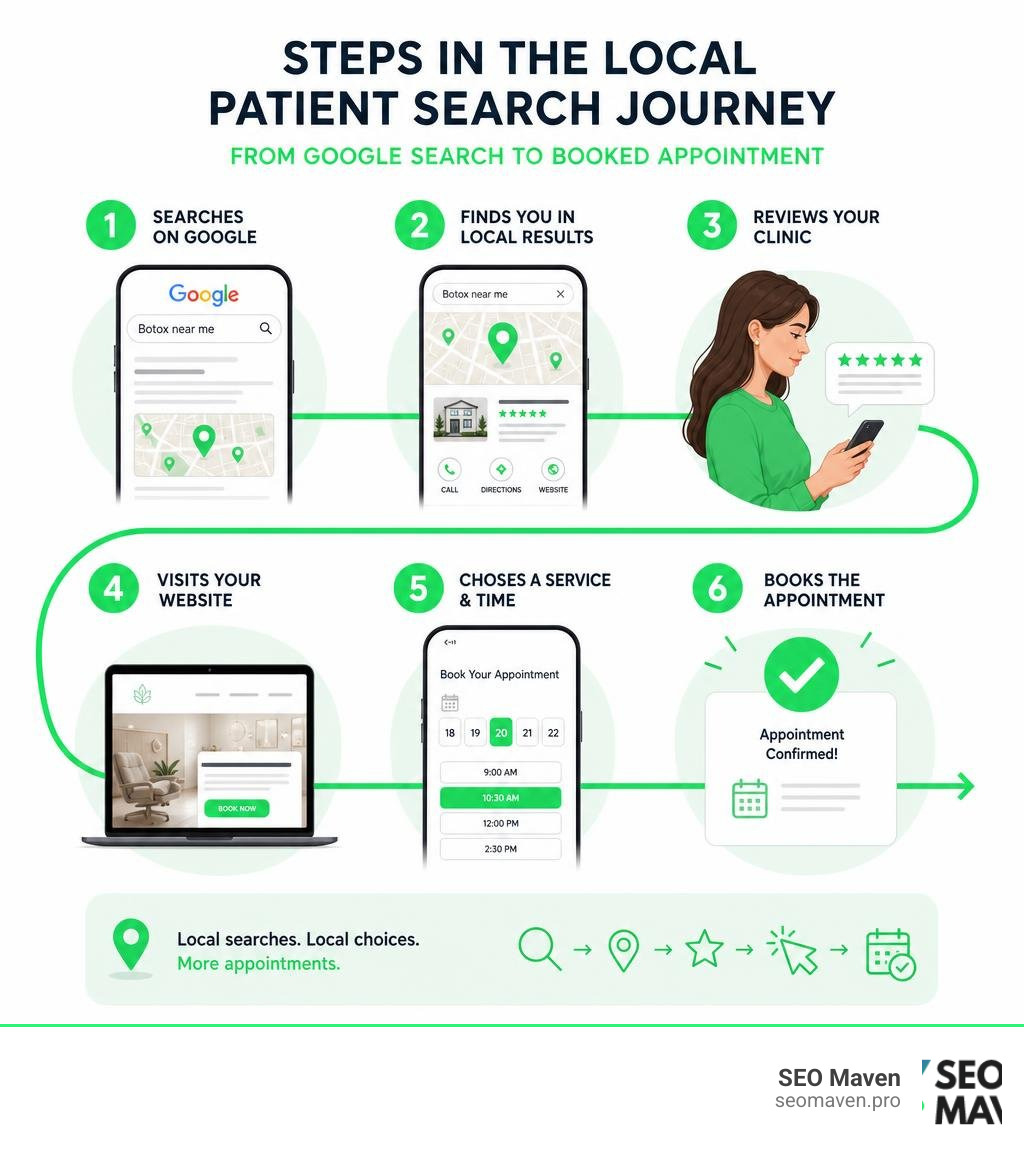
The Core Principles of Medical Spa SEO Geo Targeting
Medical spa SEO geo targeting works because most aesthetic searches are local, urgent, and treatment-specific.
Someone searching “Botox near me” is not casually browsing at 2 a.m. because they love reading about neuromodulators. They are likely comparing providers, checking reviews, and deciding where to book. That is high-intent traffic.
In local SEO, Google is trying to answer three questions:
- Is this business relevant to the search?
- Is this business close enough to the searcher?
- Is this business trusted enough to recommend?
For med spas, that means your website and local profiles need to clearly tell Google:
- What treatments you offer
- Where you offer them
- Who provides them
- Why patients trust you
- How patients can book
This is where geo targeting becomes powerful. Instead of only saying “we offer Botox,” your website should help Google understand that you offer Botox in Miami, dermal fillers in Fort Lauderdale, laser hair removal in Aventura, or body contouring near Hollywood, FL.
That local specificity matters because 72% of consumers conducting local searches visit businesses within a five-mile radius. In other words, your future patient may be only a few streets away, but if your online presence is vague, Google may not connect the dots.
For a deeper foundation, our guide on how to improve online visibility explains how local SEO, content, and website structure work together.
Here are the core principles we use when planning geo-targeted SEO for med spas:
- Match pages to search intent: A “Botox in Miami” page should answer booking-focused questions, not just define Botox.
- Build one strong page per major treatment: One generic services page is rarely enough.
- Localize naturally: Use city and neighborhood references where they help the patient, not as keyword confetti.
- Strengthen your Google Business Profile: Your GBP often drives calls before the patient ever clicks your site.
- Earn reviews consistently: Review volume, rating, recency, and relevance all support local trust.
- Keep NAP consistent: Your name, address, and phone number should match across the web.
- Make booking easy: Rankings are nice, but booked consultations pay the bills.
Think of geo targeting as putting a bright, tasteful sign on every digital road your patients use to find you.
Building a High-Converting Location Page Architecture
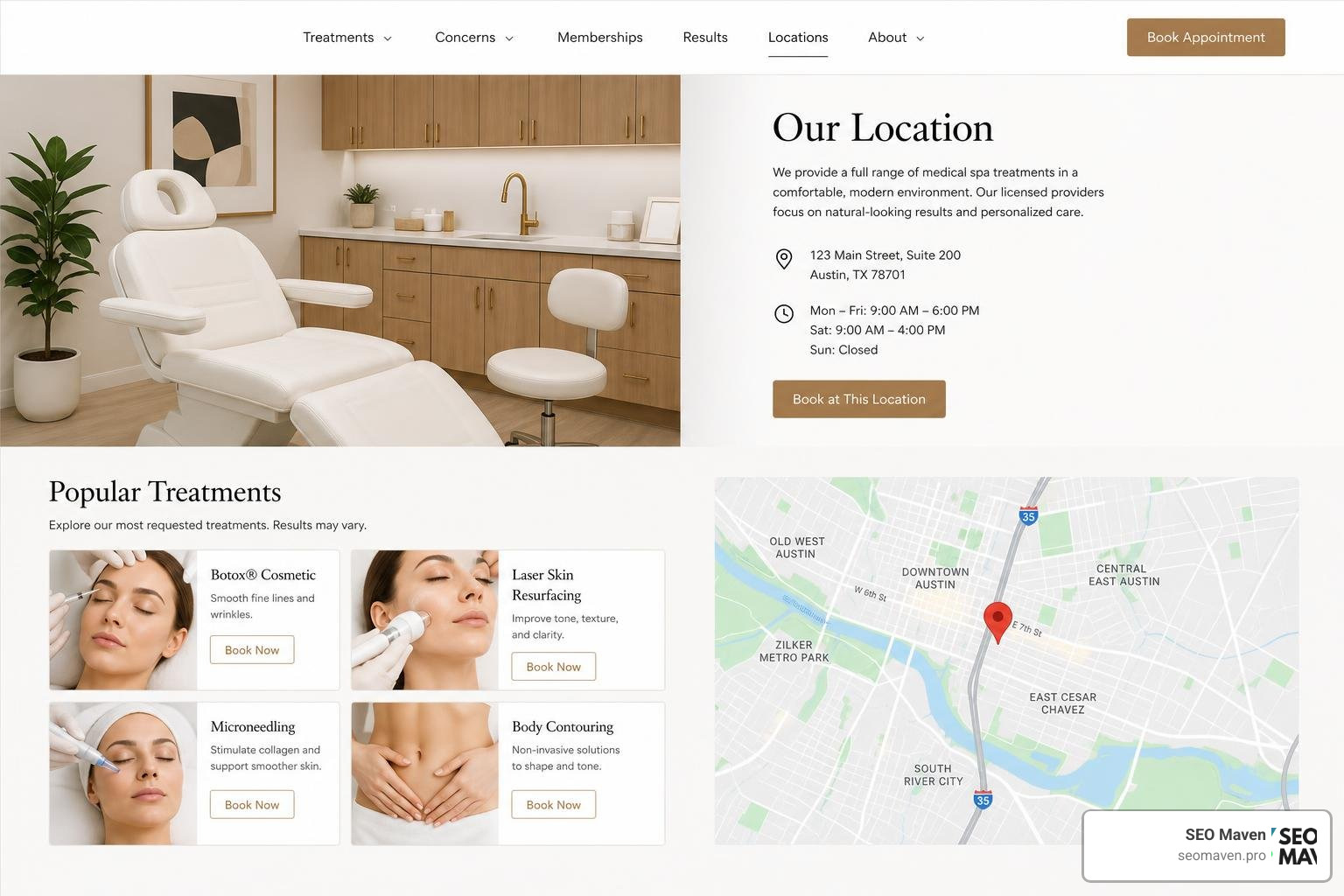
Your website architecture is the backbone of medical spa SEO geo targeting. If Google cannot understand which page should rank for which treatment and city, your pages may compete with each other or fail to rank at all.
A strong structure usually includes:
- A main med spa service page
- Individual treatment pages
- City or location pages
- Treatment plus city pages for high-value services
- Blog and FAQ content that supports the main pages
- Clear internal links between related pages
For example, a South Florida med spa may need pages such as:
/botox//botox-miami//botox-fort-lauderdale//dermal-fillers-aventura//laser-hair-removal-hollywood-fl//locations/miami//locations/fort-lauderdale/
This does not mean every med spa needs hundreds of pages on day one. We usually recommend starting with the highest-value treatments and the most important service areas first. Prove the strategy, then expand.
That is especially important for smaller practices trying to achieve more with less. At SEO Maven, our approach to SEO services is built around ROI, not vanity traffic.
Here is how single-page and multi-location structures compare:
| Website Structure | Best For | SEO Strength | Main Risk |
|---|---|---|---|
| One services page listing all treatments | Very new med spas with limited budget | Simple to manage | Hard to rank for specific treatments |
| One page per treatment | Single-location clinics | Strong treatment relevance | May not capture city-specific searches |
| One page per city | Multi-location or multi-service-area clinics | Strong local relevance | Can become too generic |
| Treatment plus city pages | Competitive med spas targeting high-value searches | Strongest geo-targeting potential | Requires unique, high-quality content |
| Location hubs with treatment links | Multi-location clinics | Best for scale and navigation | Needs careful internal linking |
The key is to avoid thin, copy-paste city pages. A page titled “Botox in Miami” should not be the same as “Botox in Fort Lauderdale” with the city name swapped. Google has become much better at spotting scaled, low-value local pages.
Good location pages should include:
- A clear city-specific H1
- Treatment and city keywords in natural language
- Local driving or neighborhood context
- Provider credentials
- Photos from the actual clinic when possible
- Reviews or testimonials, where compliant and appropriate
- FAQs specific to that service area
- Embedded map or directions
- Prominent booking CTA
- Internal links to relevant treatment pages
Step-by-Step Implementation of Medical Spa SEO Geo Targeting for Service Pages
Now let us get practical.
A treatment page should be built to rank, educate, and convert. If your page only says “we offer Botox, call us today,” it is not doing enough work. Google wants depth, and patients want confidence.
Use this step-by-step process for high-value services like Botox, dermal fillers, laser hair removal, microneedling, body contouring, and skin rejuvenation.
- Choose the primary keyword
Start with the treatment plus location.
Examples:
- Botox in Miami
- Dermal fillers in Fort Lauderdale
- Laser hair removal in Aventura
- Medical spa in Hollywood FL
- Body contouring in South Florida
Then add related variations:
- Botox near me
- Botox clinic near Miami
- Best med spa for fillers in Fort Lauderdale
- Laser hair removal for underarms in Aventura
- How much does Botox cost in Miami
- Optimize the title tag
Your title tag should include the treatment and location, ideally near the beginning.
Good examples:
- Botox in Miami, FL | Natural-Looking Results
- Dermal Fillers in Fort Lauderdale | Med Spa Injectables
- Laser Hair Removal in Aventura | Smooth Skin Treatments
Keep it readable. Keyword stuffing title tags is not a strategy. It is SEO karaoke, and nobody asked for an encore.
- Write a clear H1
Your H1 should match the main intent of the page.
Examples:
- Botox in Miami, FL
- Dermal Fillers in Fort Lauderdale
- Laser Hair Removal in Aventura
Use only one H1 per page in most cases.
- Use H2s and H3s to answer patient questions
Helpful section ideas include:
- What Is Botox?
- Who Is a Good Candidate?
- What to Expect During Treatment
- Botox Results and Timeline
- Why Choose Our Miami Med Spa?
- Frequently Asked Questions
- Book a Consultation
- Add local context naturally
Mention the city in ways that help the reader. For example:
- “Our Miami med spa serves patients from nearby Brickell, Coral Gables, and surrounding South Florida communities.”
- “Our Fort Lauderdale location is convenient for patients searching for injectable treatments near downtown and surrounding neighborhoods.”
Only mention areas you truly serve. Local SEO works best when it reflects reality.
- Include trust-building content
Medical spa pages fall into a health-adjacent category where trust matters. Include:
- Provider credentials
- Safety information
- Realistic expectations
- Treatment contraindications when appropriate
- Before-and-after photo guidance, with proper consent
- Clear disclaimers that results vary
- Easy ways to contact the clinic
- Add FAQs for long-tail searches
FAQs help capture detailed patient searches, especially voice and mobile queries.
Examples:
- How long does Botox last?
- Is laser hair removal safe for all skin types?
- How soon can I wear makeup after fillers?
- How many body contouring sessions will I need?
- Do I need a consultation before treatment?
- Use internal links
Every treatment page should link to:
- Related services
- The relevant location page
- Helpful blog content
- Booking or consultation page
Likewise, blog posts should link back to the treatment page. This builds topical authority and helps Google understand which page should rank.
- Make conversion obvious
Add calls to action such as:
- Book a consultation
- Call our Miami med spa
- Request an appointment
- View available treatments
- Get directions
Do not make patients hunt for your booking button like it is a hidden object game.
Structuring Treatment Hubs for Multi-Location Clinics
For multi-location med spas, treatment hubs and location hubs work together.
A treatment hub focuses on one service across all locations. A location hub focuses on one clinic or service area and links to treatments available there.
Example structure:
/botox//locations/miami//locations/fort-lauderdale//botox-miami//botox-fort-lauderdale/
This structure helps Google understand both the service and the geography.
Essential elements for multi-location hub pages:
- Unique NAP for each location
- Embedded Google Map for that location
- Driving directions and parking details
- Local staff or provider information
- Services offered at that location
- Location-specific photos
- Reviews connected to that clinic
- Nearby neighborhoods served
- Internal links to treatment pages
- LocalBusiness or MedicalBusiness schema
- Clear booking CTA for that location
NAP consistency is especially important. If one listing says “Suite 200” and another says “Ste 2B,” that may seem tiny to a human, but at scale, inconsistent data can weaken local trust signals.
For med spas in South Florida with multiple service areas, location hubs can help capture searches across Miami, Fort Lauderdale, Aventura, Hollywood, and nearby communities while keeping the site organized for patients.
Optimizing Google Business Profile and Local Signals

Your Google Business Profile is one of the most important assets in local med spa SEO.
For many “near me” searches, Google shows the Map Pack above traditional organic results. That means a patient may see your business name, reviews, photos, hours, and call button before they ever visit your website.
To optimize your Google Business Profile:
- Claim and verify your profile
Each legitimate location should have its own verified profile. Do not create fake locations or virtual offices. That can get profiles suspended.
- Choose the right primary category
For most medical spas, “Medical Spa” is the best primary category. Add relevant secondary categories only when they accurately describe your business.
- Complete every field
Fill out:
- Business name
- Address
- Phone number
- Website
- Hours
- Services
- Appointment link
- Business description
- Accessibility details
- Photos
- Q&A
- Add services individually
Do not leave your service menu empty. Add treatments such as Botox, dermal fillers, laser hair removal, microneedling, chemical peels, body contouring, and facials where applicable.
- Upload real photos regularly
Profiles with strong photo activity tend to earn more engagement. Use real images of your exterior, reception area, treatment rooms, staff, and approved treatment visuals.
- Publish updates
Use GBP posts to share seasonal treatments, educational content, events, and availability. Keep it professional and compliant.
- Monitor Q&A
Patients often ask questions directly on your profile. Add helpful, general answers that do not disclose private health information.
- Track calls and direction requests
Use Google Business Profile insights, Google Analytics, and call tracking where appropriate to understand which locations and services generate leads.
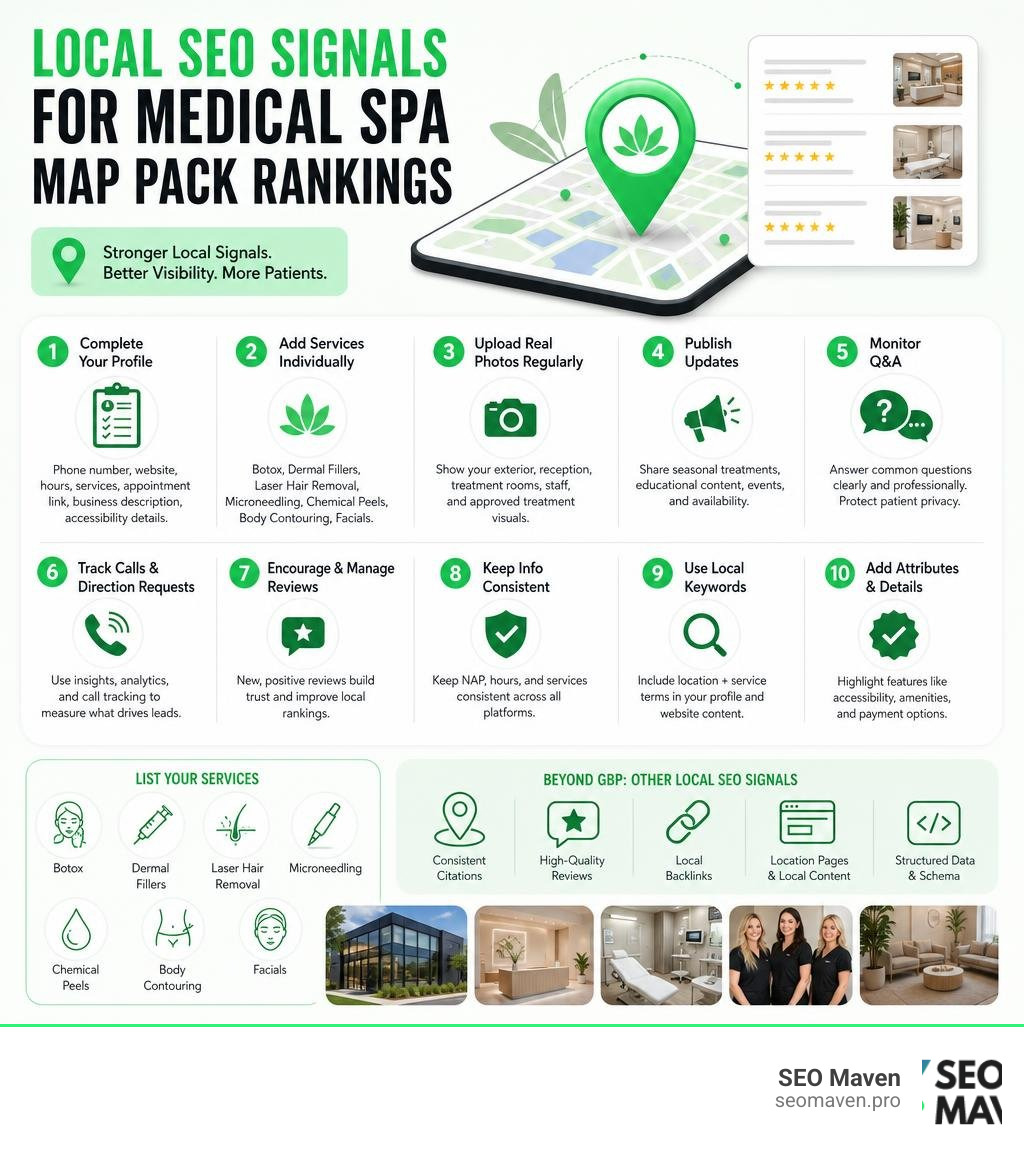
Local signals extend beyond GBP. Citations, reviews, backlinks, website content, and structured data all reinforce your local entity.
If your med spa wants help cleaning up inconsistent listings, our guide to local citation building is a strong next step.
AI search visibility also depends on these signals. As patients increasingly ask AI tools for “best med spa near me” or “where to get Botox in Miami,” those systems look for clear, consistent business data across the web. That is where GEO optimization, meaning generative engine optimization, overlaps with traditional local SEO. Clean local entities, strong reviews, structured content, and reputable mentions make your business easier for both Google and AI systems to understand.
Leveraging Reviews and Citations for Medical Spa SEO Geo Targeting
Reviews matter for rankings and conversions.
Research shows that 80% of patients read reviews before booking an appointment. For med spas, reviews are often the deciding factor between two nearby clinics with similar services.
Google looks at:
- Review quantity
- Review rating
- Review recency
- Review velocity
- Review content
- Owner responses
A steady flow of authentic reviews is better than getting 40 reviews in one week and then silence for six months. Consistency looks natural because it is natural.
Encourage reviews ethically by:
- Asking shortly after a positive appointment
- Sending an SMS or email review request
- Making the process simple
- Training staff to ask at the right moment
- Never offering incentives for positive reviews
- Never writing reviews for patients
If patients naturally mention treatments or locations, that can strengthen relevance. For example, a review that says “I had a great laser hair removal experience at the Aventura location” gives both treatment and location context. Do not script reviews, but you can ask patients to share honest details about their experience.
HIPAA compliance is critical. When responding to reviews:
- Do not confirm someone is a patient
- Do not mention their treatment
- Do not reveal appointment details
- Keep responses general and professional
- Thank them without exposing private information
Safe response example:
“Thank you for your kind feedback. We appreciate you taking the time to share your experience with our team.”
Risky response example:
“We are so glad you loved your Botox results after your Tuesday appointment.”
The second response confirms treatment and appointment details. Avoid that.
Citations are another local signal. These are mentions of your business name, address, and phone number on directories, maps, healthcare platforms, social profiles, and business listings.
For citation consistency:
- Use the exact same business name everywhere
- Match address formatting as closely as possible
- Use one primary local phone number per location
- Keep hours updated
- Remove duplicate listings
- Update listings after moves or rebrands
Our listing management services help businesses keep this information accurate across the web, which is especially helpful for multi-location med spas.
Technical SEO and Schema Markup for Local Authority
Technical SEO is not the glamorous part of med spa marketing. It is more like plumbing. Nobody compliments it when it works, but everyone notices when it breaks.
For geo-targeted medical spa SEO, technical SEO helps Google crawl, understand, and trust your pages.
Focus on these areas:
- Mobile-first design
Most local searches happen on mobile. Your website should load quickly, display cleanly, and make booking easy from a phone.
Check:
- Tap-to-call buttons
- Sticky booking buttons
- Simple navigation
- Readable font sizes
- Fast-loading images
- Short forms
- Page speed and Core Web Vitals
Large before-and-after images can slow down med spa websites. Compress images before uploading them. Use modern image formats where possible and avoid bloated plugins.
Slow pages hurt both rankings and conversions. A patient will not wait forever for your filler gallery to load. Their patience has limits, and so does their Wi-Fi.
- Clean URL structure
Use descriptive URLs:
- Good:
/botox-miami/ - Good:
/laser-hair-removal-aventura/ - Weak:
/service-page-12/ - Weak:
/treatments?id=843
- Schema markup
Structured data helps search engines understand your business and services.
Useful schema types may include:
- LocalBusiness
- MedicalBusiness
- Service
- FAQPage
- Review or AggregateRating, when compliant and accurate
- BreadcrumbList
- Organization
Schema should reflect real information on the page. Do not mark up fake reviews, exaggerated claims, or services you do not offer.
- Indexation control
Make sure important treatment and location pages are indexable. Avoid accidentally blocking them with robots.txt, noindex tags, or canonical tags pointing elsewhere.
- Avoid keyword cannibalization
If you have three pages all targeting “Botox Miami,” Google may not know which one to rank. Consolidate overlapping pages or clarify their purpose.
A clean structure might be:
- One main Botox Miami page
- Supporting blog posts about Botox questions
- Internal links from blogs to the main Botox Miami page
On-page SEO and local SEO work together, but they are not the same.
On-page SEO includes:
- Title tags
- Headings
- Body content
- Internal links
- Image alt text
- FAQs
- Schema
- Page structure
Local SEO includes:
- Google Business Profile
- Reviews
- Citations
- Map visibility
- NAP consistency
- Local backlinks
- Proximity and service area signals
For multiple med spa locations, you need both. On-page SEO tells Google what each page is about. Local SEO proves that the business is real, trusted, and relevant in that area.
Frequently Asked Questions About Med Spa Geo-Targeting
How long does it take to see results from geo-targeted SEO?
Most med spas should expect early ranking movement within a few weeks to a few months, but measurable results typically take three to six months.
A realistic timeline looks like this:
| Time Period | What Usually Happens |
|---|---|
| Month 1 | Research, technical fixes, GBP optimization, page planning |
| Months 2-3 | New pages indexed, early ranking movement, citation cleanup |
| Months 3-6 | More impressions, better local rankings, increased calls and leads |
| Months 6-12 | Stronger authority, better rankings for competitive treatments |
| 12+ months | Compounding results from content, reviews, links, and local trust |
Competitive markets like Miami and Fort Lauderdale may take longer than smaller areas because more clinics are fighting for the same top positions.
The fastest wins usually come from:
- Fully optimizing Google Business Profile
- Fixing major technical issues
- Building pages for underserved treatments
- Improving review velocity
- Cleaning up inconsistent citations
- Adding clear booking CTAs
SEO is not instant. But unlike paid ads, strong organic visibility can continue producing leads long after the first optimization push.
Will duplicate content on city pages penalize my website?
Duplicate content on city pages usually does not cause a dramatic “penalty” in the scary SEO myth sense. But thin, repetitive city pages can absolutely fail to rank.
Google wants useful, unique pages. If your Miami, Aventura, Hollywood, and Fort Lauderdale pages are identical except for the city name, they are not giving patients a reason to trust them.
To avoid low-value city pages, add:
- Unique introductions
- Location-specific service details
- Local driving directions
- Actual provider or staff information
- Photos from that location
- City-specific FAQs
- Unique reviews or patient themes
- Nearby neighborhoods served
- Local internal links
- Distinct calls to action
Do not use “find and replace” local SEO. It is easy, but easy is not always effective. In 2026, Google is better at identifying scaled content that exists only to manipulate rankings.
A strong city page should feel like it was written for a real patient in that area.
How do I manage local SEO for multiple med spa locations?
Multi-location med spa SEO requires structure, consistency, and patience.
Here is the process we recommend:
- Create a separate Google Business Profile for each real location
Each profile should have its own address, phone number if possible, hours, photos, services, and appointment link.
- Build a unique location page for each clinic
Each page should include:
- Location name
- Full NAP
- Embedded map
- Hours
- Services offered
- Local photos
- Staff or provider details
- Parking or access information
- Reviews or reputation signals
- Internal links to treatment pages
- Build treatment pages for major services
If Botox, fillers, and laser hair removal are major revenue drivers, each should have its own optimized treatment page.
- Add treatment plus city pages where competition justifies it
For high-value services in competitive areas, build pages such as:
- Botox in Miami
- Dermal fillers in Fort Lauderdale
- Laser hair removal in Aventura
- Med spa services in Hollywood FL
- Keep NAP consistent
Audit directories regularly. Inconsistent listings can confuse search engines and patients.
- Link everything logically
Your Miami location page should link to Miami treatment pages. Your Botox page should link to relevant city pages. Blog posts should support the main treatment pages.
- Track performance by location
Use:
- Google Search Console
- Google Analytics 4
- Google Business Profile insights
- Call tracking
- Form tracking
- Appointment source reporting
This helps you see which locations are growing and where more SEO work is needed.
Conclusion
Medical spa SEO geo targeting is not about stuffing city names into pages and hoping Google claps. It is about building a clear, trustworthy local search presence that connects nearby patients with the treatments they are already looking for.
To recap, the strongest strategy includes:
- Location-specific pages for your real service areas
- Dedicated treatment pages for your most valuable services
- City plus treatment pages for competitive searches
- A fully optimized Google Business Profile
- Consistent reviews and HIPAA-safe responses
- Accurate citations and NAP consistency
- Mobile-friendly design and fast-loading pages
- Schema markup that clarifies your local authority
- Helpful FAQs, blogs, and long-tail content
- Internal links that guide both users and search engines
For med spas in South Florida, including Miami, Fort Lauderdale, Aventura, and Hollywood, local competition is serious. But that also means the opportunity is serious. Patients are searching every day for treatments near them. The question is whether your clinic shows up when they are ready to book.
At SEO Maven, we help small businesses achieve more with less through focused SEO, content marketing, web design, consulting, and digital strategies built for maximum ROI. If your med spa needs a boutique partner that understands local visibility and patient acquisition, explore our medspa marketing agency services and let us help you turn local searches into booked appointments.