Why Learning How to Write SEO Press Release Content Is a Game-Changer for Small Businesses
Knowing how to write an SEO press release the right way can be the difference between a story no one reads and one that ranks on Google, gets cited by AI tools, and drives real traffic to your website.
Here is a quick answer if you need it fast:
How to Write an SEO Press Release — Quick Steps:
- Research one primary keyword and two to three supporting terms using tools like Ahrefs or Semrush
- Write a headline under 70 characters that includes your focus keyword and a specific number or action verb
- Lead with the most important facts — answer who, what, when, where, and why in the first 75 words
- Place your keyword naturally in the headline, first paragraph, one subheading, and the meta description
- Add one to two links to relevant landing pages — not your homepage
- Include at least one image with keyword-rich alt text
- Write a 75–100 word boilerplate with your brand name, industry descriptor, and contact info
- Distribute through your owned newsroom first, then a newswire service
- Track results in Google Analytics and Google Search Console
Simple. But most businesses skip half of these steps — and wonder why their press releases go nowhere.
Here is the reality: over 10,000 press releases are sent every single day, and more than 95% of pitches are turned down. A press release without SEO optimization is mostly invisible. But a well-structured, keyword-optimized release can earn media coverage, build brand authority, and even get cited by AI tools like Google’s AI Overviews, Perplexity, and ChatGPT.
This guide walks you through every step — from keyword research to distribution — so your press releases actually work.
I’m Fernando Larez, a marketing professional and business leader with hands-on experience in SEO, PR, and digital strategy across multiple industries — including helping brands master how to write an SEO press release that gets real results. In this guide, I’ll share the exact framework we use to help small businesses in South Florida turn press releases into traffic-driving, authority-building assets.
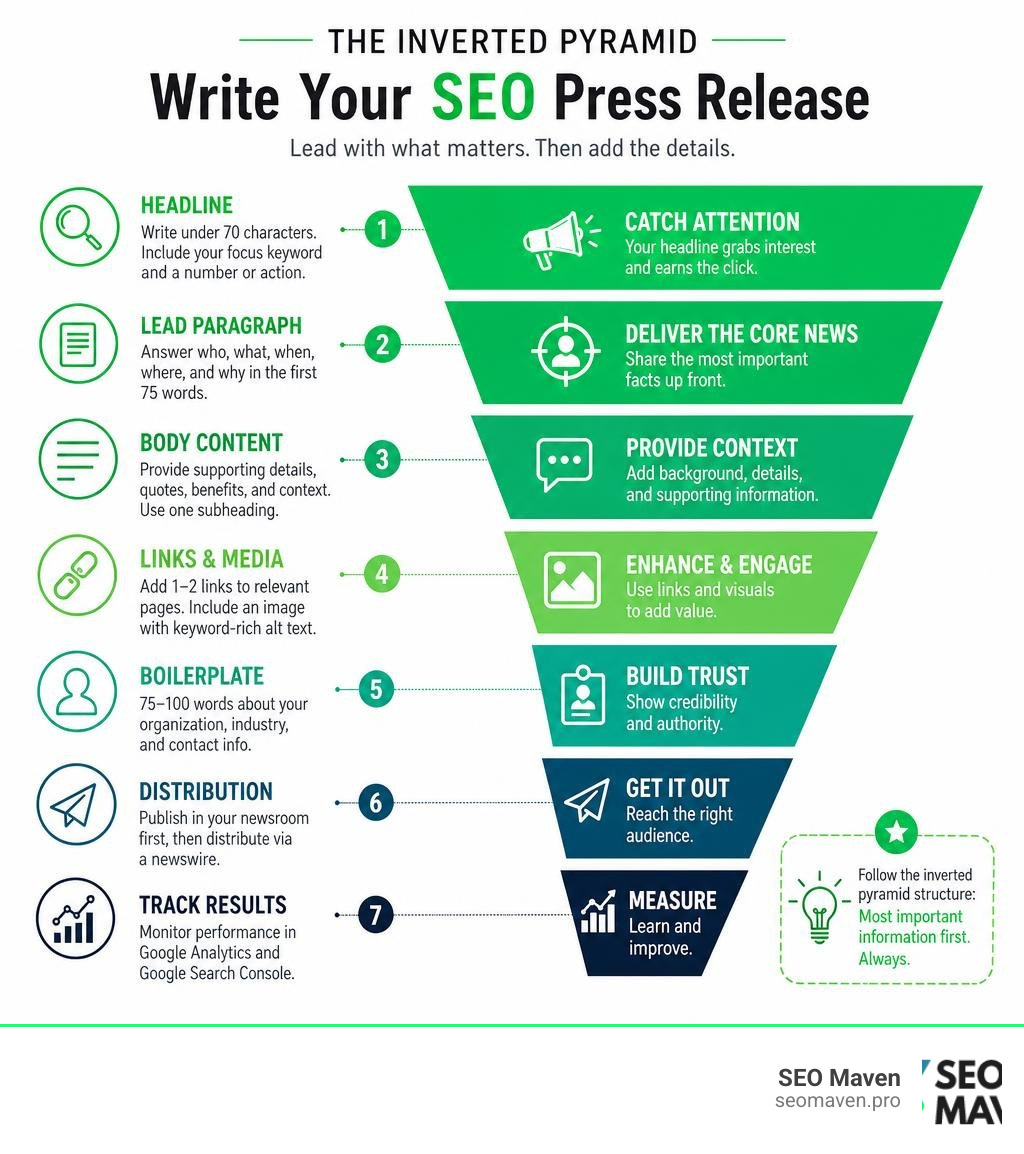
How to write seo press release terms at a glance:
What is Press Release SEO and Why It Matters in 2026
In July 2026, the digital PR landscape looks entirely different than it did even a couple of years ago. Press release SEO is no longer about stuffing a text document with keywords, paying a cheap wire service to syndicate it to hundreds of low-quality websites, and watching your rankings climb.
Today, Google’s advanced algorithms and AI-driven search models have completely devalued low-quality, syndicated links. In fact, relying on outdated link-building schemes can trigger severe Google link penalties.
Instead, modern press release SEO focuses on search discoverability, entity authority, and brand co-occurrence. It is about creating a highly optimized, newsworthy asset on your own domain first, and using distribution services to trigger broader authority signals across the web. To understand why this matters, we must explore how these signals build credibility. Learn more about these core advantages in The Ultimate Guide to Press Release SEO Benefits.
When a high-authority news outlet publishes your press release or references your story, search engines note the connection. This process, known as entity co-occurrence, teaches search algorithms that your brand is a trusted authority in your niche.
Traditional vs. SEO Press Releases
While both formats share the goal of sharing important news, their core objectives, target audiences, and technical requirements differ significantly.
| Feature | Traditional Press Release | SEO Press Release |
|---|---|---|
| Primary Audience | Journalists, editors, and traditional media producers | Human readers, search engines, and generative AI engines |
| Distribution Goal | Secure print, television, or radio media coverage | Gain organic search rankings, referral traffic, and AI citations |
| Link Strategy | Minimal to none; usually just a plain-text website address | Strategic internal links with natural, descriptive anchor text |
| Format Requirements | Strict AP style, text-focused, standard PDF or print copy | Highly interactive HTML, structured schema markup, and optimized media |
| Value Longevity | Short-lived (expires after the news cycle passes) | Long-term (drives evergreen search traffic and continuous citations) |
Traditional releases focus heavily on media relations. However, an SEO-friendly release does double duty. It acts as a high-intent landing page on your website, designed to capture search engine rankings and direct referral traffic long after the initial news cycle ends.
The Shift to AI Search and Generative Engine Optimization (GEO)
We cannot talk about how to write seo press release content in 2026 without discussing Answer Engine Optimization (AEO) and Generative Engine Optimization (GEO). Search is shifting away from standard blue links. Today, a significant portion of research and informational queries are answered directly by Google AI Overviews, ChatGPT Search, Perplexity, and Claude.
These AI platforms do not rely on traditional PageRank alone. They prioritize entity recognition, factual density, and direct, declarative language. When an AI engine generates an answer, it extracts facts from trusted sources and cites them. Statistics show that 95% of AI-generated citations originate from PR-driven content, and including citable expert quotes can boost your AI visibility by 28%.
To make your press release machine-readable and cite-worthy for these models, you must structure your content with precise, factual data. Discover how to adapt your PR campaigns for generative search engines in How to Optimize Press Releases for AI Visibility.
How to Write SEO Press Release: The Step-by-Step Framework

To build a successful press release, you must follow a structured, repeatable framework. This ensures that you satisfy both human readers and search engine crawlers. If you are new to this process, you can find a foundational breakdown in our Beginners Guide to SEO Press Releases.
Let us break down the writing process step-by-step.
How to Write SEO Press Release Headlines That Rank
Your headline is the single most important element of your press release. It is the first thing journalists see, the title tag that search engines display, and the primary text block that AI search tools crawl.
To optimize your headline for search engines while keeping it engaging for humans, follow these best practices:
- Keep it under 70 characters: This prevents your title from being cut off in Google Search Engine Results Pages (SERPs).
- Use an action verb and specific numbers: Data shows that including numbers in headlines can boost reader engagement by 36%.
- Encode an entity-action-object triple: This clear linguistic structure helps AI engines identify exactly who did what. For example, instead of writing a vague headline, use a highly descriptive format.
To see this in action, look at the difference between a weak headline and a strong, SEO-optimized headline:
- Weak Headline: “Local South Florida Marketing Agency Announces New Expansion and Digital PR Services”
- Strong Headline: “SEO Maven Launches AI-Optimized Digital PR Services in Fort Lauderdale”
The strong headline clearly identifies the entity (SEO Maven), the action (Launches AI-Optimized Digital PR Services), and the location/context (in Fort Lauderdale). This provides clear geographic and topical signals for search engines. Learn how to balance search terms and readability in Press Release Keyword Strategy: How to Write for Both Humans and Google.
How to Write SEO Press Release Body Copy for Humans and AI
Once your headline grabs attention, your body copy must deliver immediate value. We recommend using the classic journalistic “inverted pyramid” structure. This means placing the most critical details at the very top of your release and following up with supporting context.
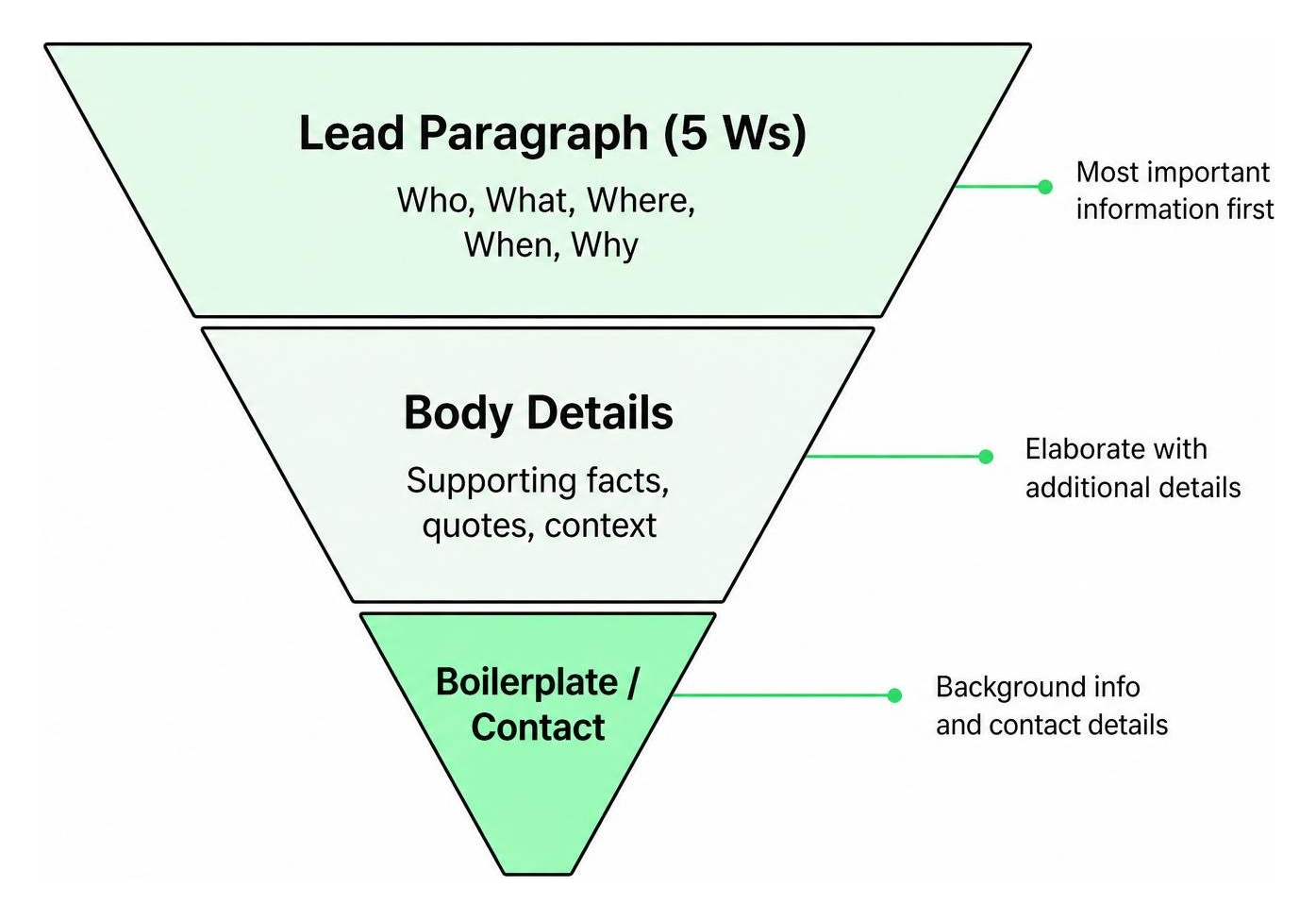
To write body copy that appeals to both humans and AI search engines:
- Front-load the 5 Ws in the lead paragraph: Within the first 75 words, clearly answer Who, What, Where, When, and Why. AI engines rely on the first 150 words of a document to decide whether to cite it or skip it.
- Write in a natural, conversational tone: Avoid stuffy corporate jargon and overused buzzwords like “revolutionary,” “groundbreaking,” or “world-class.” Plain, declarative sentences are easier for both humans to read and AI models to parse.
- Integrate keywords strategically: Place your primary keyword naturally in the first 50 words, in at least one H2 subheading, and once in the concluding paragraph. Avoid keyword stuffing, as search engines prioritize readability over keyword density.
For a comprehensive guide on formatting your body copy, quotes, and subheadings, check out How to Master Press Release Format in 30 Days.
Crafting the Perfect Boilerplate and Contact Information
The boilerplate is the short paragraph at the end of your press release that explains who your company is and what you do. Many PR teams treat this as an afterthought, but in 2026, the boilerplate acts as a critical brand-mention vehicle.
An effective, SEO-friendly boilerplate should be between 75 and 100 words and include:
- Your exact brand name and specific category descriptors.
- Your target audience and key geographic locations (such as Hollywood FL, Fort Lauderdale FL, or Miami FL).
- Your Name, Address, and Phone (NAP) data to reinforce local SEO signals.
- Clear media contact information, including a direct email address and phone number.
Think of your boilerplate as the exact sentence you want search engines to use when defining your business entity in their knowledge graphs. For a practical look at how to structure this section, see The Ins and Outs of a Press Release Example.
Key Structural Decisions for AI and Search Engine Visibility
Writing great copy is only half the battle. To ensure your press release ranks well and gets picked up by modern search systems, you must make smart structural decisions. Major wire services and search engines updated their ranking models to favor releases with strong technical and structural signals. We can explore these decisions in detail through Press Release SEO in 2026: The Six Structural Decisions That Decide Whether You Rank, Syndicate or Vanish.
Optimizing Multimedia and Alt Text
Including high-quality visual assets is no longer optional. Press releases with multiple images receive six times the engagement of text-only versions, and releases containing multimedia are 33% more likely to get picked up by journalists.
To optimize your media files for search engines:
- Use descriptive file names: Rename generic files like
IMG_9042.jpgto keyword-rich, descriptive names likeseo-maven-fort-lauderdale-team.jpg. - Write descriptive alt text: Include alt text for every image. Explain exactly what is in the image while naturally incorporating your target keywords (e.g.,
alt="SEO Maven digital marketing team working on a local SEO campaign in Fort Lauderdale"). - Embed high-quality videos: Including an optimized YouTube or Vimeo link can triple your average user engagement time.
For more media optimization ideas, read 6 Tips for an SEO Friendly Press Release.
Smart Linking and Avoiding Over-Optimization
One of the most common mistakes businesses make when optimizing a press release is over-linking. Google has made it clear that mass-syndicated press release links are treated as “nofollow” and do not pass PageRank directly.
To protect your site from link-based penalties and maximize referral value:
- Limit your links: Include only one to two natural links per release.
- Link to dedicated landing pages: Never link exclusively to your homepage. Instead, link to a specific service page, product page, or case study relevant to the news.
- Use natural anchor text: Avoid manipulative, keyword-stuffed anchor text. Instead of linking the phrase “best South Florida SEO agency,” link your actual brand name, like SEO Maven, or use natural, descriptive phrases.
By keeping your link profile clean and natural, search engines are more likely to trust your content and index your release. Learn more about modern link strategies in Press Release SEO: The Real Playbook for 2026.
Distribution Strategies and Measuring SEO Impact
Once your press release is written and technically optimized, you must get it in front of your audience. If you are working with a tight budget, you can start by exploring 10 of the Best Websites for Free Press Release Sites.
Choosing the Right Distribution Channels
For the best SEO and visibility results, we recommend a hybrid distribution strategy:
- Publish on your owned newsroom first: Always publish the HTML version of your press release on your own website before distributing it elsewhere. This ensures your site remains the canonical source of the news, preserving your authority signals for AI models and search crawlers.
- Utilize high-quality newswires: Use reputable distribution services to syndicate your release to authoritative news networks.
- Conduct direct media outreach: Personally pitch your release to local journalists and niche publications in your industry. For the best response rates, pitch your news Tuesday through Thursday, between 10:00 AM and 2:00 PM, when journalists are most active.
For a deeper dive into optimizing your distribution workflow, see How to Maximize Press Release Distribution for Search Visibility.
Key Metrics to Track Post-Publication
To measure the success of your digital PR campaigns, look beyond simple syndication counts. Track these key metrics in Google Analytics 4 (GA4) and Google Search Console:
- Referral Traffic: Monitor how many users click through to your website from the syndicated versions of your release.
- Organic Search Impressions: Check Google Search Console to see if your owned newsroom page is ranking for your target keywords.
- Brand Mentions: Keep track of unlinked brand mentions across social media and news sites, as these build entity authority.
- AI Citations: Periodically search for your brand or industry queries in tools like Perplexity and ChatGPT to see if your press release facts are being cited in generative answers.
Frequently Asked Questions about SEO Press Releases
Do press release backlinks still help SEO in 2026?
Direct links from syndicated wire copies are almost always “nofollow” or ignored by Google, meaning they do not pass PageRank directly. However, they still help your SEO indirectly. They build citation density, verify your brand entity in search graphs, and can catalyze real editorial pickup from journalists who write original articles containing valuable follow links.
How long should an SEO-friendly press release be?
We recommend keeping your press release between 300 and 600 words. This is long enough to answer all critical questions and provide citable data, but short enough to keep readers and journalists engaged.
Can AI write my entire SEO press release?
Generative AI is a fantastic tool for drafting, brainstorming headlines, and creating multiple tailored pitch angles. However, it should never write your entire release without human oversight. AI tools can hallucinate facts, use over-optimized language, and lack the professional touch needed to build trust with real journalists. Always have an expert vet and polish your final draft.
Conclusion
Mastering how to write an SEO press release is one of the most cost-effective ways for small businesses to build online authority, drive referral traffic, and secure visibility in both traditional search engines and modern AI search platforms. By focusing on high-quality content, natural keyword integration, structured schema, and a smart distribution strategy, you can turn standard company announcements into long-term marketing assets.
As a boutique digital marketing agency based in South Florida, we specialize in helping small businesses maximize their ROI with custom SEO and content marketing strategies. Whether you are looking to grow your presence in Hollywood FL, Fort Lauderdale FL, Miami FL, or across Aventura FL, we can help you achieve more with less.
Ready to elevate your digital PR and search visibility? Explore our PR and SEO services today, or get in touch with our team to build a custom growth plan for your business.