Does a Press Release Help SEO? Here’s the Quick Answer
Does press release help SEO? Yes — but not the way it did ten years ago.
Here is what you need to know upfront:
| SEO Benefit | Does It Still Work in 2026? |
|---|---|
| Links from wire syndication (PR Newswire, etc.) | No — mostly nofollow or sponsored; pass little ranking value |
| Earned editorial backlinks from journalists | Yes — these are high-value and can move rankings |
| Referral traffic from media coverage | Yes — often significant and fast |
| Branded search growth | Yes — consistent coverage builds brand recognition |
| Knowledge Graph and AI citation signals | Yes — growing in importance |
| Ranking for competitive head terms via press releases | No — this strategy is outdated and risky |
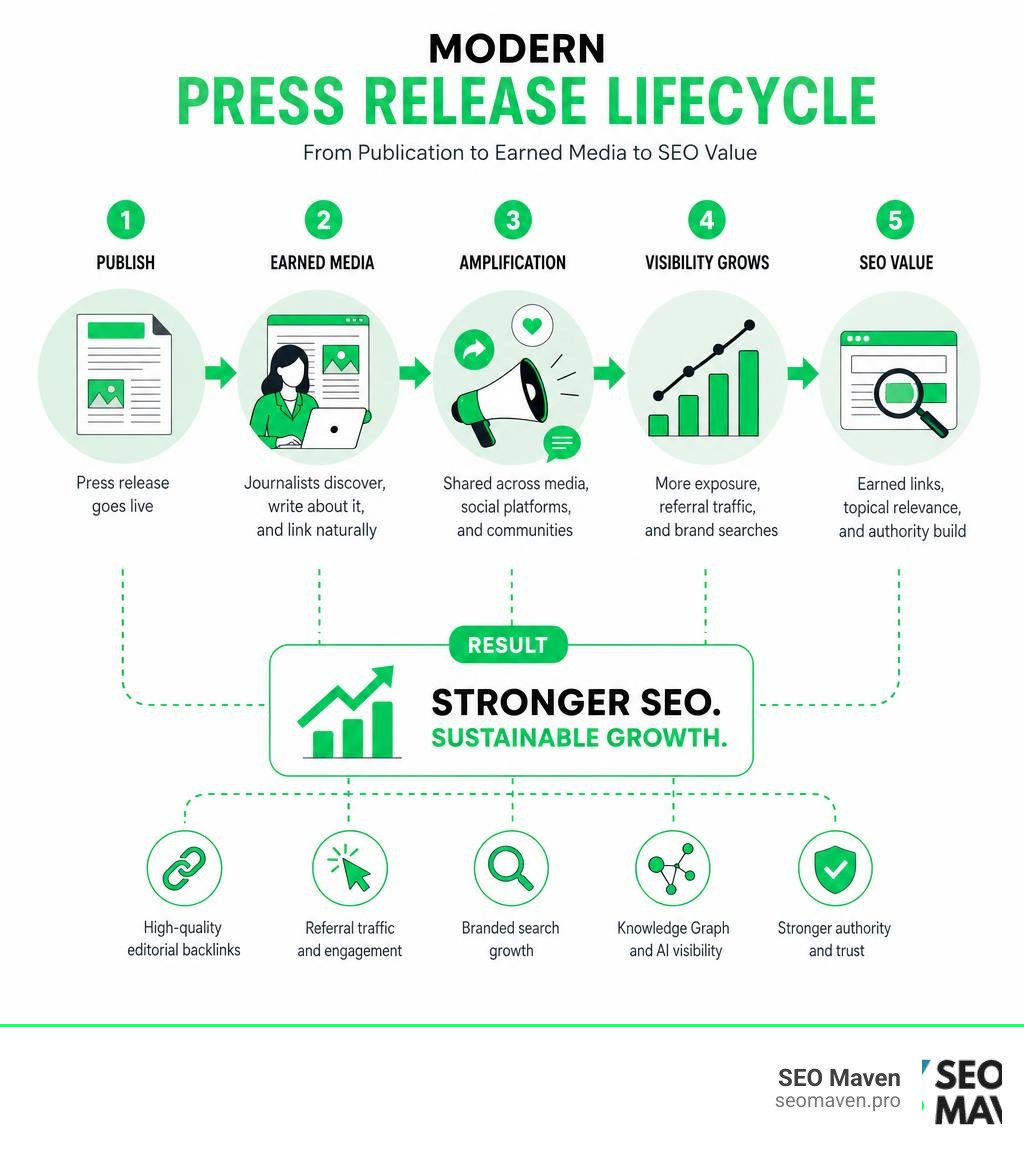
The short version: a press release does not boost your rankings on its own. The SEO value comes from what happens after the release — when journalists pick it up, write about it, and link back to your site on their own.
That distinction matters a lot, especially if you are a small business owner with limited time and budget trying to figure out where to invest your marketing energy.
Press releases have been misused for years as a shortcut for building links. Google caught on, and by 2013 had already started discounting those links. By 2026, the playbook has fully shifted. The releases that help SEO are the ones written to earn real coverage — not to game the algorithm.
I’m Fernando Larez, a marketing professional and business leader with hands-on experience in SEO, PR, and digital strategy, and I’ve seen how understanding does press release help SEO separates the businesses that get results from those that waste their budget on wire distribution that goes nowhere. In the sections below, I’ll walk you through exactly how to use press releases the right way in 2026.
Terms related to does press release help seo:
Does Press Release Help SEO in 2026?
To understand how a press release fits into your digital marketing mix in 2026, you have to look past the outdated promise of “instant backlinks.” The old-school method of blasting a keyword-stuffed document to hundreds of generic syndication sites is officially dead. In fact, relying on that strategy can actively hurt your site’s reputation.
But when done correctly, the modern press release is a powerful catalyst for search visibility.
When you publish a truly newsworthy announcement, you aren’t just trying to get indexed on a low-tier news aggregator. You are creating an official record of your company’s milestones, research, or expansions. This record serves as a trusted source for journalists, industry bloggers, and search engines alike.

The real power of a press release in 2026 lies in its ability to generate high-quality editorial coverage. When a respected publication writes about your announcement, they create a natural, editorially given link back to your website. These are the links that search engines value above all else.
Furthermore, a well-distributed press release can increase branded search demand. When people read about your business in the news, they naturally head to Google to search for your brand name. This surge in branded queries signals to search engines that your business is a growing authority in your space, which can lift your overall organic rankings.
Direct vs. Indirect Value: How Does Press Release Help SEO?
When analyzing how a press release impacts search engine optimization, we must separate direct SEO value from indirect SEO value.
- Direct SEO Value (The Owned Copy): This is the actual press release that you publish on your own website or distribute via a wire service. The direct SEO value of syndicated links is virtually zero because these links are almost always marked as
nofolloworsponsored. However, hosting the release in your own digital newsroom does have direct value. It creates a crawlable, authoritative page on your domain that can rank for specific, long-tail branded queries or product launches. - Indirect SEO Value (The Earned Coverage): This is where the magic happens. When a journalist at a high-authority publication reads your release and decides to write an original article about your news, they will typically include an editorial link back to your site. This earned backlink passes real ranking authority (PageRank) to your domain.
In addition to earned backlinks, indirect benefits include:
- Referral Traffic: Visitors who click through from a news article are highly qualified and ready to engage, driving valuable traffic to your landing pages.
- Brand Mentions: Even if a journalist mentions your brand without linking to your site, search engines recognize these unlinked mentions as trust signals, building your topical authority.
- Brand Protection: During a crisis or a major transition, issuing an official press release helps control the narrative, ensuring that search results for your brand name display accurate, authoritative information.
To make sure you are setting up your foundational strategy correctly, check out our Beginners Guide to SEO Press Releases for a step-by-step primer on getting started.
Google’s Stance: When Does Press Release Help SEO and When Is It Spam?
Google’s relationship with press releases has been a game of cat and mouse for over a decade. To keep your site safe from algorithmic penalties, you must understand where Google draws the line between a legitimate public relations effort and link manipulation.
Historically, Google devalued syndicated press release links back in 2013, warning that optimized anchor text in distributed releases was a form of link manipulation. Over the next few years, major wire services complied by changing their default outbound link settings to nofollow.
In September 2023, Google updated its Search Central documentation to align press release links explicitly with its sponsored content guidelines. According to Google’s spam policies, any links contained within syndicated press releases must use the rel="nofollow" or rel="sponsored" attributes. If you distribute a release with “dofollow” links packed with commercial anchor text (e.g., linking the phrase “best Miami SEO services” directly to a sales page), Google’s systems will likely flag it as link spam.
As detailed in Press release SEO in 2026: what still works and what doesn’t | PressPilot , attempting to use mass syndication as a primary backlink strategy is completely ineffective. Google filters out duplicate syndicated copies, usually indexing only one or two versions while ignoring the rest.
The takeaway is clear: use links in your press releases safely and purposefully. Link to your website to give readers and journalists an easy way to find you, but make sure those links are qualified correctly so they don’t trigger spam filters.
The Anatomy of an SEO-Friendly Press Release
Writing a press release that appeals to both busy journalists and sophisticated search algorithms is a balancing act. If you write only for the search engines, your release will read like spam, and reporters will delete it instantly. If you write only for traditional print media without considering digital structure, search engines won’t be able to index and display your news effectively.

An SEO-friendly press release must start with a genuinely newsworthy hook. Before you write a single word, ask yourself: Would someone outside of my company actually care about this news? Announcements about minor website updates or routine internal hires rarely make the cut. Focus instead on impactful events, such as:
- Proprietary research or industry-first data studies.
- Significant community impact or major local expansions (like opening a new office in Fort Lauderdale or Hollywood FL).
- Strategic partnerships with recognizable brands.
- New, innovative product launches that solve a distinct consumer problem.
Once you have your newsworthy angle, you must format it correctly. To master this layout, read our comprehensive guide on How to Master Press Release Format in 30 Days and review a real-world template in The Ins and Outs of a Press Release Example to see how these elements fit together on the page.
Writing Headlines and Leads for Journalists and Search Engines
Your headline is the single most important element of your press release. It is your first—and often only—chance to grab a journalist’s attention in a crowded inbox, and it serves as the title tag that search engines display on results pages.
To write a headline that works for both audiences, keep these best practices in mind:
- Keep it under 60-70 characters: This ensures that your title doesn’t get cut off in email subject lines or search engine results.
- Front-load the news and the brand name: Put your most important information and your main keyword at the beginning of the headline.
- Make it declarative and specific: Avoid vague, hype-filled language. Instead of “Company XYZ Launches Revolutionary New Software,” write “SEO Maven Launches AI-Powered Local Search Tool for South Florida Small Businesses.”
Directly beneath your headline, include a brief, compelling subheading that expands on the main hook.
Next comes the lead paragraph, which must follow the classic journalistic inverted pyramid structure. Within the first 75 to 100 words, you must answer the 5 Ws: Who, What, When, Where, and Why. Journalists should be able to read just the first paragraph and understand the entire story. Search engines also heavily weight the content in the opening paragraph, so placing your primary keyword naturally here is essential.
For more strategic tips on crafting headlines that stand out, check out 6 Tips for an SEO Friendly Press Release – Digital Third Coast .
Strategic Keyword Usage and Link Handling
Keyword optimization in a press release requires a light touch. Keyword stuffing—forcing your target phrases into every paragraph—will make your release unreadable and flag your content as low-quality.
Instead, select one primary keyword that directly relates to your announcement and target page, and use it naturally in:
- The headline.
- The lead paragraph.
- One of the subheadings or body paragraphs.
Use secondary keywords and natural synonyms throughout the rest of the text. A polished, highly readable press release will always perform better than one optimized to meet a rigid keyword density metric, as emphasized in Press Release SEO: The Real Playbook for 2026 | IP .
When it comes to links, less is more. Including too many links makes your release look promotional and spammy. We recommend including no more than 1 to 3 links in a standard 400-word release.
Handle your links using these guidelines:
- Link to the most relevant page: Instead of pointing all links to your homepage, link to the specific landing page, blog post, or media kit that provides more context about the news.
- Use natural anchor text: Avoid using exact-match commercial keywords as anchor text (e.g., “click here for Miami SEO services“). Instead, use your brand name or descriptive phrases (e.g., “read the full study on the SEO Maven website“).
- Qualify your links: For any release distributed through a paid wire service, ensure the links are tagged with
rel="nofollow"orrel="sponsored". This protects your site’s search health while still allowing interested readers and journalists to visit your site.
For a deeper dive into safe linking strategies, consult Press Release SEO: The Complete Guide 2026 – Announce Chain .
Optimizing for AI Search and Knowledge Graph Signals
In 2026, the search landscape is no longer limited to standard organic listings. Millions of users get their information directly from AI-driven search experiences like ChatGPT, Perplexity, and Google’s AI Overviews. This shift has given rise to Generative Engine Optimization (GEO) and Answer Engine Optimization (AEO).
AI search models do not read press releases to count backlinks. Instead, they parse them as factual data sources to build and verify their internal databases, known as Knowledge Graphs.
When an AI engine synthesizes an answer about your industry, it looks for consistent, verifiable facts across trusted web sources. A professionally distributed press release acts as an official, timestamped record that AI engines use to confirm your brand’s entities, key executives, and core offerings. To understand the mechanics of this process, read How to Optimize Press Releases for AI Visibility .
Entity Validation and Knowledge Graph Seeding
To rank in AI search, your business must exist as a recognized “entity” in Google’s Knowledge Graph. An entity is a distinct, well-defined concept or object (such as a person, place, or business) that search engines can identify without ambiguity.
Press releases are highly effective tools for entity validation. By distributing consistent information through reputable channels, you help search engines connect the dots between your brand name, your location, your key personnel, and your products. This process relies on three core strategies:
- The Entity Anchor Protocol: This involves using your press releases to explicitly define your brand identity. Ensure that your business name, physical address, and phone number (NAP data) are formatted identically across your website, social profiles, local listings, and press releases.
- The Citational Drift Strategy: This strategy focuses on earning unlinked brand mentions on authoritative news sites. AI models track how often your brand is mentioned in relation to specific topics (e.g., mentioning “SEO Maven” in an article about South Florida small business growth), building your topical authority even without a direct hyperlink.
- Structured Data (Schema Markup): When publishing a press release in your website’s newsroom, always implement
schema.org/NewsArticleorschema.org/PressReleasestructured data. This code tells search engine crawlers exactly who published the release, when it was modified, and what entities are involved, making it highly machine-readable.
For a deeper look at how entity validation works, see SEO Value of Press Releases: Beyond Backlinks in 2026 | Resource .
Writing for LLMs: Factual Density and Declarative Tone
Large Language Models (LLMs) are designed to ignore marketing fluff, buzzwords, and vague claims. If your press release is packed with phrases like “world-class, cutting-edge, industry-leading solutions,” an AI engine will likely filter it out as low-value noise.
To optimize your press releases for AI citation, write with high factual density and a declarative tone:
- Lead with facts and data: AI models love statistics. Adding verifiable data points to your release can boost your AI citation rates significantly. Instead of saying “our tool dramatically improves local search visibility,” write “our tool increased local organic impressions by 41% over a 90-day period.”
- Use clear, declarative sentences: Write in plain, straightforward language. Spell out acronyms on their first use and avoid complex, convoluted sentence structures.
- Include authoritative quotes: Expert quotes provide qualitative context that LLMs use to understand sentiment and expertise. Ensure your quotes are attributed to a named, credentialed expert within your company (e.g., “Fernando Larez, President of SEO Maven, stated…”).
- Cite external sources: If your release references industry trends, link directly to the authoritative third-party studies or government databases that verify your claims.
By structuring your content this way, you make it easy for AI engines to extract facts and cite your brand as a trusted source in their conversational answers. Learn more about writing for modern audiences in 6 Tips to Make Your Press Release SEO Friendly in 2025 .
Frequently Asked Questions about Press Release SEO
Does Google penalize press releases for duplicate content?
No, Google does not penalize your website for duplicate content resulting from distributed press releases. It is a common misconception that having the same press release appear on multiple syndication sites will trigger a penalty.
However, Google is highly efficient at handling duplicate content. When the same text is published across 100 different news sites, Google’s algorithm will group them together and filter out the duplicates. Typically, only one or two versions—usually the ones on the highest-authority domains—will actually appear in the search results. While this isn’t a penalty, it does mean that having your release mirrored on dozens of low-quality syndication sites provides very little SEO value.
Should I publish a press release on my own domain or a wire service first?
You should always publish the canonical version of the press release on your own website’s newsroom first.
If you distribute the release through a wire service before publishing it on your own domain, Google’s crawlers will index the wire service’s copy first. Because the wire service has higher domain authority, Google may treat their version as the original source and view your newsroom’s copy as a duplicate. By publishing on your own site first, you establish ownership of the content. When you do distribute the release, try to ensure the wire service version points a rel="canonical" link back to your original newsroom URL.
How do you measure the SEO performance of a press release?
To accurately measure the impact of a press release, you must look beyond simple “view” metrics provided by wire services. Track these key performance indicators (KPIs) over an 8 to 12-week period post-publication:
- Earned Backlinks: Monitor your backlink profile using tools like Google Search Console to see if journalists at genuine publications have written about your news and linked back to your site.
- Branded Search Lift: Watch for an increase in search queries for your company name or specific product names in the weeks following the announcement.
- Referral Traffic: Analyze your website analytics to track how many visitors are clicking through from news sites and how they behave once they arrive.
- AI Citations: Search for industry topics or your brand name within AI search tools like Perplexity or Google’s AI Overviews to see if your press release data is being cited in conversational answers.
For additional guidance on tracking and analyzing these metrics, read Do Press Releases Help SEO? Benefits & Best Practices .
Conclusion
So, does press release help seo in 2026?
The answer is a resounding yes—but only if you abandon the outdated link-building playbook. The true value of a press release lies in its power to build brand authority, secure high-value editorial coverage, and feed critical entity signals to modern AI search engines.
For small businesses in South Florida—from Miami and Fort Lauderdale to Hollywood FL and Aventura FL—maximizing every marketing dollar is essential. You cannot afford to waste your budget on automated wire blasts that search engines ignore. Instead, you need a strategic, integrated approach that combines traditional public relations with cutting-edge search engine optimization.
At SEO Maven, we are a boutique agency focused on delivering maximum ROI for small businesses. We help you cut through the noise, helping you achieve more with less by crafting compelling, newsworthy stories that earn real media pickup and build lasting search authority.
If you are ready to elevate your digital presence, discover How an SEO Agency Can Help You Rank and review our Ultimate Checklist for Miami SEO Services to see how we help local businesses grow.
Ready to take your brand to the next level? Explore our PR and SEO services today, and let us help you turn your company’s milestones into measurable search success.