What Is Content Creation Writing (and Why It Matters for Your Business)
Content creation writing is the practice of producing written material — blog posts, web copy, social media posts, emails, and more — specifically designed to reach, engage, and convert a defined online audience.
Here’s a quick breakdown of what it involves:
| Element | What It Means |
|---|---|
| Purpose | Educate, build trust, and drive action — not just self-expression |
| Audience focus | Written for a specific reader, not for the writer |
| Distribution | Published on platforms like blogs, YouTube, Medium, or social media |
| Business value | Builds brand awareness, generates leads, and supports SEO |
| Key skills | Research, SEO basics, clear writing, consistency |
This is not the same as writing a novel or a personal essay. When you create content for a business, you are writing for someone else’s needs — not your own.
And the numbers back this up. According to recent survey data, 80% of marketers say their top goal with content is building brand awareness. Another 72% want to build credibility and trust. And 68% focus on educating their audience.
For a small business owner trying to compete online, that distinction is everything.
Here’s the problem most businesses face: they treat content like filler. Blog posts written just to “have something up.” Social captions with no strategy. Website copy that talks about the brand instead of the reader. That approach doesn’t build traffic. It doesn’t build trust. And it definitely doesn’t build revenue.
Content creation writing done right is systematic, audience-first, and built around what people are actually searching for. This guide walks you through exactly how to do it.
I’m Fernando Larez, a marketing professional and business leader with hands-on experience in SEO, digital strategy, and brand development across multiple industries — including deep work in content creation writing that drives real organic growth. In this guide, I’ll share the frameworks, skills, and strategies that separate content that gets results from content that gets ignored.
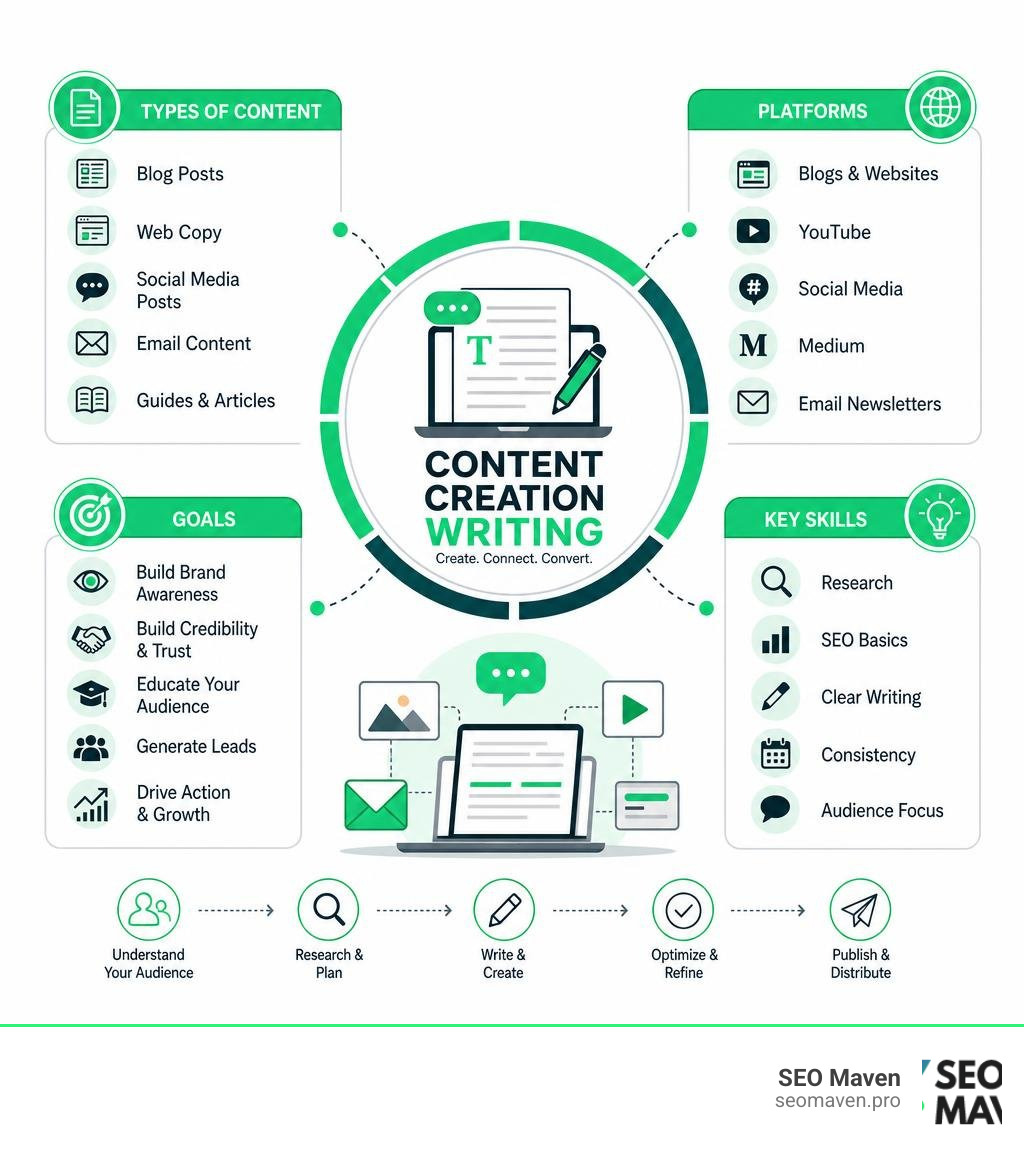
Quick look at content creation writing:
Traditional Writing vs. Content Creation Writing
To succeed in the digital landscape of July 2026, we have to throw out the old school playbook. Many people make the mistake of treating digital content like a printed essay or a personal diary. It is not.
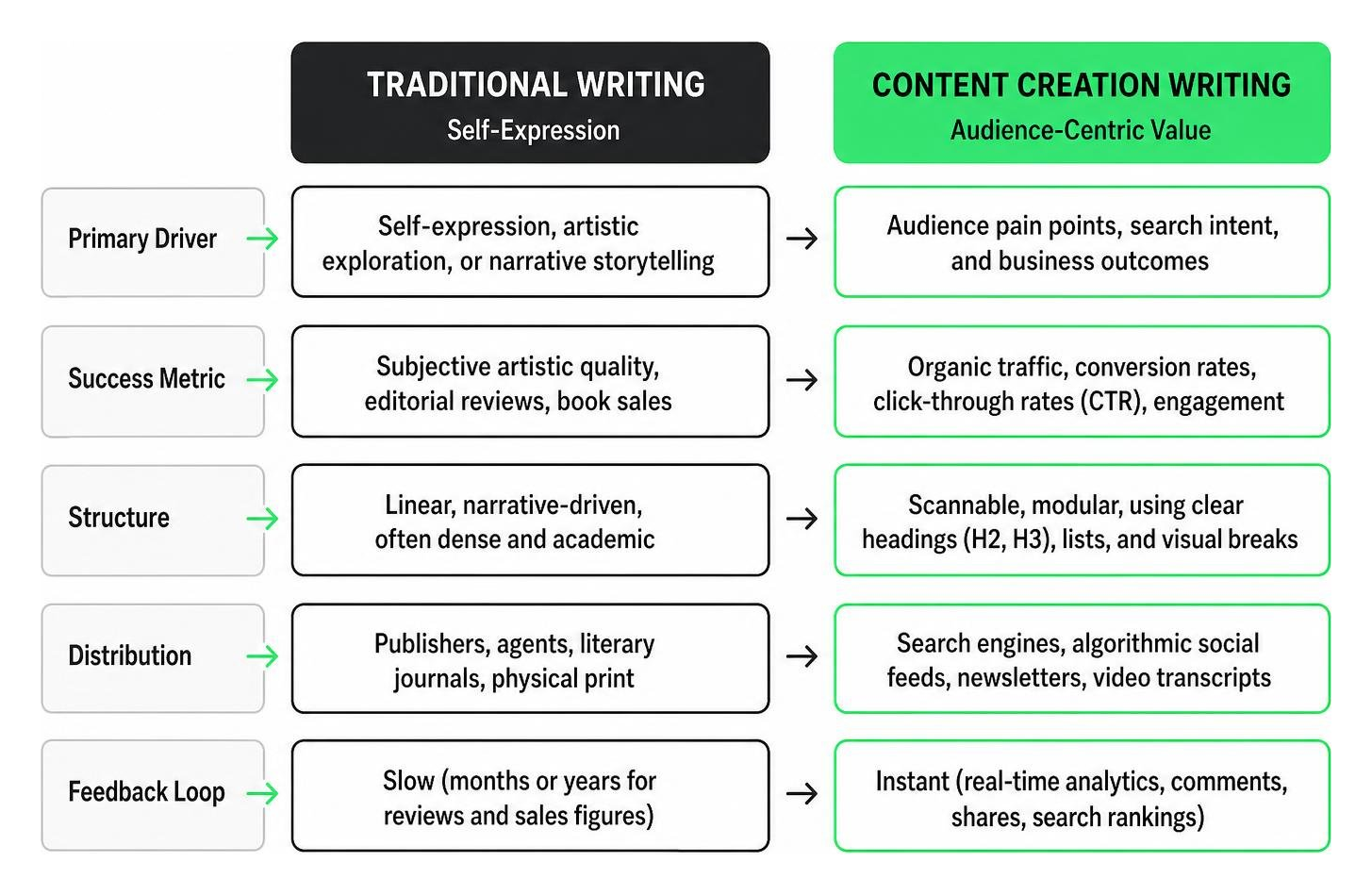
Let’s look at how traditional writing differs fundamentally from modern content creation writing:
| Feature | Traditional Writing | Content Creation Writing |
|---|---|---|
| Primary Driver | Self-expression, artistic exploration, or narrative storytelling | Audience pain points, search intent, and business outcomes |
| Success Metric | Subjective artistic quality, editorial reviews, book sales | Organic traffic, conversion rates, click-through rates (CTR), engagement |
| Structure | Linear, narrative-driven, often dense and academic | Scannable, modular, using clear headings (H2, H3), lists, and visual breaks |
| Distribution | Publishers, agents, literary journals, physical print | Search engines, algorithmic social feeds, newsletters, video transcripts |
| Feedback Loop | Slow (months or years for reviews and sales figures) | Instant (real-time analytics, comments, shares, search rankings) |
Traditional writing often values mystery and slow reveals. In contrast, digital content values immediate clarity. Think of it this way: art is subjective, but content is not. If a piece of content fails to answer a user’s question or guide them toward a solution, it fails its primary purpose—no matter how beautifully written the prose is.
This approach is echoed in Content Writing Guide: Types + Tips for Businesses (2026) – Shopify, which highlights that effective content bridges the gap between what a business offers and what the reader actively needs.
We also have to consider the math of the internet. The digital landscape operates on the 1% rule: only about 1% of a platform’s users actively create almost all of its content. Meanwhile, roughly 69% of internet users in the US and Europe are “spectators”—they consume digital media but rarely contribute. This means there is a massive, hungry audience waiting for high-quality, structured content. But because search intent dictates how they find you, your words must be optimized to match exactly what they are typing into search engines.
The Shift from Self-Expression to Audience-Centric Value
When we write for a business, we leave our personal egos at the door. You are not writing to show off your vocabulary; you are writing to solve a specific problem.
To do this effectively, we must build detailed audience personas. We need to know who our readers are, what keeps them awake at night, and what specific questions they need answered. This allows us to provide real information gain—a concept that search engines in 2026 value immensely. Information gain means adding unique value that doesn’t exist elsewhere, such as original research, experiences, free templates, or simplified frameworks.
By shifting our focus from “What do I want to say?” to “What does my audience need to learn?”, we build real authority. This is a core pillar of How to Build a Brand That Actually Sticks. If your content consistently provides actionable, real-world value, your brand becomes the default solution in your niche.
How Distribution Platforms Reshape the Writer’s Role
Modern distribution platforms like Medium, Substack, LinkedIn, and YouTube have completely changed what it means to be a writer. In the past, writers relied on traditional gatekeepers like publishers or editors to get their work seen. Today, distribution platforms allow anyone to build a creative career from scratch.
However, this means writers must understand algorithmic recommendations. Platforms use machine learning to analyze user behavior and serve content they are likely to engage with. In fact, over 80% of social media content recommendations are now powered by AI.
As a writer, you are no longer just putting words on a page. You are managing a digital ecosystem. A Substack writer must also be a newsletter marketer. A YouTube creator must write scripts optimized for retention while understanding click-through metrics. We must adapt to this spectator culture by packaging our writing into formats that are easy to share, easy to bookmark, and impossible to ignore.
The Core Skills of High-Value Content Creators
If you want to stand out in a sea of generic digital text, you need to develop specific, high-leverage skills. The average writer focuses on grammar and spelling. The high-value content creator focuses on strategy, psychology, and layout.
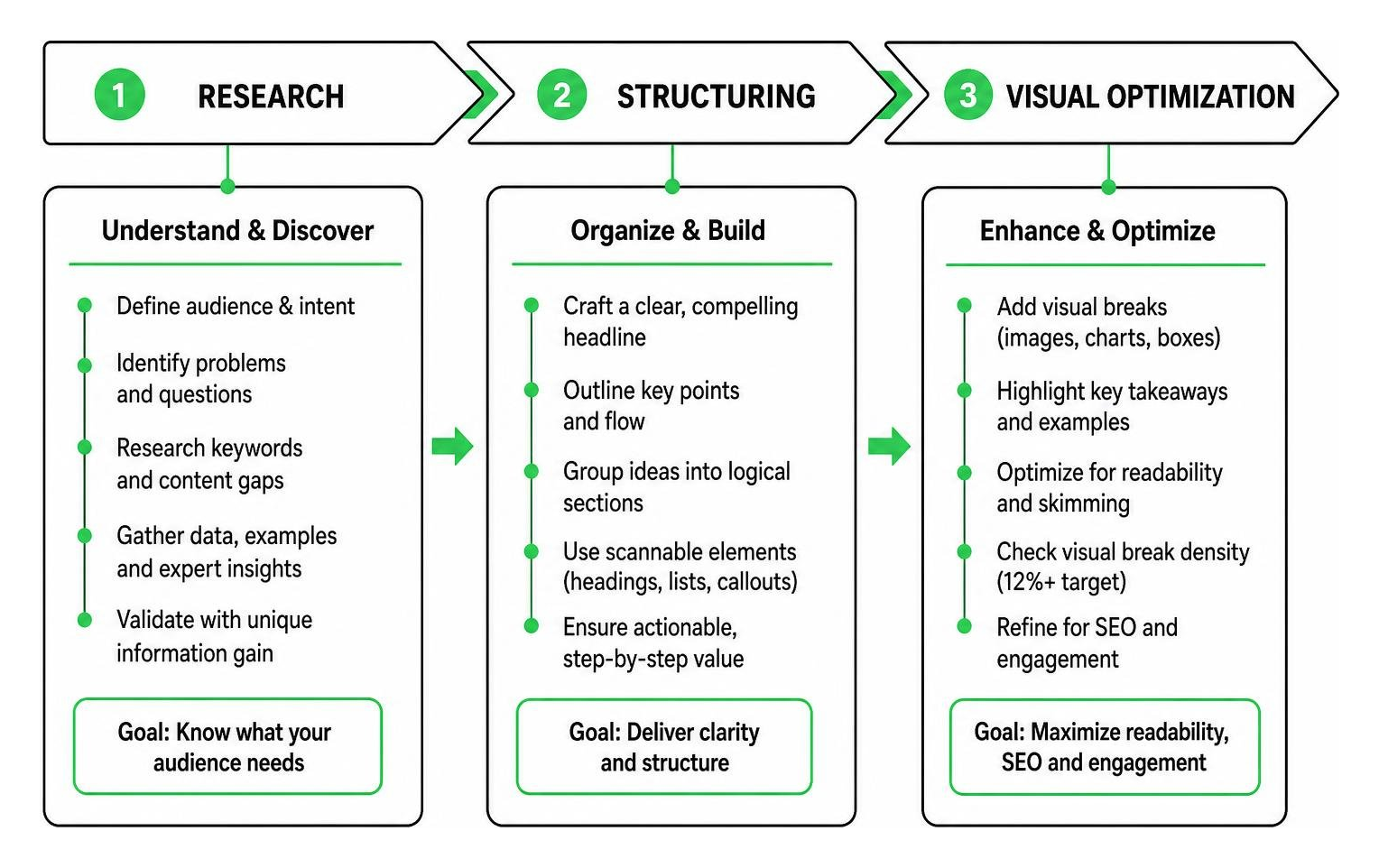
- Information Advantage: To write great content, you must know something your competitors don’t—or explain it much better. This means doing deep research, interviewing subject matter experts, and using advanced tools like Content Toolkit to find hidden search trends and content gaps.
- Actionable Content: Readers don’t want abstract theories. They want step-by-step instructions. If you are writing about digital marketing, don’t just say “optimize your site.” Give them the exact checklists, tools, and steps to do it.
- Simplifying Concepts: The best writers can take highly complex, technical jargon and translate it into simple, conversational language that a beginner can easily understand.
- Visual Break Density (VBD): Most online readers skim. If they see a massive wall of text, they will hit the back button. We target a visual break density of 12% or higher—meaning at least 12 visual elements (like bullet points, bold text, images, or callout boxes) per 1,000 words.
Transitioning to High-Value Content Creation Writing Roles
If you are currently working as a general freelance writer, you might feel stuck in a low-paying loop. The average content writer makes about $21 to $25 per hour, with an estimated average annual salary of $61,034. While that is a solid starting point, the real financial leverage comes when you transition into high-value roles.
Here are the four primary paths to elevate your career:
- Copywriter: Unlike content writers who focus on education and awareness, copywriters write persuasive text designed to drive immediate action (like sales, sign-ups, or downloads). Good copywriting has a massive ROI, which is why top copywriters command premium rates.
- Ghostwriter: Many founders, CEOs, and industry leaders want to build a personal brand but don’t have the time to write. As a ghostwriter, you write articles, LinkedIn posts, or books in their unique voice. This path offers incredible leverage because you work directly with high-level decision-makers.
- Newsletter Writer: Building a direct relationship with an audience via email allows you to bypass platform algorithms entirely. Successful newsletter writers monetize through sponsorships, premium subscriptions, or digital products.
- Writerpreneur: This involves packaging your specialized knowledge into digital assets. For example, Steph Smith’s book Doing Content Right has generated over $250,000 in sales by teaching others how to master digital publishing.
To learn more about how to position yourself for these top-tier opportunities, check out our guide on How to Master Content Creation in Marketing.
Mastering SEO and Search Intent in 2026
You cannot talk about content creation writing without talking about Search Engine Optimization (SEO). In 2026, search engines have evolved far beyond simple keyword matching. Today, semantic search and artificial intelligence drive how users find answers.
To rank well, we must focus on:
- Long-Tail Keywords: These are highly specific search phrases (e.g., “boutique content marketing agency in Fort Lauderdale”) that represent about 70% of all search traffic. They have lower search volume but much higher conversion intent.
- E-E-A-T (Experience, Expertise, Authoritativeness, Trustworthiness): Search engines prioritize content written by real humans with verifiable experience. Citing expert sources and sharing case studies is non-negotiable.
- Featured Snippets and AI Overviews: AI-generated search overviews now appear on roughly 42% of informational queries. To ensure your content is cited in these overviews—which can increase your organic click-through rate by 35%—you must answer user queries directly, concisely, and accurately within the first few paragraphs of your headings.
Navigating the Business and Distribution of Digital Content
Writing the content is only half the battle. The other half is ensuring the right people see it, engage with it, and take action. This requires a deep understanding of digital marketing metrics, distribution channels, and return on investment (ROI).

Many businesses waste thousands of dollars producing blog posts that no one reads. If you are wondering whether outsourcing this process is right for your business, take a look at our analysis: Is Agency Content Creation Actually Worth the Hype?. The short answer is yes—but only if the agency focuses on business metrics (like lead generation and organic conversions) rather than vanity metrics (like page views or word counts).
Building Leverage: Operational, AI, and Attention Leverage
To scale your content efforts without burning out, you need to build leverage. In the business of writing, leverage comes in three forms:
- Operational Leverage: Building a structured team of specialized writers, editors, and designers. Instead of doing everything yourself, you manage the editorial pipeline.
- AI Leverage: Using AI tools as research assistants, outline builders, and proofreaders. This allows you to produce high-quality drafts in a fraction of the time.
- Attention Leverage: Building a loyal, owned audience (like an email list or social media following). When you own the connection to your audience, you don’t have to pay for ads or pray to search engine algorithms to get your message heard.
Localizing Content Strategies for Regional Markets
For businesses operating in specific geographic areas, localized content is a goldmine. If you are targeting customers in Florida, general advice won’t cut it. You need content that speaks directly to the local culture, climate, and business environment.
For example, a business in South Florida needs to understand the regional nuances of major hubs like Miami, Fort Lauderdale, and Aventura. If you are looking to hire local talent or build a localized presence, you can explore regional job markets through resources like Writer Jobs, Employment in Hollywood, FL | Indeed or Content Writer jobs in Miami, FL – Indeed.
Furthermore, partnering with local experts who understand the regional landscape can give your brand a major competitive advantage.
To explore how to dominate the local market, check out our deep dive: Mastering the Sunshine State Content Strategy. Whether you are analyzing 2000+ Creative Writing jobs in Florida or crafting specific campaigns for local neighborhoods, regional relevance is what drives high-intent conversions.
Ethical Challenges and the Role of AI in 2026
The rise of generative artificial intelligence has brought incredible efficiency to digital marketing, but it has also introduced significant ethical, legal, and quality challenges.
As writers and business owners, we must navigate issues like plagiarism, copyright infringement, algorithmic bias, and the rapid spread of misinformation. Because AI models are trained on existing web data, they can easily reproduce biased or inaccurate information. Maintaining transparency and citing primary sources is critical to keeping your audience’s trust.
The Future of Content Creation Writing in the AI Era
AI is not a passing fad. In 2026, 71% of social media images are AI-generated, and AI tools are used to draft millions of blog posts daily. However, this has led to an explosion of “AI slop”—generic, repetitive, and low-quality content that offers zero value to the reader.
This is why human-guided content remains dominant. According to recent industry data, human-generated or heavily human-edited content pulls in 5.44 times more traffic than pure AI-generated text. Why? Because consumers can easily spot generic copy. In fact, 36% of consumers say they can identify AI-written marketing materials, and many refuse to do business with brands that rely solely on automated text.
The future of writing belongs to the “Prompt Writer” and the “AI-Assisted Editor.” We use AI to brainstorm, structure outlines, and summarize research, but we rely on human writers to inject emotion, real-world experience, and strategic direction.
Maintaining Quality and Authenticity Against AI Slop
To future-proof your content strategy, you must prioritize quality over sheer volume. Here is our checklist for maintaining authenticity:
- Involve Subject Matter Experts (SMEs): Have real professionals review your content for technical accuracy.
- Conduct Original Research: Publish your own data, surveys, and case studies. AI cannot replicate original findings.
- Show Firsthand Experience: Share your personal struggles, failures, and successes. This builds a human connection that algorithms cannot copy.
- Partner with Professional Agencies: If you don’t have the in-house resources to maintain this standard, consider working with vetted content marketing professionals to ensure your brand’s voice remains sharp, accurate, and authoritative.
Frequently Asked Questions about Content Creation Writing
What is the average salary for a content creation writer in 2026?
The average content writer makes approximately $21 to $25 per hour, which translates to an average salary of $61,034 per year (with total estimated compensation around $67,157). However, those who step into leadership roles, such as a Digital Content Writing Manager, earn an average annual salary of $130,780.
How do I start content creation writing with no prior experience?
The best way to start is by choosing a niche you are passionate about and writing mock articles. You don’t need formal qualifications—just curiosity and strong research skills. Create a simple online portfolio, write guest posts, or offer your services to local businesses to build your initial proof of work.
Will AI completely replace content creation writers?
No. While AI is excellent at drafting and summarizing, it lacks the ability to build genuine human connection, think strategically, or conduct original, research. AI is transforming writers into high-level editors and strategists rather than replacing them entirely.
Conclusion
At SEO Maven, we know that great writing is about more than just filling up a page with words. It is about understanding your audience, matching their search intent, and creating high-quality, authentic content that drives real business results. As a boutique digital marketing agency based in South Florida, we specialize in helping small businesses in Miami, Fort Lauderdale, Hollywood, and Aventura maximize their ROI by doing more with less.
If you are ready to stop wasting time on generic content and start building a digital strategy that actually converts, explore our curated list of top providers: Stop Searching and Hire These Content Creation Agencies.
Or, let’s work together directly to craft a custom strategy for your brand. Visit SEO Maven’s Marketing Services today to book a consultation and take your digital presence to the next level.