Your Website Should Make You Money — Here’s How
Web design for ROI is the practice of building and optimizing websites to generate measurable business returns — more leads, more sales, and lower customer acquisition costs.
Here’s what drives website ROI in 2026:
- Clear conversion goals — every page has one primary action
- Fast load times — under 1 second can produce up to 3x higher conversion rates
- Mobile-first design — over 64% of web traffic now comes from mobile devices
- Trust signals — testimonials, case studies, and real imagery
- SEO foundation — organic search drives over 50% of all website traffic
- Data-driven optimization — continuous improvement based on analytics, not guesses
Last month, a consultant shared that her website cost thousands to build — then admitted it had generated zero client inquiries in six months. That is not just a design problem. That is a revenue leak hiding in plain sight.
Most business owners think about their website in one of two ways: as a cost to minimize, or as a portfolio piece to be proud of. Neither framing is right.
Your website is either working for you 24/7 — qualifying leads, answering objections, and driving conversions — or it is quietly costing you money every single day.
The average website conversion rate is just 2.35%. But businesses that treat web design as a strategic investment — not an aesthetic exercise — consistently beat that number. The American Cancer Society boosted revenue by 4.5% after a research-driven redesign. One jewelry brand saw a 700% increase in sales following website optimization. These results did not come from prettier graphics. They came from smarter design decisions tied to real business goals.
Every dollar invested in user experience design can return up to $100. That kind of ROI does not happen by accident.
I’m Fernando Larez, a marketing professional and business leader based in Hollywood, Florida, with hands-on experience in SEO, digital strategy, and brand development — including helping businesses achieve stronger web design for ROI through data-driven campaigns and conversion-focused execution. In this guide, I’ll walk you through exactly how to turn your website from a digital brochure into your most effective sales tool.
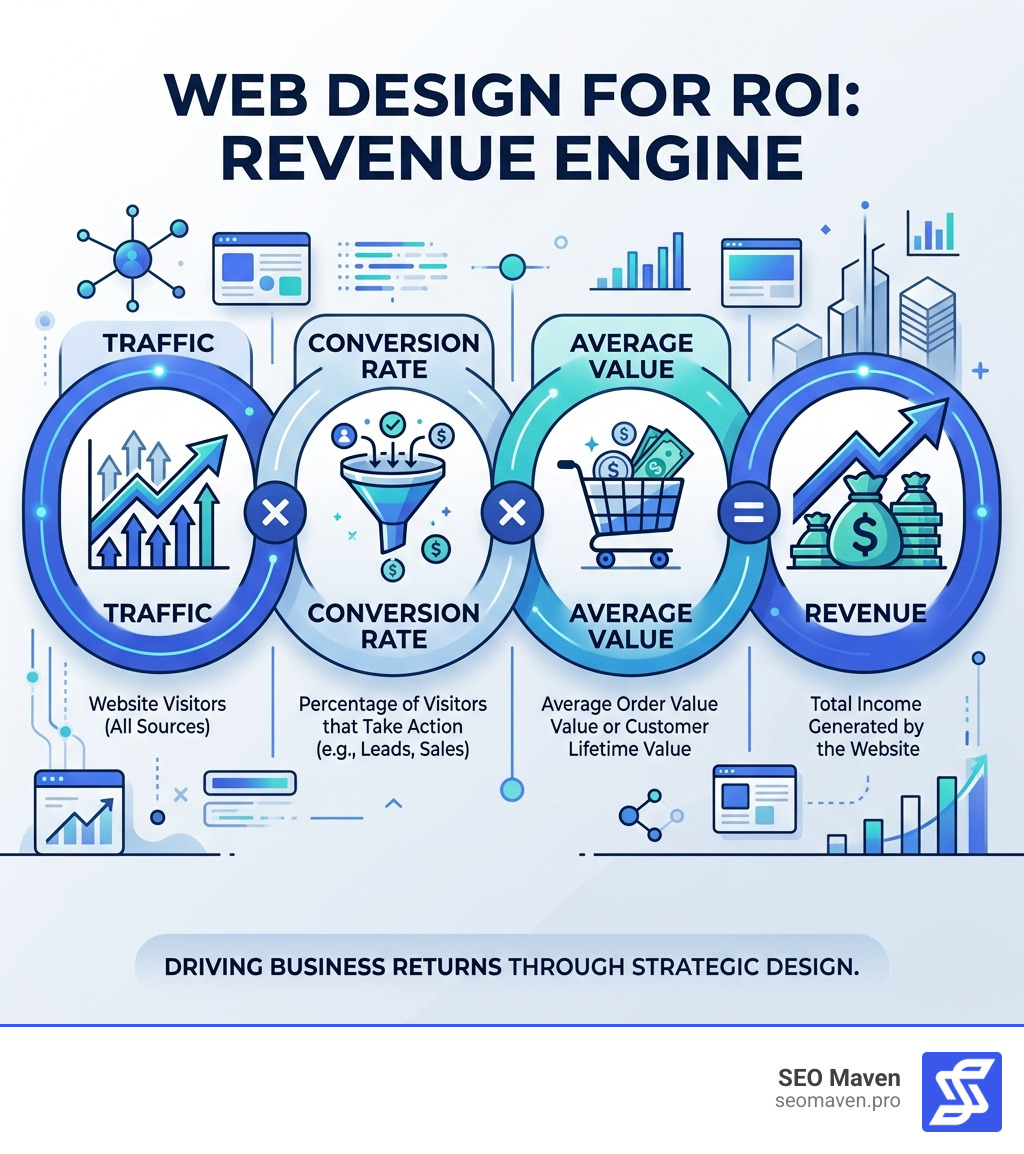
The Strategic Shift: Understanding Web Design for ROI
To win in the 2026 digital landscape, we have to stop looking at websites as “online brochures” and start seeing them as strategic weapons. In the classic book Web Design for ROI: Turning Browsers into Buyers & Prospects into Leads, the core message is clear: design must be accountable to metrics.
If your site looks like a million bucks but brings in zero, it’s a failure. A high-performing site is a revenue engine. It’s built on business goals first, aesthetics second. When we shift from “What looks cool?” to “What drives revenue?”, we gain a massive competitive advantage. Billions of dollars in spending decisions are influenced by websites every year; if yours isn’t laser-focused on financial returns, you’re leaving money on the table for your competitors in Miami or Fort Lauderdale to scoop up.
Why Most Websites Fail to Deliver
Most websites fall into the “aesthetic trap.” Business owners often get distracted by flashy animations or trendy layouts that actually create user friction. If a visitor can’t figure out what you do within three seconds, they leave. Technical debt—clunky code from old plugins or unoptimized images—slows the site down, killing your conversion rate before the page even finishes loading. Finally, poor messaging that focuses on “we” instead of the customer’s needs makes the site feel like a vanity project rather than a solution.
Shifting from Visuals to Performance
Performance-driven design means making data-driven decisions. Instead of guessing where a button should go, we look at heatmaps. Instead of picking a font because it’s “pretty,” we choose one that is highly legible on mobile devices. This audience-first approach uses psychological triggers—like social proof and scarcity—to align the design with your bottom line.
The Core Elements of a High-Performing Website

A website that makes money isn’t a mystery; it’s a formula. It starts with User-Centric Design, which prioritizes the visitor’s ease of use over the designer’s ego. The visual hierarchy must guide the eye toward the most important information, supported by trust signals like client logos and verified reviews.
Maximizing Web Design for ROI through User-Centric UX
User Experience (UX) is the invisible force that drives Web design for ROI. We design for how people actually read: the F-pattern (scanning across the top and down the left) or the Z-pattern for simpler landing pages.
- 1:1 Attention Ratio: On high-intent pages, there should be one goal. If you give a user ten options, they often choose none—a phenomenon known as “analysis paralysis.”
- Micro vs. Macro Conversions: While a sale is a macro-conversion, a newsletter signup or a video view is a micro-conversion. Both are vital for tracking the user journey.
- Insights: Using tools like HotJar allows us to see exactly where users get stuck, allowing for surgical design fixes that immediately improve the flow.
Crafting Irresistible Calls-to-Action (CTAs)
Your CTA is the bridge between a browser and a buyer. In 2026, “Submit” is a dirty word. High-ROI CTAs use benefit-driven language like “Get My Free Quote” or “Start Saving Today.”
- Placement: Primary CTAs should be “above the fold” (visible without scrolling) and repeated at the bottom of the page.
- Design: Use high-contrast colors that pop against your background.
- Mobile-First: Ensure buttons are “thumb-friendly”—large enough to tap easily on a smartphone screen.
- Safety Valves: For visitors not ready to buy, include a secondary CTA (like a free guide) to keep them in your ecosystem.
2026 Investment Guide: Costs, Timelines, and Expectations
How much does a website cost in 2026? It’s like asking how much a house costs—it depends on the square footage and the finishes. However, we can look at industry benchmarks for South Florida businesses to set realistic expectations.
Typical Pricing Tiers in 2026
- Starter Builds: Template-based sites for small businesses often start around $3,950. These are great for getting a professional presence quickly.
- Premium Custom: For businesses needing unique functionality and deep SEO integration, projects typically begin around $7,500 to $12,500.
- Advanced Enterprise: A high-performing B2B lead generation site or a complex e-commerce platform can easily reach $100k+ and involve hundreds of staff hours.
- Ongoing Costs: Don’t forget maintenance. Hosting, security updates, and performance monitoring usually range from $85 to $200+ per month to ensure your asset doesn’t become a liability.
The Redesign Timeline
A professional build isn’t overnight. A typical SMB website (10–20 pages) takes 10–14 weeks.
- Strategy Phase: Defining goals and site architecture.
- Design Phase: Creating the visual look and user flow.
- Development Phase: Building the site on a staging server. Complex builds with custom integrations can take 16–20 weeks. The biggest bottleneck? Content readiness. If you have your photos and copy ready on day one, the process moves significantly faster.
Technical Foundations: SEO, Accessibility, and Speed
A beautiful site that nobody sees is a sunk cost. To achieve SEO Optimized Web Design: What, Why, & How to Achieve ROI, the technical foundation must be laid during the wireframing stage, not “bolted on” at the end.
The Impact of Page Speed on Revenue
Speed is a massive ranking factor and a conversion killer. Sites loading in under one second can produce conversion rates up to three times higher than those loading in five seconds.
- Performance Engineering: We compress images, use Content Delivery Networks (CDNs), and streamline code to ensure your site is lightning-fast.
- Core Web Vitals: Google tracks LCP (loading), CLS (visual stability), and INP (interactivity). If you fail these, your rankings—and your ROI—will suffer.
Future-Proofing Web Design for ROI with AI and GEO
By April 2026, the game has changed. We are now optimizing for Generative Engine Optimization (GEO). This means structuring your site so AI assistants (like ChatGPT or Google’s Gemini) can easily find and recommend your business.
- Semantic Structure: Using clean code and schema markup to tell search engines exactly what your content means.
- Contextual AI: Implementing AI-powered chatbots that can answer customer questions at 2 AM, pre-qualifying leads before they ever talk to your sales team.
- Accessibility: Inclusive design isn’t just about ethics; it’s about audience reach. 15% of the population has a disability. If your site isn’t ADA compliant, you are excluding millions of potential customers and risking legal headaches.
Measuring Success: Metrics That Prove Your Website’s Value
If you can’t measure it, you can’t improve it. We use the Portfolio of data from GA4 and Search Console to track the health of your investment.
Tracking Qualitative and Quantitative ROI
- Conversion Rate: The percentage of visitors who take action. (Target: 2-5% for professional services).
- Average Order Value (AOV): How much each customer spends.
- Cost Per Acquisition (CPA): What you pay in marketing to get one new customer.
- Staff Time Savings: If a new “Contact Us” hierarchy reduces repetitive phone inquiries by 25%, that is a tangible ROI in saved labor costs.
Continuous Optimization and A/B Testing
A website is never “done.” It is a living organism. We use hypothesis testing to try different headlines or button colors. Small, data-informed changes can increase leads by 10% to 50% over time. This iterative approach ensures your Web design for ROI stays high as market trends shift in Florida and beyond.
Frequently Asked Questions about Website ROI
What is a good conversion rate for a business website in 2026?
While the average is 2.35%, high-performing sites in professional services often see 3% to 5%. If you are below 2%, your design is likely a “leak” in your business.
How often should a website be redesigned to maintain ROI?
Most sites have a lifespan of 3 to 5 years. Beyond that, technology (like mobile standards or AI search) moves so fast that your site will begin to feel dated and perform poorly. A site that lasts 5 years instead of 2 effectively doubles your ROI.
Can small design changes really impact the bottom line?
Absolutely. One healthcare provider boosted their organic click-through rate by 52% just by improving meta descriptions and adding direct phone numbers to the design. Changing button text from “Submit” to “Get My Free Audit” can frequently double clicks overnight.
Conclusion
At SEO Maven, we believe your website should be your hardest-working employee. As a boutique agency based in South Florida, we specialize in helping Hollywood and Miami businesses achieve more with less. We don’t just build “pretty” sites; we engineer high-performance digital assets designed for maximum financial return.
Whether you need a full Web Design & Development overhaul or a strategic SEO audit to find your revenue leaks, we are here to help you turn your browsers into buyers. Don’t let your website be a “digital brochure” for another day. More info about marketing services is available to help you start your journey toward a high-ROI digital presence. Let’s make your website earn its keep.