Why Your Business Needs a Digital Headquarters
How to build a real estate website is one of the most important questions a real estate professional can ask — because right now, 96% of buyers use the internet during their home search, and 51% find the home they actually purchase online.
If you’re not showing up, someone else is.
Here’s a quick overview of the 7 steps to build a real estate website:
- Define your niche and domain name
- Choose the right platform (WordPress, Wix, or Squarespace)
- Design for mobile and user experience
- Integrate IDX for live MLS listings
- Add high-converting lead generation tools
- Optimize for local SEO and authority
- Launch, test, and maintain your site
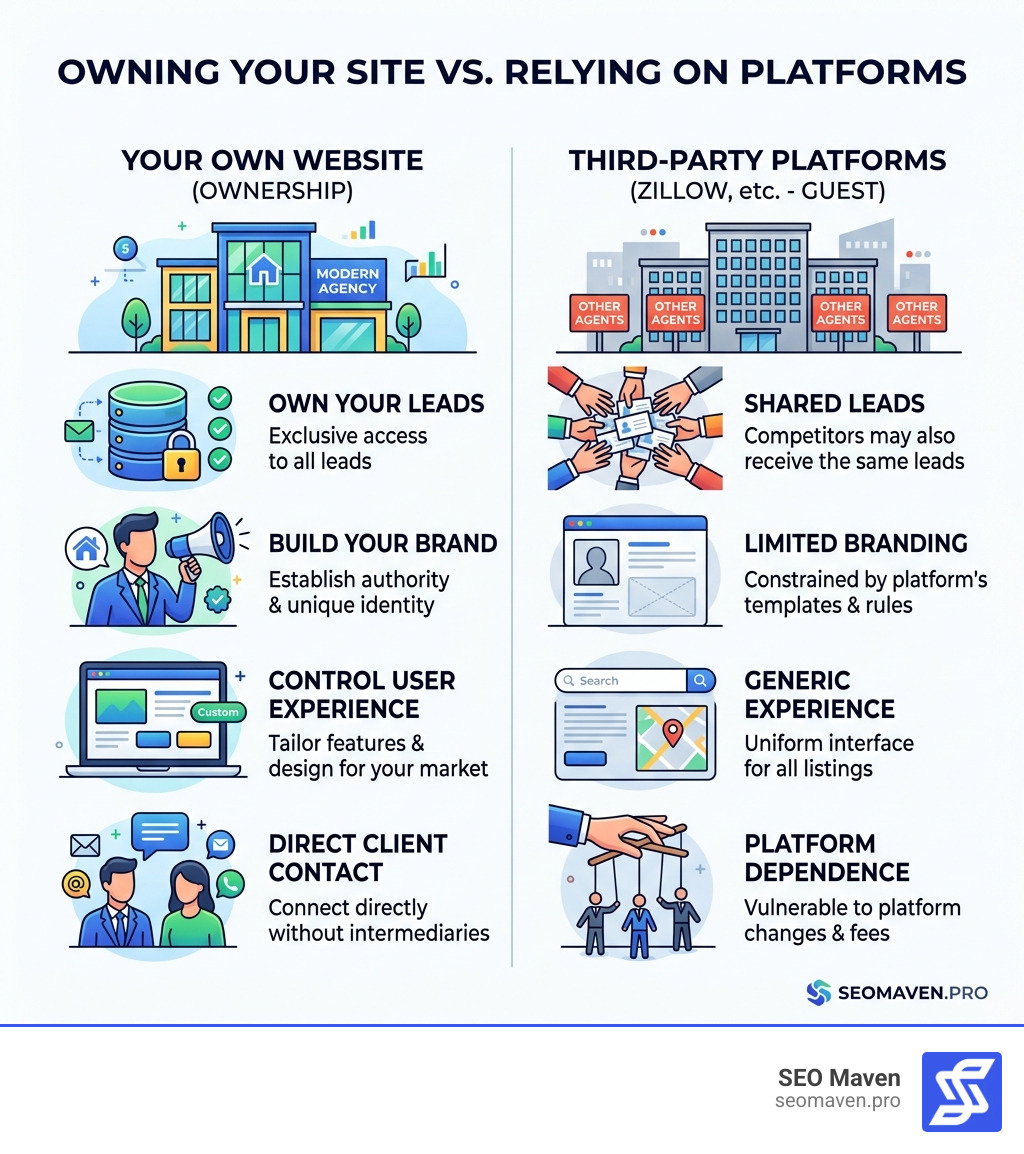
Many agents rely on Zillow or their brokerage’s website. That’s a mistake. On those platforms, you are a guest — you don’t own the leads, the brand, or the experience. Your own website changes that entirely.
Think of it as your 24/7 digital headquarters — a place where buyers and sellers find you, trust you, and contact you, without you lifting a finger.
Whether you’re starting from scratch or rebuilding something that isn’t working, this guide walks you through every step in plain language.
I’m Fernando Larez, a marketing professional and digital strategist based in Hollywood, Florida, with hands-on experience in SEO, brand development, and lead generation across competitive markets — including helping businesses learn how to build a real estate website that actually drives results. Let’s get into it.
How to Build a Real Estate Website: The 7-Step Process
Building a website might feel like trying to fold a fitted sheet — confusing and slightly frustrating at first — but it is actually a very structured process. When we talk about How to Build a Real Estate Website, we aren’t just talking about making something that looks pretty. We are building a lead-generation machine.
The process begins with strategic planning and moves into the technical foundation. You wouldn’t build a house without a blueprint, and you shouldn’t build a website without a clear path forward. According to Real Estate Website Development Made Simple: 8 Essential Steps, success lies in the details of how you plan your navigation and data integration. If you want to dive deeper into the technical side, you can check out our More info about web design and development page.
Step 1: Define Your Niche and Domain
The first step in How to Build a Real Estate Website is deciding who you are talking to. Are you the go-to expert for luxury condos in Aventura? Or do you specialize in first-time homebuyers in Fort Lauderdale? Defining your niche allows you to tailor your design and content to a specific audience.
Once you have your niche, you need a domain name. This is your digital address. Here are a few tips for choosing a great one:
- Keep it short and memorable: Avoid hyphens or strings of numbers.
- Include keywords: Using words like “homes,” “realty,” or your city name can help with SEO.
- Consider the .realtor TLD: For members of the National Association of Realtors, this top-level domain adds instant credibility.
- Brand consistency: Ensure your domain matches your social media handles and business cards.
Step 2: Selecting the Best Platform to Build a Real Estate Website
Choosing a platform is one of the biggest decisions you’ll make. In April 2026, the “Big Three” remain the top contenders: WordPress, Wix, and Squarespace.
WordPress is the heavyweight champion, powering over 40% of the internet. It offers the most flexibility and ownership. Wix and Squarespace are “drag-and-drop” builders that are easier for beginners but offer less customization for complex real estate data.
| Feature | WordPress | Wix | Squarespace |
|---|---|---|---|
| Ease of Use | Moderate (Learning curve) | High (Very easy) | High (Intuitive) |
| IDX Integration | Excellent (Plugins) | Good (Apps) | Moderate (Limited) |
| SEO Control | Maximum | Good | Good |
| Ownership | Full Ownership | Rented Platform | Rented Platform |
For a more detailed breakdown, see our More info about builder comparisons which explores the nuances between these popular choices.
Step 3: Design for User Experience and Conversion
In 2026, a mobile-first design isn’t just a “nice to have”—it’s mandatory. Most buyers will browse listings on their phones while sitting in traffic or waiting for coffee. If your site doesn’t load quickly or look great on a small screen, they will leave.
Your design should focus on:
- Intuitive Navigation: Don’t make people hunt for the “Search Properties” button.
- Brand Colors and Typography: Use a palette that conveys trust (blues and greys) or luxury (black and gold).
- Whitespace: Give your content room to breathe so it doesn’t overwhelm the visitor.
We focus heavily on User-Centric Design because a website that is easy to use is a website that converts.
Step 4: Integrating IDX to Build a Real Estate Website with Live Data
This is the “engine room” of your site. IDX (Internet Data Exchange) is the technology that allows you to pull live listings from the MLS (Multiple Listing Service) directly onto your website.
Without IDX, your site is just a brochure. With it, your site becomes a search portal that rivals the national giants. According to the How to Build a Real Estate Website From Scratch: The 2026 Step-by-Step Guide, integrating a reliable IDX provider ensures your listings are always up-to-date, which keeps users coming back.
Step 5: Creating High-Converting Lead Generation Tools
Once you have visitors looking at properties, you need a way to capture their information. Standard contact forms are okay, but high-converting sites use specific tools:
- Home Valuation Tools: “What’s my home worth?” is the #1 question for sellers.
- Viewing Schedulers: Let buyers book a tour with a few clicks.
- Virtual Tours: Use 360-degree photography or drone video to showcase homes.
It’s also crucial to ensure your forms and tools are accessible to everyone. For more on this, read our More info about accessibility guide to ensure you’re meeting legal standards like ADA compliance.
Step 6: Optimizing for Local SEO and Authority
You might not outrank Zillow for “homes for sale,” but you can absolutely outrank them for “best neighborhoods for families in Hollywood, FL.” This is where hyper-local content comes in.
Create neighborhood guides that include:
- Local market statistics.
- School information and park guides.
- “Best of” lists for local restaurants and shops.
By focusing on local SEO, you position yourself as the neighborhood expert. You can learn more about how we handle this on our More info about SEO services page.
Step 7: Launching and Ongoing Maintenance
Before you hit “publish,” you must run through a checklist. Test every form, check every link, and ensure your site loads in under three seconds. After launch, the work doesn’t stop. You’ll need to monitor analytics to see where your traffic is coming from and keep your security plugins updated to protect user data.
For a full suite of support options, check our More info about marketing services to see how we help businesses stay ahead after the initial launch.
Essential Features and Lead Generation Tools
To truly master How to Build a Real Estate Website, you need to understand the features that move the needle. A professional site should be more than a gallery of photos; it should be a functional tool for the user.
- Advanced Property Search: Users should be able to filter by price, bedrooms, school district, and even specific features like “pool” or “waterfront.”
- Interactive Maps: Integrating Google Maps allows buyers to see exactly where a property sits in relation to their work or favorite spots.
- Social Proof: Testimonials and “Recently Sold” sections build immediate credibility. When a seller sees you’ve successfully closed five deals in their zip code recently, they are much more likely to call you.

We always advocate for User-Centric Design when implementing these features. If a feature makes the user’s life easier, it belongs on your site.
Optimizing for Local SEO and Authority
SEO (Search Engine Optimization) is the long game. For real estate agents in South Florida, the goal is to dominate local search. This isn’t just about keywords; it’s about providing value.
A strong blog strategy is your best friend here. Instead of generic posts about “how to paint your kitchen,” write about “The 5 things you need to know before buying a condo in Miami.” This builds authority and earns you backlinks from local businesses and news outlets. For a deeper dive into these strategies, visit our More info about search engine optimization guide.
Frequently Asked Questions about Real Estate Web Design
We hear a lot of the same questions from agents in Hollywood and Miami. Here are the straight answers.
How much does it cost to build a real estate website?
The cost varies wildly based on your approach. A DIY WordPress site might only cost you the price of hosting and a few premium plugins. However, a custom-built, high-end real estate website can range from $1,000 to over $10,000 depending on the complexity of the IDX integration and custom design features. Remember to factor in monthly maintenance costs, which typically range from $35 to $300 for professional hosting and security.
How long does it take to build a professional real estate site?
If you use a template and have your content ready, you could have a basic site up in 1-2 weeks. However, a professional, custom-designed site usually takes 4-8 weeks. A significant portion of this time is often waiting for MLS approval for your IDX feed, which is a third-party process out of the developer’s hands.
Can I build a real estate website for free?
Technically, yes, using platforms like Wix or Jimdo. However, we don’t recommend it for serious professionals. Free plans usually come with branding restrictions (e.g., “yoursite.wix.com”), limited SEO capabilities, and no way to integrate a professional IDX feed. To build trust with high-value clients, a small investment in a professional platform is non-negotiable.
Conclusion
Learning How to Build a Real Estate Website is an investment in your future as an agent or broker. In a market as competitive as South Florida—from the luxury high-rises of Miami to the family suburbs of Hollywood—your website is often your first and only chance to make a great impression.
At SEO Maven, we are a boutique agency focused on providing small businesses with maximum ROI. We don’t believe in “one size fits all” templates. We believe in building digital headquarters that reflect your unique brand and drive real, local leads. Whether you need a brand-new build or want to optimize your current site for the 2026 market, we are here to help.
Ready to take your online presence to the next level? Get started with professional web design and development today and let’s build something that works for you 24/7.